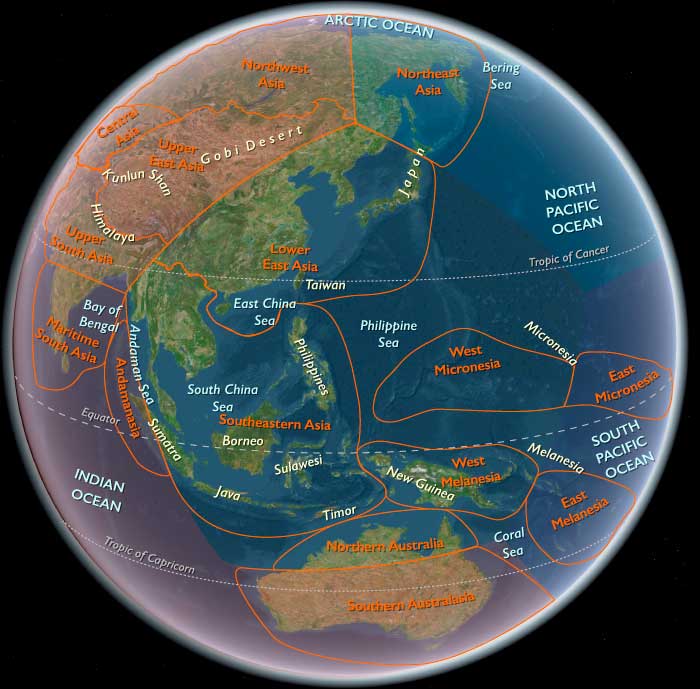
Event
Krakatoa, or Krakatau, volcano erupts at 10:02…
Krakatoa, or Krakatau, volcano erupts at 10:02 AM (local time) on August 26, 1883, followed by three more massive eruptions over the next two days.
The combination of pyroclastic flows, volcanic ashes and tsunamis has disastrous results in the region.
There are no survivors from three thousand people located on the island of Sebesi, about thirteen kilometers (eight point one miles) from Krakatoa.
Pyroclastic flows kill around one thousand people at Ketimbang on the coast of Sumatra some forty kilometers (twenty-five miles) north from Krakatoa.
The official death toll recorded by the Dutch authorities is thirty-six thousand four hundred and seventeen, although some sources put the estimate at one hundred and twenty thousand or more.
Many settlements are destroyed, including Teluk Betung and Ketimbang in Sumatra, and Sirik and Serang in Java.
The areas of Banten on Java and the Lampung on Sumatra are devastated.
There are numerous documented reports of groups of human skeletons floating across the Indian Ocean on rafts of volcanic pumice and washing up on the east coast of Africa, up to a year after the eruption.
Some land on Java is never repopulated; it will revert to jungle and is today the Ujung Kulon National Park.
Ships as far away as South Africa rock as tsunamis hit them, and the bodies of victims are found floating in the ocean for weeks after the event.
The tsunamis that accompany the eruption are believed to have been caused by gigantic pyroclastic flows entering the sea; each of the four great explosions is accompanied by a massive pyroclastic flow resulting from the gravitational collapse of the eruption column.
This causes several cubic kilometers of material to enter the sea, displacing an equally huge volume of seawater.
The town of Merak is destroyed by a tsunami forty-six meters (one hundred and fifty-one feet) high.
Some of the pyroclastic flows reach the Sumatran coast as much as forty kilometers (twenty-five miles) away, having apparently moved across the water on a "cushion" of superheated steam.
There are also indications of submarine pyroclastic flows reaching fifteen kilometers (nine point three miles) from the volcano.
One hundred and sixty three villages are destroyed, thirty-six thousand three hundred and eighty killed

-
{# Image navigates to the detail page; the magnifying-glass chip is the only Fancybox lightbox trigger (kept a separate sibling — anchors can't nest). #}
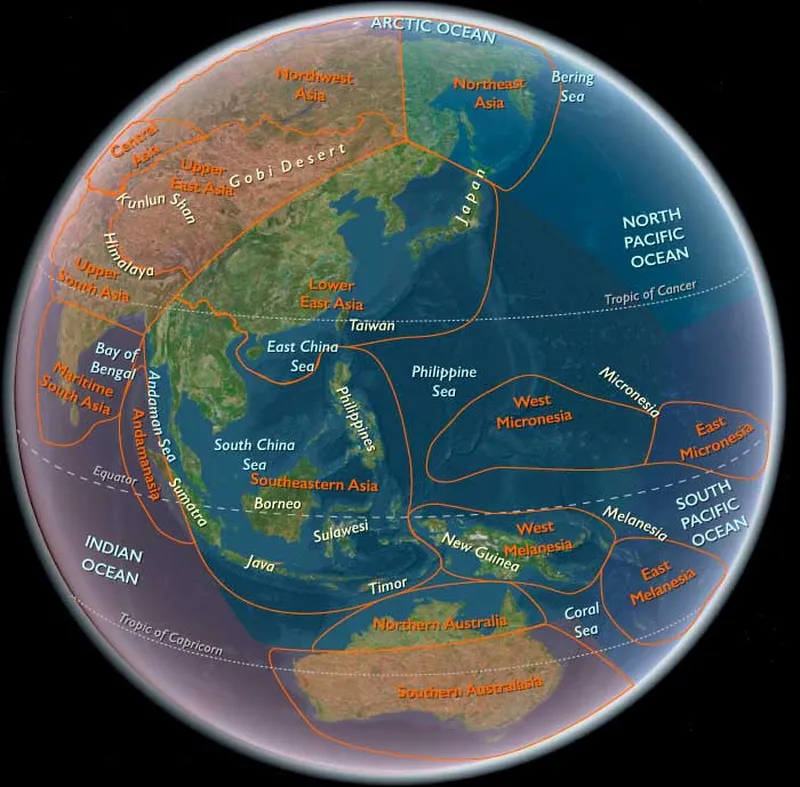 The Far East
World
The Far East
World
-
{# Image navigates to the detail page; the magnifying-glass chip is the only Fancybox lightbox trigger (kept a separate sibling — anchors can't nest). #}
 Southeast Asia
Region
Southeast Asia
Region
-
{# Image navigates to the detail page; the magnifying-glass chip is the only Fancybox lightbox trigger (kept a separate sibling — anchors can't nest). #}
 Sundachina
Subregion
Sundachina
Subregion