Lempira had been fighting against neighboring chiefs…
1537 CE
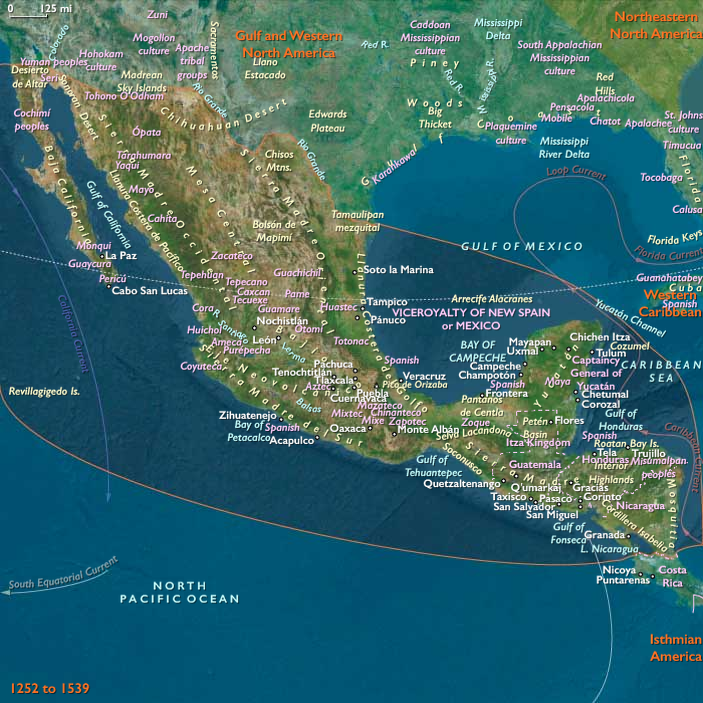
Lempira had been fighting against neighboring chiefs when the Spaniards arrived in Cerquin, but because of their threat, he has allied with the Lenca subgroup of Cares, thus unifying the different Lenca tribes.
Based in Cerquin hill, he organizes resistance against the Spanish troops in 1537, managing to gather an army of almost thirty thousand soldiers, from two hundred villages.
As a result, other groups also take up arms in the valley of Comayagua and Olancho.
Spanish attempts to stop him, led by Francisco de Montejo and Alonso de Cáceres, are unsuccessful until 1537.
There are two very different historical accounts of Lempira.
The first, by Antonio de Herrera y Tordesillas, appearing in Historia general de los hechos de los castellanos ..., published in 1626 in Seville, Spain, identifies Lempira as a war captain appointed by Entipica, leader of the Cares, a named subgroup of the Lenca.
Herrera reports that Lempira, whose name means something like "Lord of the Mountains" in Lenca, commanded over thirty thousand soldiers from over two hundred different Lenca towns.
In 1537, there were widespread indigenous uprisings in Honduras, and the Cares were one group that revolted against Spanish rule.
The Spaniards, on instruction from Montejo, attack him at Cerquin, near Gracias a Dios.
Lempira, according to Herrera, retreated to a fortified hill top where he resisted the Spaniards for many months.
Finally, the Spaniards lured him out to talk, and a concealed Spanish soldier with an arquebus shot and killed him.
On seeing this, Herrera reports, the Lenca surrendered.
This is essentially the story as taught to Honduran children in school.
In the 1980s, the Honduran historian Mario Felipe Martínez Castillo discovered a very different account of Lempira in a document entitled Méritos y Servicios: Rodrigo Ruiz, Nueva España written in 1558 in Mexico City, and located in the Archivo General de Indias in Seville, Spain.
That document, Patronato 69 R.5, tells the story of Rodrigo Ruiz and his service in the conquest of Honduras under Francisco Montejo.
It includes his account of killing Lempira.
The document is in the form of a series of questions, answered by witnesses to the services Rodrigo Ruiz gave to the Spanish King.
Ruiz wrote the questions, one of which is translated in part as follows: “ "...after I cut off his head, they retreated and within 4 days we controlled all of their towns, and they gave obiedience to your Majesty as they were obligated to do... and later we founded the town of Gracias a Dios.
Ask them to say what they know and if its true that I served in said war, all the time it lasted, serving with myself, my weapons, my horse, at my cost, and was not rewarded for it."
Rodrigo Ruiz goes on to detail other service to the Spanish Crown.
The many witnesses in this one hundred page- page document agree that Rodrigo Ruiz fairly outlined his service and told the truth.
Ruiz asked for a pension of one thousand pesos for his service.
Interestingly, the modern Honduran Lenca preserve in their oral tradition elements that match the Ruiz story, Lempira's belief that wearing Spanish clothing made him impervious to Spanish bullets, and that Lempira died in combat, not through ambush.
After the Spanish conquest, Honduras becomes part of Spain's vast empire in the New World within the Kingdom of Guatemala.
Trujillo and Gracias are the first city-capitals.
The Spanish will rule the region for approximately three centuries.
Locations
Groups
Topics
Commodities
Subjects
Regions
Middle America
View →Subregions