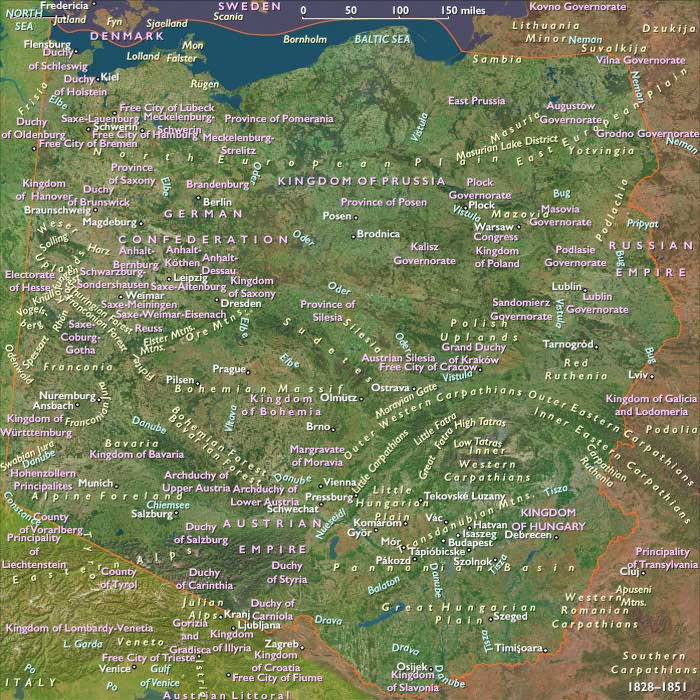
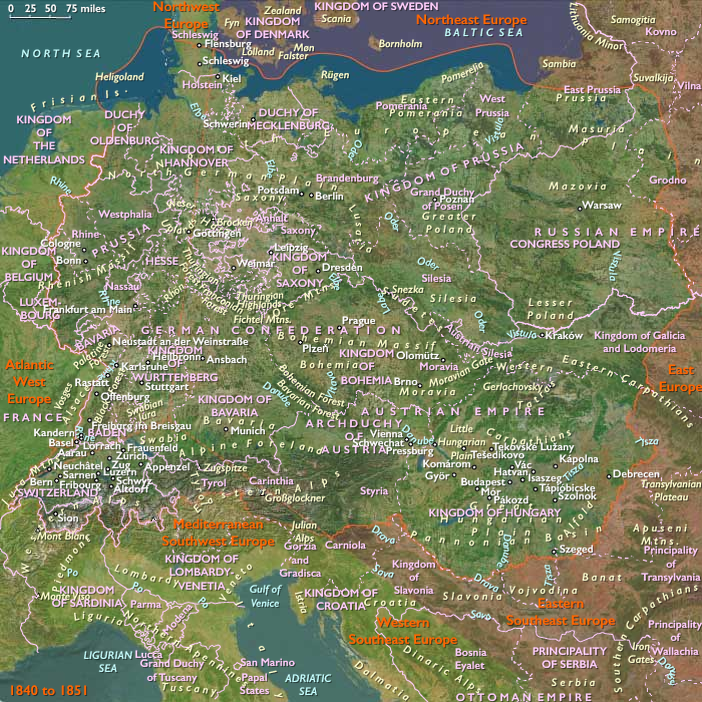
The German-speaking Habsburg lands, as part of…
1840 CE to 1851 CE
German nationalists and liberals had convened an assembly in Frankfurt in May 1848 that suspended the diet of the German Confederation and took tentative steps toward German unification.
However, the close association of nationalism and liberalism in Germany belied the growing conflict between these two ideologies.
Although ethnic Germans from Bohemia were participating in the Frankfurt assembly, Czech nationalists and liberals had rejected Bohemian participation in the German nation being born in Frankfurt.
They envision a reconstituted Habsburg Empire in which the Slavic nations of central and southern Europe will assume equality with the German and Hungarian components of the empire and avoid absorption by either Germany or Russia.
The government has given concessions that appeared to endorse this plan, and the Czechs had convened an Austro-Slavic congress in Prague in June as a counterpart to the Frankfurt assembly.
As conservative political authority give way before the revolutionary forces, two bold military commanders begin to reassert control over the situation, often ignoring or contravening timid
orders from the court.
General Alfred Windischgratz routs the revolutionaries from Prague and Vienna and reestablishes order by military force.
South of the Alps, General Joseph Radetzky reestablishes Austrian control of Lombardy-Venetia by August.
Although only Hungary remains in the hands of the revolutionaries, the Austrian government begins to reorganize in the fall of 1848.
A team of ministers associated with constitutionalism is presented to the constituent assembly in November.
The minister-president not only commits the government to popular liberties and constitutional institutions but also to the unity of the empire.
To cap the reorganization, the mentally incompetent Ferdinand formally abdicates on December 2, 1848, and his eighteen-year- old nephew is crowned Emperor Franz Joseph I (r. 1848-1916).
Locations
People
Groups
Topics
Subjects
Regions
Central Europe
View →Subregions