
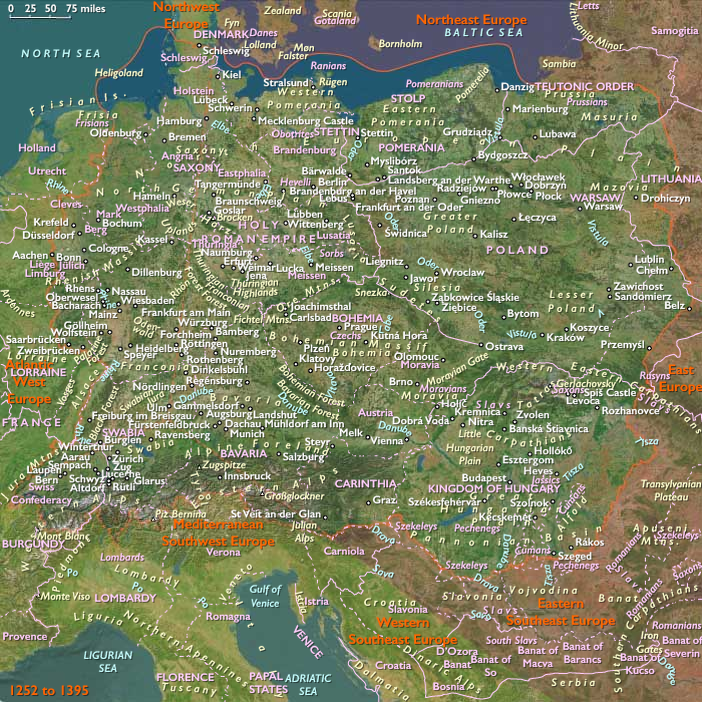
…Little Cumania (Kiskunság). As the Cumans …
Years: 1290 - 1290
…Little Cumania (Kiskunság).
As the Cumans came into the kingdom the Hungarian nobility suspected that the king intended to use the Cumans to strengthen his royal power at their expense.
During the following centuries the Cumans in Hungary will be granted rights and privileges, the extent of which depends on the prevailing political situation.
Some of these rights will survive until the end of the nineteenth century, although be then the Cumans had long since assimilated with Hungarians.
The Cumans are different in every way to the local population of Hungary—their appearance, attire, and hairstyle set them apart.
Elizabeth the Cuman, the daughter of a Cuman chieftain Seyhan, had in 1270 become queen of Hungary, ruling during the minority of her son (future king Ladislaus IV of Hungary) in the years of 1272-1277.
A struggle took place between her and the noble opposition, which led to her imprisonment by the rebels; but supporters freed her in 1274.
During her reign, gifts of precious clothes, land, and other objects were given to the Cumans with the intent to ensure their continued support, and in particular during the civil war between King Béla IV of Hungary and Stephen V of Hungary, when both sides tried to gain Cuman support.
Bela during this conflict in 1264 sent Cuman troops commanded by the chieftain Menk to fight his son Stephen.
Elizabeth married King Stephen V of Hungary; they were parents of six children.
Their son, Ladislaus IV of Hungary, became the king of Hungary while her other son, Andrew of Hungary, became Duke of Slavonia.
Stephen V of Hungary had by 1262 taken the title of 'Dominus Cumanorum' and become the Cumans' highest judge.
After Stephen's enthronement, the Cumans came directly under the power of the king of Hungary and the title of 'Dominus Cumanorum' (judge of the Cumans) had passed to the count palatine, who was the highest official after the king.
The Cumans have their own representatives and are exempt from the jurisdiction of county officials.
Locations
People
Groups
- Polytheism (“paganism”)
- Hungarian people
- Slavonia region
- Bulgarians (South Slavs)
- Papal States (Republic of St. Peter)
- Czechs [formerly Bohemians] (West Slavs)
- Cuman people, or Western Kipchaks, also called Polovtsy, Polovtsians)
- Christians, Roman Catholic
- Bulgarian Empire (Second), or Empire of Vlachs and Bulgars
- Bohemia, Kingdom of
- Franciscans, or Order of St. Francis
- Hungary, Kingdom of
Topics
Commodoties
Subjects
Regions
Subregions
Years: 1290 - 1290
Locations
People
Groups
- Polytheism (“paganism”)
- Hungarian people
- Slavonia region
- Bulgarians (South Slavs)
- Papal States (Republic of St. Peter)
- Czechs [formerly Bohemians] (West Slavs)
- Cuman people, or Western Kipchaks, also called Polovtsy, Polovtsians)
- Christians, Roman Catholic
- Bulgarian Empire (Second), or Empire of Vlachs and Bulgars
- Bohemia, Kingdom of
- Franciscans, or Order of St. Francis
- Hungary, Kingdom of
Topics
Commodoties
Subjects
Regions
Subregions