
Lübeck’s burgomaster Jurgen Wullenwever, forced to leave…
1537 CE
Lübeck’s burgomaster Jurgen Wullenwever, forced to leave the city after its defeat by the Danish-Swedish alliance, is captured, imprisoned, tortured, and executed in 1537.
People
Groups
Subjects
Regions
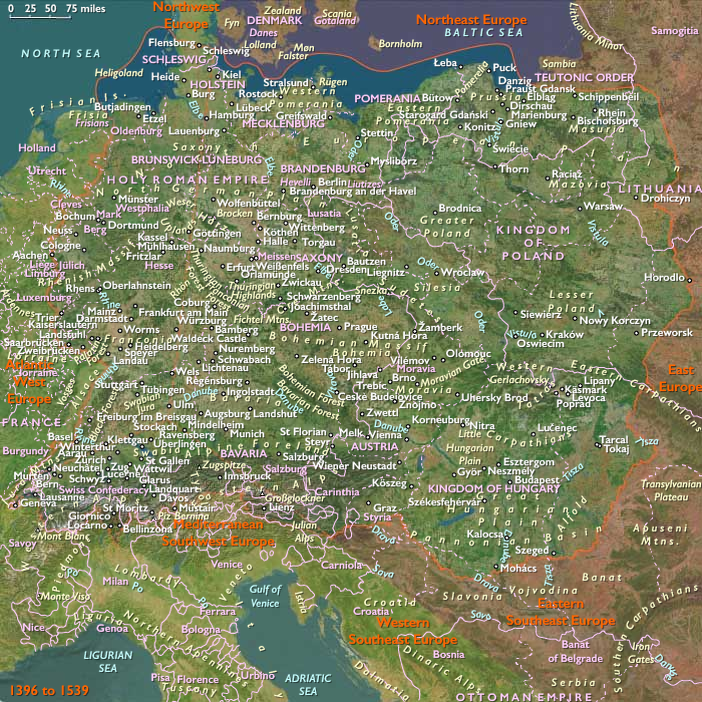
Central Europe
View →Subregions
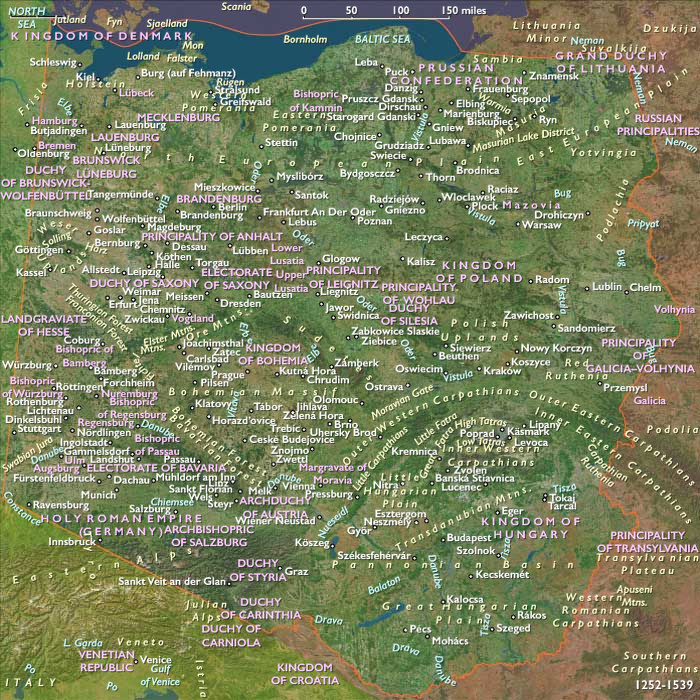
East Central Europe
View →Related Events
No active filters.
Showing 10 events out of 37630 total
Salahuddin's father sultan Ali had been engaged in a mortal combat against the Portuguese in Melaka, but hostilities had paused temporarily after his death.
However, in September 1537, an Acehnese fleet appears before Melaka, carrying a standing regiment of circa three thousand men.
The Acehnese land successfully but cannot invest the fortress.
After some ferocious fighting, they have to withdraw with great losses after two days.
Since the expedition is not mentioned in the local chronicles we cannot be sure that Salahuddin was still the ruler at this time.
From the account of Fernão Mendes Pinto it appears that his brother "Alaradim" (Alauddin) was already on the throne by 1539.
The much later chronicle Bustanus Salatin will alleges in about 1640 that Salahuddin lived for nine years after his deposition until his death in 1548.
It is thus somewhat unclear whether he was deposed before or after the launch of an unsuccessful attack on Melaka.
Hoesein Djajadiningrat believed that the coup came first and the attack was led by Alauddin al-Kahar, while Denys Lombard places the coup two years after the attack, which he believes was led by Salahuddin himself.
Binnya U, descendant of the Thai chief Wareru, had established Hanthawaddy as the capital of the Mon Hanthawaddy Kingdom, which covers all of what is now Lower Burma.
In 1519, António Correia, then a merchant from the Portuguese casados settlement at Cochin, had landed in Bago, then known to the Portuguese as Pegu, looking for new markets for pepper from Cochin.
A year later, Portuguese India Governor Diogo Lopes de Sequeira had sent an ambassador to Pegu.
Tabinshwehti and his court had selected Hanthawaddy as their first target because its king, Takayutpi, is a weak leader who does not command respect of his vassals.
Takayutpi's brother-in-law Saw Binnya practically rules the Martaban region as a sovereign, and scarcely acknowledges the high king at Pegu.
Takayutpi in turn makes an alliance with the Prome Kingdom, a vassal of the Confederation of Shan States.
Toungoo's opening maneuvers amounted to a mere raids of Hanthawaddy territory: its initial dry-season raids in 1534–1535, 1535–1536, and 1536–1537 have all failed against Pegu's fortified defenses, aided by foreign mercenaries and firearms.
In each campaign, Toungoo armies have only six thousand to seven thousand men, a few hundred cavalry and a few dozen war elephants, and do not yet have access to foreign troops and firearms.
Unlike his father Binnya Ran II, Takayutpi cannot organize any retaliatory actions.
His nominal subordinates in the Irrawaddy delta and Martaban send no aid.
Nonetheless, Pegu's defenses, led by two leading ministers of the court, Binnya Law and Binnya Kyan, have withstood the raids.
The situation for Mạc Đăng Doanh turns desperate a few years later as an official Ming delegation reports that the Mạc rule is illegitimate and that the Lê should be restored to power.
As a result, in 1537 a huge Ming army comes down from the north with orders to defeat the Mạc.
In the summer of this year, Mạc Đăng Doanh dies and his father reclaims the throne.
Once again, Mạc Đăng Dung manages to send the Ming away by means of diplomacy (and bribes).
The Ming official position is that the Mạc should rule over the northern half of Vietnam, while the Lê should rule over the southern half (in other words, below the Red River).
The Ming army now returns home, but the Nguyễn and the Trịnh refuse to accept this division of the country and the war continues.
Lithuania and Russia negotiate a five-year truce, without prisoner exchange, in which Homel remains under the king's control, while …
…Muscovy retains Sebezh and …
…Zavoloch'ye.
The Russians retain Smolensk in the truce that ends the Russo-Polish War of 1534—37.
Trondheim, like other Scandinavian cities, ceases to be an archbishopric from the introduction into Norway of the Reformation in 1537.
Bo Jonsson Grip had in the 1370s built a fortress at the location of Gripsholm Castle.
Sold to queen Margaret in 1404, it had remained the property of the crown until in 1472, when it was acquired by Sten Sture the Elder.
Donated in 1498 to a convent for males of the order of the Carthusians, it had functioned as a convent for almost thirty years.
The Carthusian Abbey in 1526 had been confiscated by King Gustav I during the Swedish Reformation.
The King has torn it down, and builds a fortified castle with circular corner towers and a wall, for defensive purposes.
Of the original medieval fortress, only the façade of a wall remains.
This is Sweden’s first major building reflecting Renaissance concepts.
Philipp Melanchthon writes “Treatise on the Power of the Papacy”, a confession of faith that is added to Luther's.
Like Luther, Melanchthon emphasizes the justification of the sinner by faith in Christ as a gift of God's grace alone, as taught by Saint Paul.