The Prussian and Austrian troops invading France…
March 1793 CE
The Prussian and Austrian troops invading France had retreated after the Battle of Valmy, allowing the French revolutionary army to counterattack.
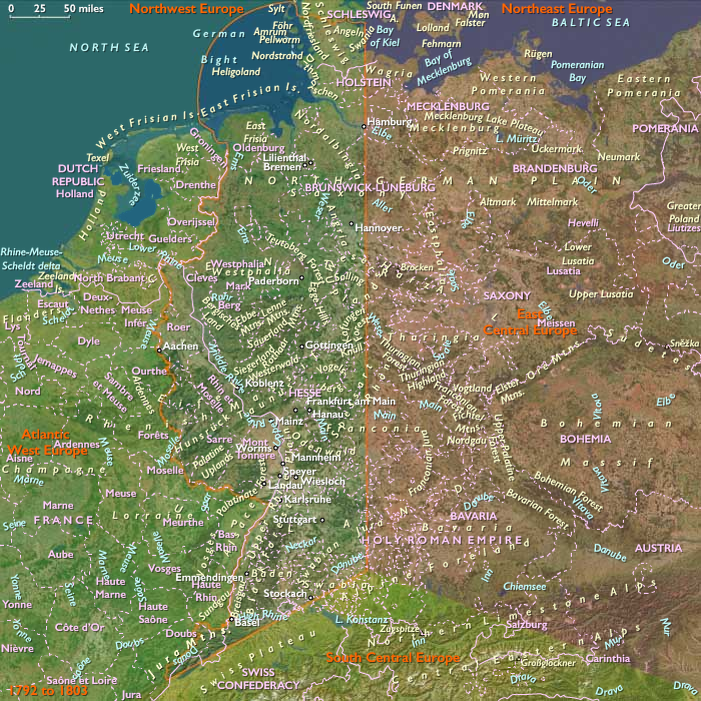
The troops of General Custine had entered the Palatinate in late September, and occupied Mainz on October 21, 1792.
The ruler of Mainz, Elector-Archbishop Friedrich Karl Joseph von Erthal, had fled the city.
On the next day, twenty citizens of Mainz founded a Jacobin club, the Gesellschaft der Freunde der Freiheit und Gleichheit (English: Society of the Friends of Liberty and Equality).
Together with their filial clubs founded later in Speyer and Worms, they promote the Enlightenment and the French revolutionary ideals of liberté, égalité, fraternité in Germany, aiming for a German republic to be established following the French model.
Most of the founding members of the Jacobin club are professors and students of the University of Mainz, together with the university librarian, Georg Forster, some merchants and Mainz state officials.
For some time the ecclesiastic Friedrich Georg Pape is president of the club and editor of the Mainzer Nationalzeitung (English: Mainz National Newspaper).
By order of the French National Convention, elections in the French-occupied territories west of the Rhine had been held on February 24, 1793.
One hundred and thirty cities and towns had sent their deputies to Mainz.
The first democratically elected parliament on the territory of future Germany, called the Rheinisch-Deutscher Nationalkonvent (English: Rhenish-German National Convention), meets initially on March 17, 1793, in the Deutschhaus building in Mainz (today the seat of the Rhineland-Palatinate state parliament)
The convention declares the represented territory (which extends to Bingen in the west and to Landau in the south) to be free and democratic, and disclaims any ties to the empire.
The convention's president, Andreas Joseph Hofmann, proclaims the Rhenish-German Free State (German: Rheinisch-Deutscher Freistaat) from the balcony of the Deutschhaus.
It is decided on March 23, 1793, to send delegates (among them Georg Forster and Adam Lux) to Paris to seek the accession of the Free State to France.
The French National Convention grants this request on 30 March.
Locations
People
Groups
Topics
Subjects
Regions
Central Europe
View →Subregions