
Manchester Town Hall, a Victorian, Neo-gothic municipal…
1877 CE
Manchester Town Hall, a Victorian, Neo-gothic municipal building in Manchester, England, designed by architect Alfred Waterhouse as the ceremonial headquarters of Manchester City Council, is completed in 1877.
The rapid growth and accompanying pollution in Victorian cities has caused great problems for architects including denial of light, overcrowding, awkward sites, noise, accessibility and visibility of buildings, and air pollution.
Provision for "the sufficiency of window light supplied throughout the building" has been addressed by the use of architectural devices: suspended first floor rooms, made possible by the use of iron-framed construction, skylights, extra windows and dormers, "borrowed lights" for interior spaces and glazed white bricks in conjunction with mosaic marble paving in areas where the light was "less strong".
Clear glass was used in important rooms, with light-colored tints for colored glazing, as "the sky of Manchester does not favour the employment of deeply stained glass." (Bowler, Catherine; Brinblecombe, Peter (2000), "Environmental Pressures on Building Design and Manchester's John Rylands Library", Journal of Design and History (The Design History Society) 13 (3): 175–191)
Despite its medieval styling, the building has been designed to support modern practical technologies.
It has gas lighting, and a warm-air heating system, which provides fresh air drawn through ornamental stone air inlets placed below the windows and admitted behind the hot water pipes and 'coils' of rooms.
Warmed, fresh air is fed into the stairwells and through hollow shafts within the spiral staircases to ventilate the corridors.
The pipes that supply gas for lighting are ingeniously concealed underneath the banister rails of the spiral staircases.
Waterhouse has designed the building structure to be fireproof, using a combination of concrete and wrought-iron beams.
Images

Manchester Town Hall Photo taken 1 January 2012, by mark andrew)
Regions
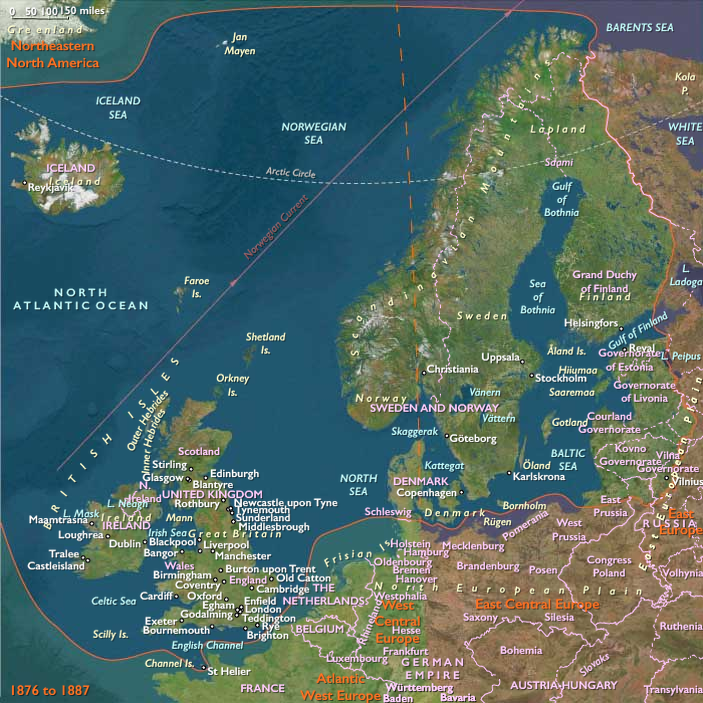
North Europe
View →Subregions
