
Many Taoists in eastern China have begun …
Years: 184 - 184
Many Taoists in eastern China have begun to turn to magic and faith healing during the first century CE.
Sometime before 183, a major Taoist movement had emerged from Ji Province (modern central Hebei) -- the Taiping Sect, led by Zhang Jue (also known as Zhang Jiao), who claims he has magical powers to heal the sick.
It is said that Zhang Jue is a grandson of Zhang Daoling, founder of the Taoist sect Way of the Celestial Masters, or Way of Five Pecks of Rice (he is not, so far as is known.)
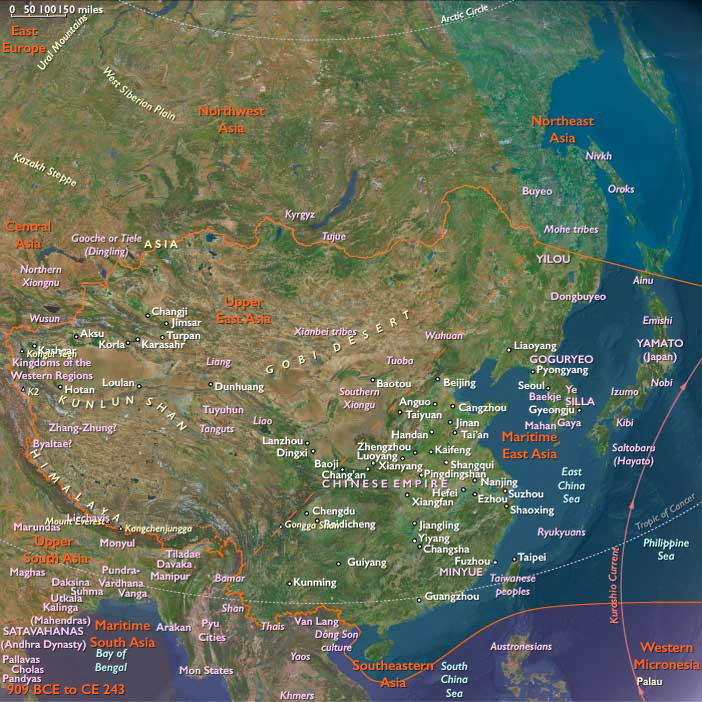
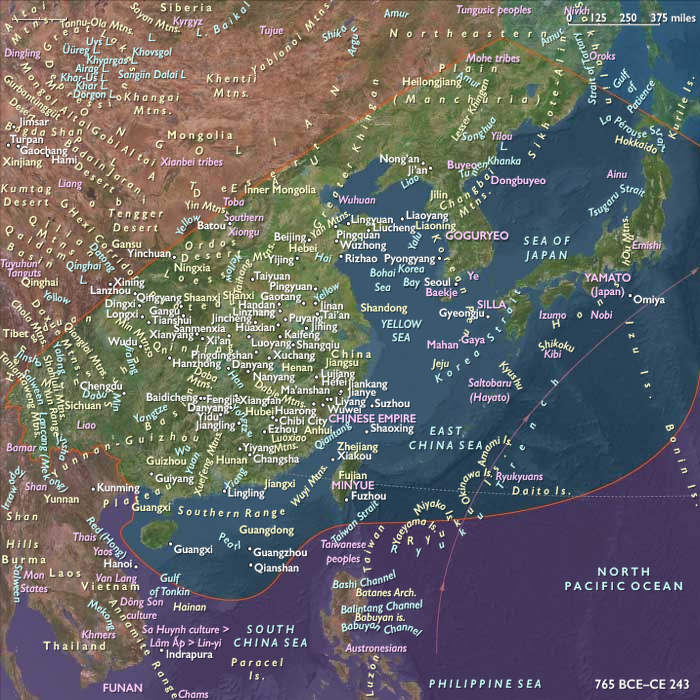
By 183, his teachings and followers had spread to eight provinces—Qing (modern central and eastern Shandong), Xu (modern northern Jiangsu and Anhui), You (modern northern Hebei, Liaoning, Beijing, and Tianjin), Ji, Jing (modern Hubei and Hunan), Yang (modern southern Jiangsu and Anhui, Jiangxi, and Zhejiang), Yan (modern western Shandong), and Yu (modern central and eastern Henan).
Several key imperial officials became concerned about Zhang's hold over his followers, and suggested that the Taiping Sect be disbanded.
Emperor Ling did not listen to them.
Zhang in fact plans a rebellion.
He commissions thirty-six military commanders and set up a shadow government, and he writes a declaration:
The blue heaven is dead.
The yellow heaven will come into being.
The year will be Jiazi.
The world would be blessed.
(Under China's traditional sexagenary cycle calendar method, the year 184 is the first year of the cycle, known as Jiazi.)
Zhang has had his supporters write Jiazi in large characters with white talc everywhere they can—including on the doors of many imperial offices in the capital Luoyang and other cities.
One of Zhang's commanders, Ma Yuanyi, enters into a plan with two powerful eunuchs, and they plan to start a rebellion to overthrow the Han Dynasty from inside.
Early in 184, this plot is discovered, and Ma is immediately arrested and executed.
Emperor Ling orders that Taiping Sect members arrested and executed, and Zhang immediately declares a rebellion.
A major cause of the rebellion is an agrarian crisis, in which famine has forced many farmers and former military settlers in the north to seek employment in the south, where large landowners exploit the labor surplus to amass large fortunes.
The situation is further aggravated by smaller floods along the lower course of the Yellow River, driving thousands of peasants from their farms; epidemics follow amid great discontent.
The peasants are further oppressed by high taxes imposed in order to fund the construction of fortifications along the Silk Road and garrisons against foreign infiltration and invasion.
In this situation, landowners, landless peasants, and unemployed former-soldiers had formed armed bands (from around 170), and eventually private armies, setting the stage for armed conflict.
At the same time, the Han Dynasty central government is weakening internally.
The power of the landowners has become a longstanding problem, but in the run-up to the rebellion, the court eunuchs in particular have gained considerably in influence over the emperor, which they abuse to enrich themselves.
Ten of the most powerful eunuchs have formed a group known as the Ten Attendants, and the emperor refers to one of them (Zhang Rang) as his "foster father".
The government is widely regarded as corrupt and incapable and the famines and floods are seen as an indication that a decadent emperor has lost his mandate of heaven.
Locations
People
Groups
- Taoism
- Chinese (Han) people
- Chinese Empire, Tung (Eastern) Han Dynasty
- Way of the Five Pecks of Rice
Topics
- Han dynasty China
- Disasters of Partisan Prohibitions
- Five Pecks of Rice
- Yellow Turban Rebellion
- Three Kingdoms Period in China
Commodoties
Subjects
Regions
Subregions
Related Events
Showing 10 events out of 60915 total
Years: 184 - 184
Locations
People
Groups
- Taoism
- Chinese (Han) people
- Chinese Empire, Tung (Eastern) Han Dynasty
- Way of the Five Pecks of Rice
Topics
- Han dynasty China
- Disasters of Partisan Prohibitions
- Five Pecks of Rice
- Yellow Turban Rebellion
- Three Kingdoms Period in China
Commodoties
Subjects
Regions
Subregions