
Margrave Gero of the Saxon Eastern March…
954 CE
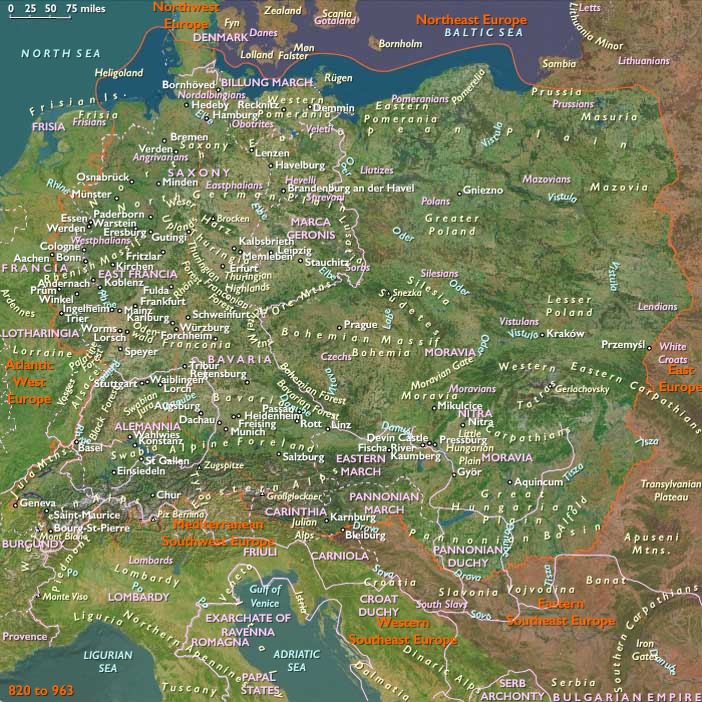
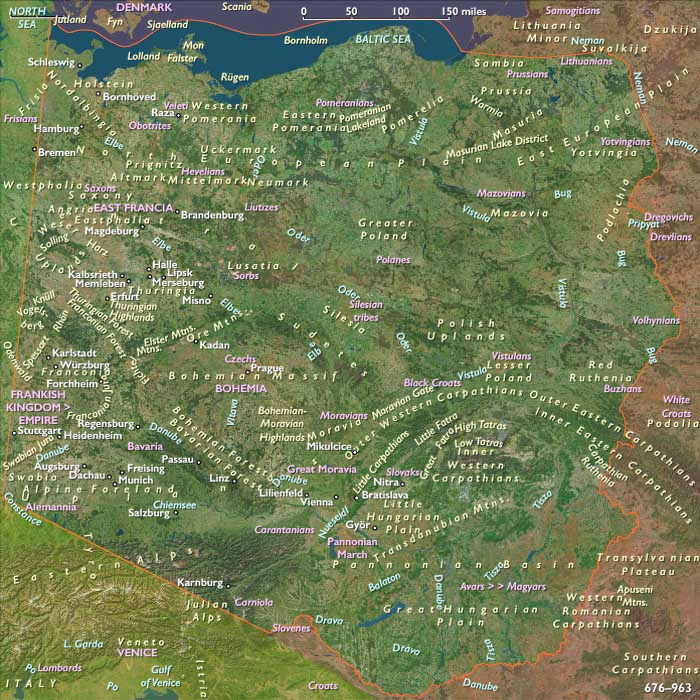
Margrave Gero of the Saxon Eastern March (the Marca Geronis), aided by Otto I's son-in-law, Conrad of Lorraine, launches a successful campaign in 954 to subdue the Ukrani, who had come in reach of the March after the 929 Battle of Lenzen.
Groups
Commodities
Subjects
Regions
Central Europe
View →Subregions
East Central Europe
View →Related Events
No active filters.
Showing 10 events out of 52895 total
Berengar II, de facto King of Italy, had appeared, through the agency of Conrad the Red, Duke of Lotharingia, at the 952 Reichstag in Augsburg and paid homage to Otto.
He and his son Adalbert remain Italian kings as Otto's vassals, though they had had to cede the territory of the former March of Friuli to him, which the German king has enfeoffed to his younger brother Duke Henry I of Bavaria as the Imperial March of Verona.
When Otto has to deal with the revolt of his son, Duke Liudolf of Swabia in 953, Berengar attacks the Veronese march; …
…he also lays siege to Count Adalbert Atto's Canossa Castle.
Alberic II, Patrician and self-styled prince of Rome, had in 936 married his stepsister Alda of Vienne, the daughter of King Hugh of Italy, and had had a son with her, Octavianus.
However, there is some doubt about this.
Benedict of Soracte recorded that Octavianus was the son of a concubine (Genuit (Alberic) ex his principem ex concubinam filium, imposuit eis nomen Octabianus), but his Latin is unclear.
If he were the son of Alda, he would have been eighteen when he became pope, and he would have been a seventh generation descendant of Charlemagne on his mother's side.
If he was the son of a concubine, he would have been somewhat older, possibly up to seven years older.
Born in the region of the Via Lata, the aristocratic quarter that was situated between the Quirinal Hill and the Campus Martius, he had been given the name of Octavianus, a clear indicator of how the family saw themselves and the future destiny of the son of Alberic.
Sometime before his death in 954, Alberic administers an oath to the Roman nobles in St. Peter's providing that the next vacancy for the papal chair would be filled by his son Octavianus, who by this stage had entered the Church.
With his father’s death, and without any opposition, he succeeds his father as Princeps of the Romans, somewhere between the ages of seventeen and twenty-four.
The Great Magyar Raid of 954: A Devastating Incursion into West Francia and Italy
In 954, the Magyars launch one of their most devastating raids into West Francia, Burgundy, and Italy, marking one of their final large-scale incursions into Western Europe. This raid sweeps through the heartlands of West Francia, devastating northeastern France before moving through Burgundy and into Italy via the Great Saint Bernard Pass.
The Magyar Raid: Path of Destruction
-
Northeastern France
- The Magyar forces cross into West Francia, targeting major cities and trade routes.
- They ravage the outskirts of Cambrai, Laon, and Reims, looting monasteries, villages, and towns.
- The ecclesiastical centers of Reims and Laon, crucial to the Carolingian tradition, are particularly affected.
Burgundy
- After pillaging northeastern Francia, the Magyars turn southward into Burgundy, continuing their path of destruction.
- The weakened West Frankish monarchy, led by King Lothair, is unable to mount a coordinated defense.
-
Italy via the Great Saint Bernard Pass
- The Magyars, having devastated Burgundy, move into Italy, crossing the Great Saint Bernard Pass, a key Alpine route.
- Northern Italy, already suffering from political instability, is helpless against the rapid Magyar cavalry raids.
Consequences of the 954 Raid
-
Severe Weakening of West Francia
- This raid exposes the continued weakness of the West Frankish monarchy, as local lords are forced to defend their own lands.
- King Lothair’s inability to organize an effective response further erodes Carolingian legitimacy.
-
Final Phase of Magyar Raids
- The 954 raid is one of the last major Magyar incursions into Western Europe.
- The Magyars are soon defeated decisively by Otto I of Germany at the Battle of Lechfeld in 955, marking the end of their raids into Francia and Italy.
-
Rise of Feudal Defense Strategies
- With kings unable to stop invasions, regional rulers increase fortifications and rely on private armies, reinforcing the feudal system.
Conclusion: The Last Devastation Before the Magyar Defeat
The Great Magyar Raid of 954 is one of the final large-scale invasions of West Francia and Italy, devastating major Frankish heartlands before the Magyars' military power is crushed at Lechfeld in 955. This event marks the last phase of the Hungarian threat to Western Europe, after which Magyar incursions cease permanently, leading to their eventual settlement in Hungary under a Christian kingdom.
-
Italy via the Great Saint Bernard Pass
- The Magyars, having devastated Burgundy, move into Italy, crossing the Great Saint Bernard Pass, a key Alpine route.
- Northern Italy, already suffering from political instability, is helpless against the rapid Magyar cavalry raids.
Consequences of the 954 Raid
-
Severe Weakening of West Francia
- This raid exposes the continued weakness of the West Frankish monarchy, as local lords are forced to defend their own lands.
- King Lothair’s inability to organize an effective response further erodes Carolingian legitimacy.
-
Final Phase of Magyar Raids
- The 954 raid is one of the last major Magyar incursions into Western Europe.
- The Magyars are soon defeated decisively by Otto I of Germany at the Battle of Lechfeld in 955, marking the end of their raids into Francia and Italy.
-
Rise of Feudal Defense Strategies
- With kings unable to stop invasions, regional rulers increase fortifications and rely on private armies, reinforcing the feudal system.
Conclusion: The Last Devastation Before the Magyar Defeat
The Great Magyar Raid of 954 is one of the final large-scale invasions of West Francia and Italy, devastating major Frankish heartlands before the Magyars' military power is crushed at Lechfeld in 955. This event marks the last phase of the Hungarian threat to Western Europe, after which Magyar incursions cease permanently, leading to their eventual settlement in Hungary under a Christian kingdom.
The Norse ruler of York, Erik Bloodaxe, has struggled with Norse-Irish king Sihtricson of Dublin and English king Eadred for control of the city during his six-year reign, but it is the Northumbrians that succeed in ousting him, driving him to his death in an ambush on Stainmore.
Eadred takes control of Northumbria, apparently unopposed.
Nikephoros Phokas, a son of Bardas Phokas, an important imperial general in Anatolia, on the borders of the empire, had quickly embraced a military career of arms and as a young patrician had distinguished himself at his father's side in a war against the Hamdanid Arabs in the East.
In 954-955, Constantine names him commander in chief of the armies of the East, replacing his aged father.
Nikephoros proceeds to restructure the army to reinforce discipline and improve recruiting.
At this point, he probably writes the treatises on military tactics that are attributed to him, although proof is lacking.
The Hamdanid Emir of Aleppo, Sayf al-Dawla, is to be Constantinople’s most persistent opponent on their eastern frontier in the period from 945 to 967, by virtue of his control over most of the borderlands between the Christains and the Muslims (the al-thughūr) and his commitment to jihad.
Sayf al-Dawla had already campaigned against the Empire in 938 and 940, but it is after his establishment of a large domain centered on Aleppo in 945, that he had begun confronting them on an annual basis.
Despite the numerical advantages enjoyed by the imperial forces, the Hamdanid's emergence had blunted an imperial offensive that had been unfolding since the mid-920s and had already resulted in the fall of Malatya (934), Arsamosata (940), and Qaliqala (in 949).
His main enemy during the first decade of continuous conflict with the Empire had been the Domestic of the Schools (commander-in-chief) Bardas Phokas.
After a few initial failures, Sayf al-Dawla had quickly established his supremacy, heavily defeating Bardas near Marash in 953.
Expeditions led by Bardas in the next two years had also been defeated, allowing Sayf al-Dawla to refortify his frontier zone and strengthen it against further imperial attacks.
Using his light cavalry to evade the more slow-moving imperial troops, Sayf al-Dawla is also able to launch destructive raids deep into imperial territory; however, his raids avoid fortified positions, and he cannot challenge effective imperial control over their recent conquests.
After 955, however, the situation had begun to change: the ineffective Bardas Phokas had been dismissed and replaced by his more capable son, Nikephoros, under whose supervision the Byzantine army's equipment has been upgraded, its ranks filled with Armenians, and its training intensified.
The new imperial leadership, which includes Nikephoros's brother Leo and his nephew John Tzimiskes, has resolved on a forward strategy and has begun raiding deep into Hamdanid territory.