The earliest inhabitants of Messenia are thought…
765 BCE to 622 BCE
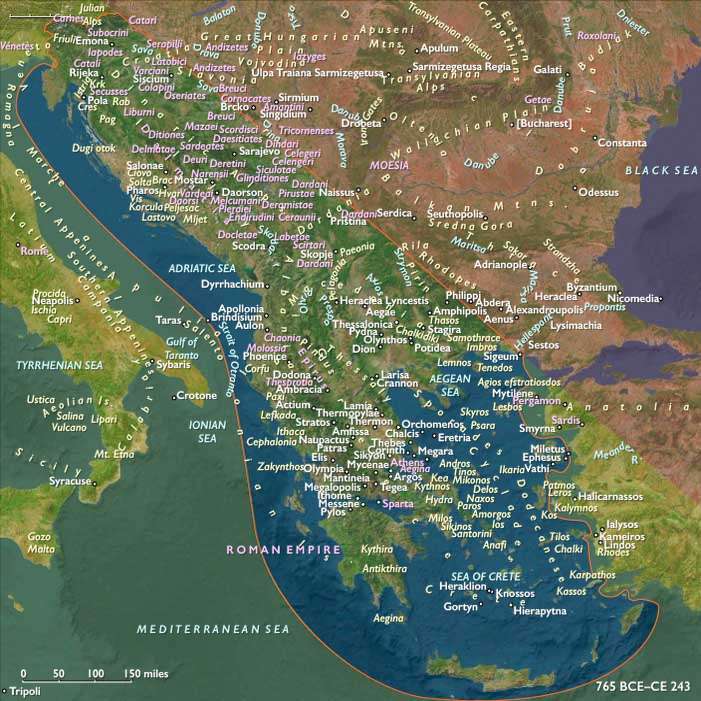
The earliest inhabitants of Messenia are thought by the Greeks of the Classical period to have been 'Pelasgians', as in other regions of Greece.
The Hellenic tribes had then supposedly arrived in Greece, and Messenia was settled by Aeolian Greeks.
The Homeric poems suggest that during the Mycenaean period, eastern Messenia was under the rule of Menelaus of Sparta, while the western coast is under the Neleids of Pylos; after Menelaus’s death, the Neleids pushed the frontier as far as Taygetus.
The Mycenaean city of Pylos almost certainly lay in Triphylia, and not at the site in Messenia, which in historic times bore that name.
Excavations at Pylos and Nichoria have revealed for Messenia's late Bronze Age (1300s BCE) a bureaucratic, agricultural kingdom ruled by the wanax at Pylos.
The Messenians spoke Mycenaean Greek, and worshiped the Greek gods at local shrines like that at Sphagianes.
Messenia was supposedly invaded by Dorians under Cresphontes, arriving from Arcadia, during the legendary Dorian invasion of the Peloponnese during the Greek Dark ages, taking as their capital Stenyclarus in the northern plain, and then extending over the whole district first their suzerainty, then their rule.
The relative wealth of Messenia in fertile soil and favorable climate attracts the neighboring Spartans during the Archaic period.
The first Messenian War breaks out as a result of the murder of the Spartan king Teleclus by the Messenians, it is claimed, which, in spite of the heroism of King Euphaes and his successor Aristodemus, ends around 720 BCE in the subjection of Messenia by Sparta.
The result is a Spartan victory, the loss of sovereignty by Messenia, and the transfer of land ownership to the Spartans.
The Second Messenian War between the Greek states of Messenia and Sparta starts around forty years after the end of the First Messenian War with the uprising of the enslaved.
The long war will end with a Spartan victory 668 BCE, with Messenia remaining under Spartan control.
Groups
Commodities
Regions
Southeast Europe
View →Subregions