
Matthew Parker, Archbishop of Canterbury, helps issue…
1568 CE
Matthew Parker, Archbishop of Canterbury, helps issue the Bishops' Bible, an English translation of the Bible produced in 1568 under the authority of the established Church of England.
Locations
Topics
Regions
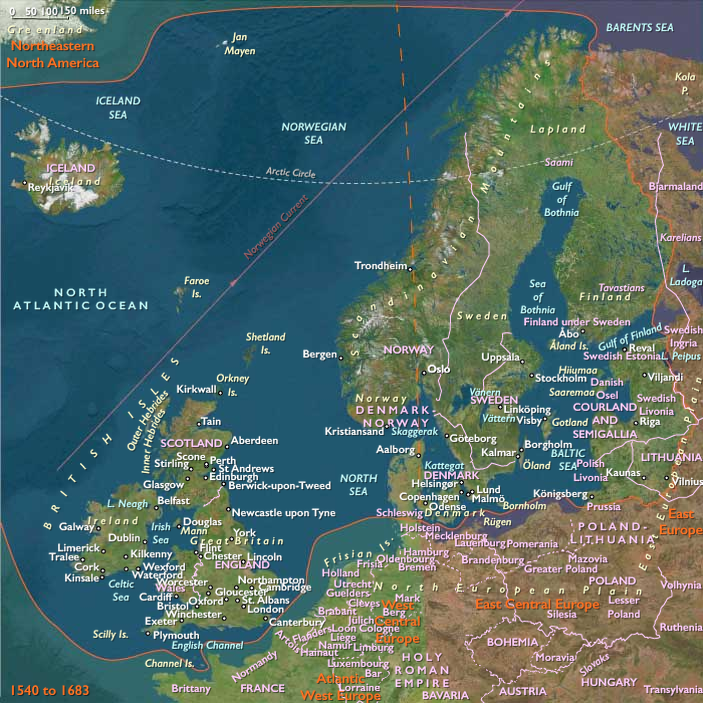
North Europe
View →Subregions
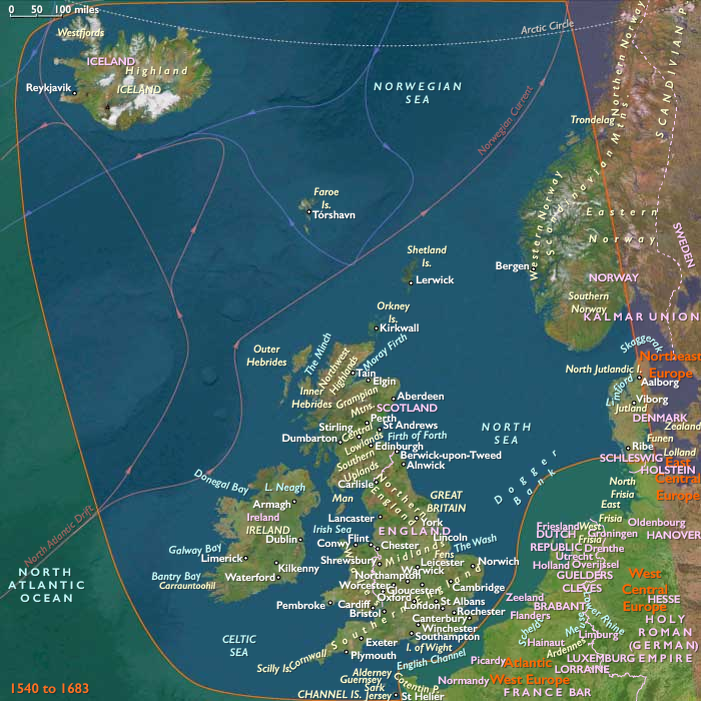
Northwest Europe
View →Related Events
No active filters.
Showing 10 events out of 35531 total
The members of Álvaro de Mendaña de Neira’s expedition are the first Europeans to sight Tuvalu (known in the nineteenth and twentieth centuries as the Ellice Islands) when they encounter the island of Nui ,but are unable to land.
The Spanish explorers led by Álvaro de Mendaña, after crossing the Pacific, discover a group of nearly one thousand islands east of Papua New Guinea.
Finding alluvial gold on Guadalcanal, the largest of these, Mendaña believes he has found the source of King Solomon's gold for the Temple in Jerusalem, and consequently names the islands "The Islands of Solomon".
Mendaña de Neyra’s expedition discovers "a low barren island, judged to be eight leagues in circumference," to which he gives the name of "San Francisco," on October 20, 1568. (The island will eventually be named for Captain Samuel Wake, master of the British trading schooner Prince William Henry, who visits in 1796.)
Mahachakrabarti regains control of Ayutthaya in 1568 after his son Mahindra fails to recapture Siam’s northern provinces from the Burmese.
Mahachakrabarti’s son-in, Maha Dhammaraja, “Lord of the White Elephant,” supports the Burmese, resulting in his daughter being held hostage by her maternal grandfather, the king.
Bayinnaung, in response to this hostage-taking of his granddaughter, sends a huge army into Siam, where it lays siege to Ayutthaya.
López de Legazpi sends one of his men back to Spain in 1568 to report on his progress.
Having heard of the rich resources of the walled Muslim city called Maynilad in Luzon, he dispatches two of his lieutenant-commanders, Martín de Goiti and Juan de Salcedo, to explore the northern region.
Nobunaga in 1568 begins his campaign to restore order in Kyoto.
An obstacle in the southern Omi province, however, is the Rokkaku clan, led by Rokkaku Yoshikata, who refuse to recognize Yoshiaki as shogun and are ready to go to war.
Nobunaga launches a rapid attack, driving the Rokkaku clan from their castles.
Nobunaga reaches Kyoto within a short time and drives the Miyoshi clan out of the city, establishing Yoshiaki as the fifteenth shogun of the Ashikaga shogunate.
Nobunaga refuses the post of Kanrei, or Shogun's Deputy.
Eric, raving mad for the past six months, recovers his mental composure and as his first act restores as his advisor his most trusted councilor, the hated Jöran Persson; he now has his commoner mistress, Karin Månsdotter, crowned queen over the objections of the nobility.
He does not, however, send his brother back to prison; on the contrary he reconciles with him.
John uses the first pretext he can find, Eric’s marriage, to lead a rebellion against his brother.
Almost the entirety of the nobility, wishing to have revenge for Eric’s treatment of them, rally behind John.
This rebellion, somewhat conveniently, results in the King once again showing signs of insanity.
Eric is forced to abdicate in September 1568 and is succeeded by his brother, who takes the title John III.
Following this, Persson is once again arrested.
John, who has never forgiven Persson for his treatment while imprisoned in Gripsholm, orders his death following a very hasty trial, which finds him guilty of a number of crimes surrounding his role in suppressing the nobility.
Persson dies very slowly; he is severely tortured before being beheaded at some point between September 18 and 21, 1568.
Maximilian II is in 1568 forced to recognize the trisection of Hungary and to accept the reduction of Royal Hungary (i.e., that part of Hungary that had come under Habsburg rule) to the western fringe of the country, the northwestern mountains, and Croatia.
The Ottomans, as a result of the signing of a peace treaty with Austria in 1568, strengthen their rule in Moldavia and ...