
Bishop Foulques has meanwhile had tumultuous relations …
Years: 1211 - 1211
April
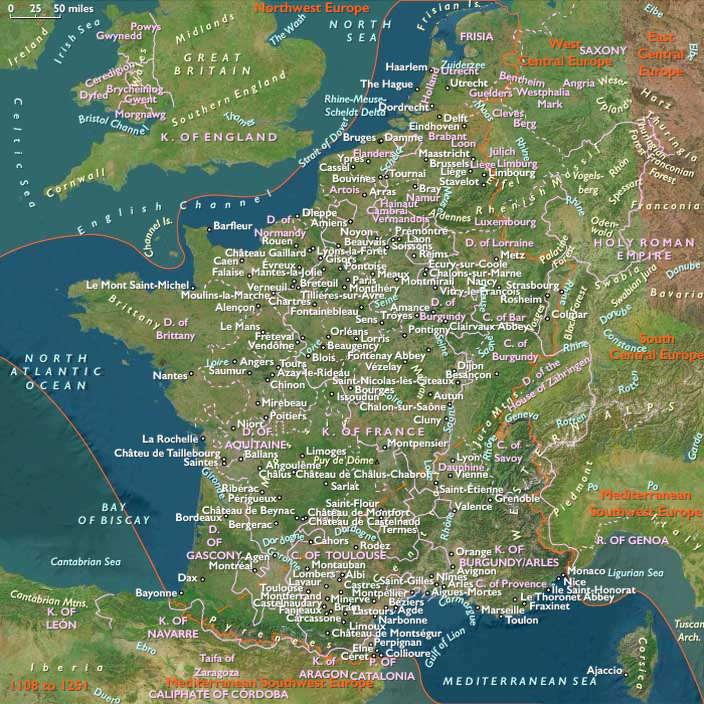
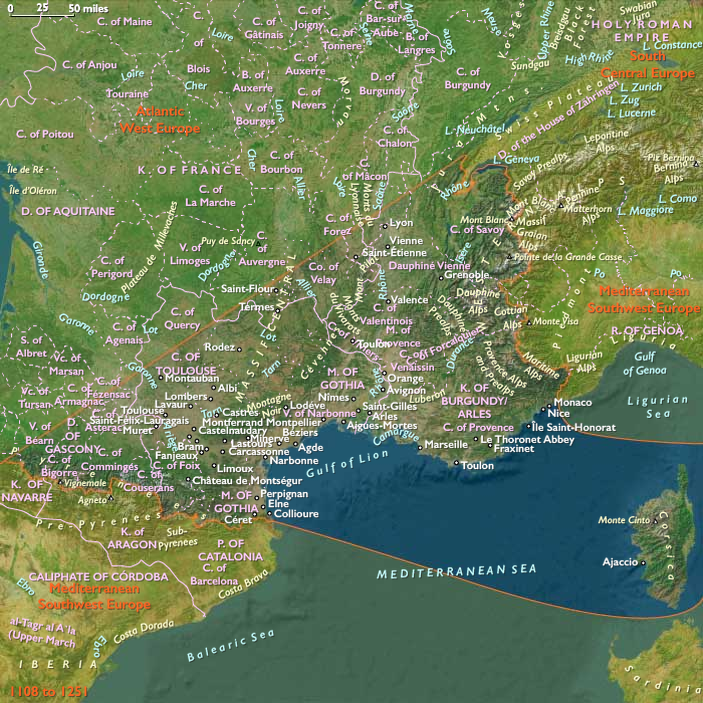
Bishop Foulques has meanwhile had tumultuous relations with his diocese in Toulouse, primarily on account of his support of the Albigensian Crusade, which is popularly perceived as a war of aggression against the region.
During his episcopate, an urban society (or militia) called the White Brotherhood, so-called from its members' habit of wearing white crosses on their chests, has been established.
The society, called a "pious institution" by William of Puylaurens, is militant towards usurers—i.e., Jews—and Cathars, robbing them and destroying their homes.
Most of the Whites come from the city proper.
A Black Brotherhood, so-called in opposition to the White, had soon formed and the two factions have warred in the streets of Toulouse.
The Blacks, many of whom come from the suburbs, are moderate in their political outlook and some may have been Cathars, the very heretics the Whites have been set up to destroy.
They defend Cathar and Jewish homes and shops from the violence of the Whites.
According to William of Puylaurens, "daily the two parties would clash, banners flying, bristling with weapons, even with cavalry in evidence."
From the White Brotherhood, Folquet selects five hundred men-at-arms and sends them to aid the Albigensian Crusade in besieging Lavaur.
Pro-Crusade Sirventes are even composed by the bishop for the troops to sing.
Count Raymond, however, has forbidden the citizens to go and tries to force Folquet from the city.
The White Brotherhood goes, however, and the bishop, hated by many Toulousains and by Count Raymond as well, eventually leaves on April 2 to join the siege at Laveur.
Locations
People
- Folquet de Marselha
- Peter II of Aragon
- Pope Innocent III
- Raymond VI
- Raymond-Roger
- Simon IV de Montfort
Groups
- Jews
- Papal States (Republic of St. Peter)
- Toulouse, County of
- France, (Capetian) Kingdom of
- Christians, Roman Catholic
- Cistercians, Order of the (White Friars)
- Catharism (Albigenses)
- Waldenses
Topics
Commodoties
Subjects
Regions
Subregions
Years: 1211 - 1211
April
Locations
People
- Folquet de Marselha
- Peter II of Aragon
- Pope Innocent III
- Raymond VI
- Raymond-Roger
- Simon IV de Montfort
Groups
- Jews
- Papal States (Republic of St. Peter)
- Toulouse, County of
- France, (Capetian) Kingdom of
- Christians, Roman Catholic
- Cistercians, Order of the (White Friars)
- Catharism (Albigenses)
- Waldenses
Topics
Commodoties
Subjects
Regions
Subregions