
Mediterranean Southwest Europe (1504–1515 CE): Religious Persecution, …
Years: 1504 - 1515
Mediterranean Southwest Europe (1504–1515 CE): Religious Persecution, Theatrical Innovations, and Cultural Shifts
The era 1504–1515 CE in Mediterranean Southwest Europe sees significant religious persecution, particularly affecting Jewish communities, alongside notable developments in theatrical arts and stagecraft, reflecting broader cultural shifts.
Religious Persecution and Expulsions
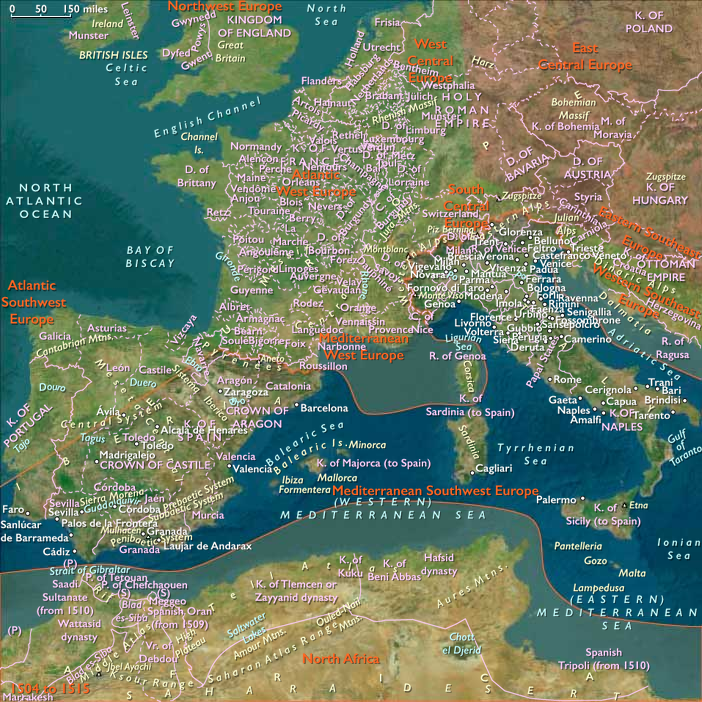
The beginning of the Spanish expulsions of the Jews in 1504 severely affects Jewish communities in southern Italy and Sicily. Major centers of Jewish culture, including Palermo, Naples, Amalfi, Bari, Brindisi, and Taranto, previously thriving during the Middle Ages, are decimated under Spanish rule. This persecution represents a substantial demographic and cultural loss for the region, effectively ending centuries of vibrant Jewish presence.
Innovations in Theater and Stagecraft
Italian humanists' exploration of classical Greek and Roman texts leads, around 1508, to major innovations in theatrical staging and design. Descriptions of ancient illusionistic techniques inspire the use of unified perspective settings and elaborate stage machinery. Innovations include the revival of the classical periaktoi, three-sided revolving prisms used to swiftly change scenery, along with the introduction of a proscenium frame and front curtain, significantly enhancing audience engagement and theatrical realism.
Lighting also becomes essential to theatrical productions, owing to the predominantly indoor settings of Renaissance theaters. The use of candles and oil lamps becomes integral, influencing stage direction, atmosphere, and dramatic effects.
Cultural Shifts and Intellectual Developments
The period further marks a shift towards more secular and humanist intellectual pursuits across Mediterranean Southwest Europe, influenced significantly by rediscovered classical texts. This intellectual climate encourages advancements in both scholarly work and creative artistic expression, laying the groundwork for ongoing developments throughout the sixteenth century.
Legacy of the Era
The era 1504–1515 CE highlights a period of transition characterized by stark contrasts—intense religious persecution on one hand and vibrant cultural and artistic innovation on the other. These developments reflect the complex interplay of continuity and change shaping the cultural and intellectual identity of Mediterranean Southwest Europe.
Groups
- Italy, Kingdom of (Holy Roman Empire)
- Aragon, Crown of
- Castile, Crown of
- Holy Roman Empire
- Naples, Aragonese Kingdom of
Topics
Subjects
Regions
Subregions
Years: 1504 - 1515
Groups
- Italy, Kingdom of (Holy Roman Empire)
- Aragon, Crown of
- Castile, Crown of
- Holy Roman Empire
- Naples, Aragonese Kingdom of
Topics
Subjects
Regions
Subregions