
Mediterranean Southwest Europe (1528–1539 CE): Michelangelo’s Mannerism …
Years: 1528 - 1539
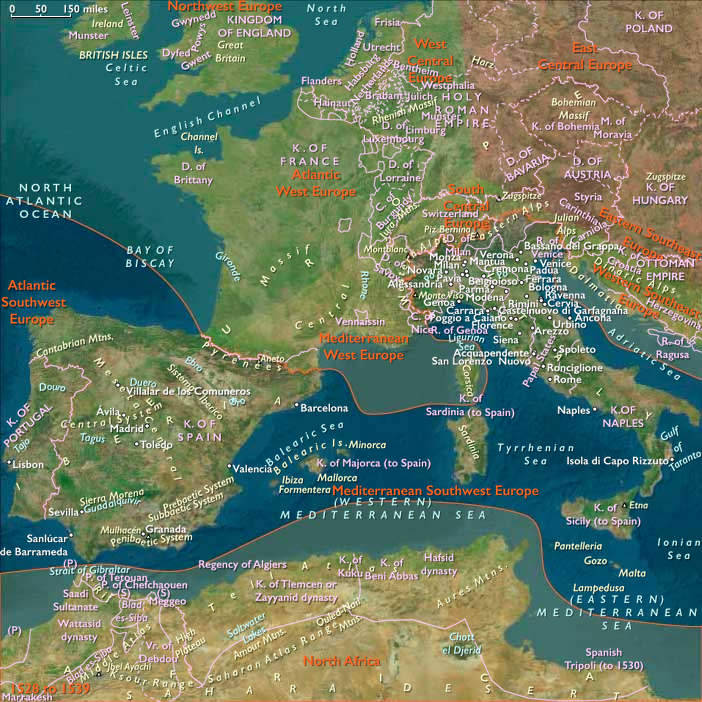
Mediterranean Southwest Europe (1528–1539 CE): Michelangelo’s Mannerism and the Aftermath of War in Italy
The era 1528–1539 CE in Mediterranean Southwest Europe witnesses profound artistic innovations, political upheavals, and cultural transformations. Dominated by the enduring influence of Michelangelo Buonarroti, the period also reflects deep scars from the devastating War of the League of Cognac, notably the traumatic Sack of Rome and the end of the Florentine Republic, reshaping both the political landscape and artistic expression.
Michelangelo and the Rise of Mannerism
From an early age, Michelangelo develops an innovative and intensely personal style, widely admired and relentlessly imitated by his contemporaries. His defining quality, known as terribilità—an awe-inspiring grandeur infused with emotional intensity—sets a new artistic standard that other artists continually strive to emulate.
Michelangelo’s celebrated masterpieces, especially the frescoes on the Sistine Chapel ceiling, profoundly influence aspiring artists. Figures such as the monumental Ignudi and the powerful depiction of the Libyan Sibyl establish benchmarks of anatomical precision and expressive dynamism, becoming focal points for artistic study and emulation.
His architectural innovations, particularly the bold vestibule of Florence’s Laurentian Library, combine dramatic spatial tension with unprecedented formal inventiveness, significantly influencing subsequent architects and artists. Similarly, his sculptural forms adorning the Medici tombs in Florence’s Sagrestia Nuova epitomize a dynamic emotional intensity that marks a departure from earlier Renaissance classicism.
Michelangelo’s later work, prominently exemplified by The Last Judgment (begun in 1536), signals the emergence of Mannerism—an artistic movement characterized by elongated proportions, exaggerated emotions, and complex, often unsettling compositions. Michelangelo’s highly personal style thus shapes the direction of European art, even as it prompts eager young artists to copy—and sometimes even to steal—his drawings, actions that Michelangelo himself finds deeply irritating.
The Sack of Rome and Political Turmoil
Simultaneously, the War of the League of Cognac (1526–1530) leaves a deep imprint on Mediterranean Southwest Europe. Triggered by Pope Clement VII’s effort to curb the influence of Holy Roman Emperor Charles V in Italy, the conflict culminates dramatically with the infamous Sack of Rome in 1527. Imperial troops—many unpaid and undisciplined—plunder Rome, inflicting devastating destruction, massacres, and widespread suffering, and effectively ending Rome's Renaissance golden age.
The shockwaves reverberate beyond Rome. The Florentine Republic, allied with the League against Charles V, collapses in the war’s aftermath, as imperial and papal forces besiege and ultimately recapture the city in 1530. In 1532, Pope Clement VII transforms Florence into a hereditary monarchy under the Medici, marking a decisive end to its republican tradition and significantly altering the political and cultural trajectory of the region.
Legacy of the Era
The period 1528–1539 CE thus emerges as a critical turning point in Mediterranean Southwest Europe. Michelangelo’s profound influence establishes Mannerism as a dominant artistic language, shaping cultural expression for decades. Concurrently, the destructive War of the League of Cognac, the catastrophic Sack of Rome, and the loss of the Florentine Republic fundamentally reshape Italy’s political landscape, embedding deep social and cultural shifts that would profoundly affect future generations.
People
Groups
- Italy, Kingdom of (Holy Roman Empire)
- Holy Roman Empire
- Florence, Medici-ruled
- Florence, Republic of
Topics
Subjects
Regions
Subregions

Years: 1528 - 1539
People
Groups
- Italy, Kingdom of (Holy Roman Empire)
- Holy Roman Empire
- Florence, Medici-ruled
- Florence, Republic of
Topics
Subjects
Regions
Subregions