
Mediterranean Southwest Europe (1840–1851 CE): Liberalism, Constitutional …
Years: 1840 - 1851
Mediterranean Southwest Europe (1840–1851 CE): Liberalism, Constitutional Conflicts, and Early Unification Efforts
The era 1840–1851 CE in Mediterranean Southwest Europe is defined by intense ideological struggles between liberal factions in Spain and burgeoning nationalist efforts in Italy, each significantly influencing the region’s evolving political landscape.
Liberal Ascendancy and Ideological Divisions in Spain
Following the conclusion of the First Carlist War in 1839, Spain's political atmosphere remains charged with ideological tension. The regency of Maria Cristina, initially supported by liberal elements within the military, is destabilized by internal dissatisfaction, ultimately forcing her resignation in 1840. A liberal government subsequently assumes control, marking the beginning of a prolonged struggle between competing liberal factions.
Spanish Liberals are united in their anticlericalism, constitutionalism, and economic liberalism, advocating for a centralized administrative structure, written constitutions, and laissez-faire economics. However, deep divisions exist between Moderates, who favor restricted suffrage and strong institutional guarantees to protect elite interests, and Progressives, who seek broader electoral participation and greater popular involvement. A more radical faction, the Democrats, emerges advocating republican ideals and far-reaching social reforms.
Moderates secure substantial support from the army and local political bosses known as caciques, ensuring parliamentary dominance through patronage networks. Their coalition with supporters of Queen Isabella II maintains stability but faces ongoing tensions due to unresolved issues regarding state relations with the Roman Catholic Church. Despite ideological opposition to clerical power, Moderates compromise with the Church, securing state recognition of ecclesiastical influence in education, though this fails to secure significant rural conservative support.
Italian Nationalism and Revolutionary Activity
In Italy, nationalist aspirations continue to gain momentum against the backdrop of persistent foreign dominance—Austria in the north and the Bourbons in the south. The influential revolutionary figure Giuseppe Garibaldi, associated with Young Italy and deeply committed to republican principles, becomes an emblematic leader advocating for Italian unification.
Revolutionary fervor intensifies in the context of broader European upheavals in 1848, igniting widespread insurrections. Palermo sees the outbreak of a significant popular uprising that rapidly spreads across Sicily and subsequently to the mainland. These revolts combine nationalist and republican goals, challenging both Bourbon and Austrian rule.
The Kingdom of Sardinia, governed by the ambitious statesman Camillo Benso, Count of Cavour, positions itself as a focal point of nationalist sentiment, yet its initial military effort in the First Italian War of Independence (1848–1849) against Austria ends in failure. Despite these setbacks, the foundations for future unification efforts are firmly established.
Andorra's Continued Stability
Amid regional turmoil, Andorra maintains its traditional stability, continuing to function effectively under its longstanding arrangement of dual sovereignty between the Bishop of Urgell and the French head of state. This arrangement safeguards the principality's autonomy and economic independence from broader geopolitical conflicts.
Cultural and Intellectual Developments
The era witnesses sustained cultural engagement with liberal, nationalist, and Enlightenment ideals throughout Mediterranean Southwest Europe. Intellectual currents and political activism intertwine, fostering a climate conducive to revolutionary change, particularly visible in the flourishing nationalist movements in Italy and the liberal constitutional debates in Spain.
Conclusion: Prelude to Transformative Change
The years 1840–1851 are critical in Mediterranean Southwest Europe's political evolution, marked by liberal constitutional struggles in Spain and rising nationalist efforts toward Italian unification. Despite immediate setbacks, these developments significantly shape the trajectory of subsequent political transformations, laying essential groundwork for the region's mid-nineteenth-century revolutions.
People
- Camillo Benso, Count of Cavour
- Ferdinand VII of Spain
- Giuseppe Garibaldi
- Giuseppe Mazzini
- Carlos María Isidro of Spain
- Isabella II of Spain
- Maria Christina of the Two Sicilies
Groups
- Andorra, Principality of
- Austria, Archduchy of
- Austrian Empire
- Spain, Bourbon Kingdom (first restoration) of
- Sardinia, Kingdom of
- Sicilies, Kingdom of the Two
Topics
- Young Italy
- Carlist War, Second
- Italian War of Independence, First, or Italian Revolution of 1849-49 (Italian War of Independence of 1848-49)
- 1848, Revolutions of
Subjects
Regions
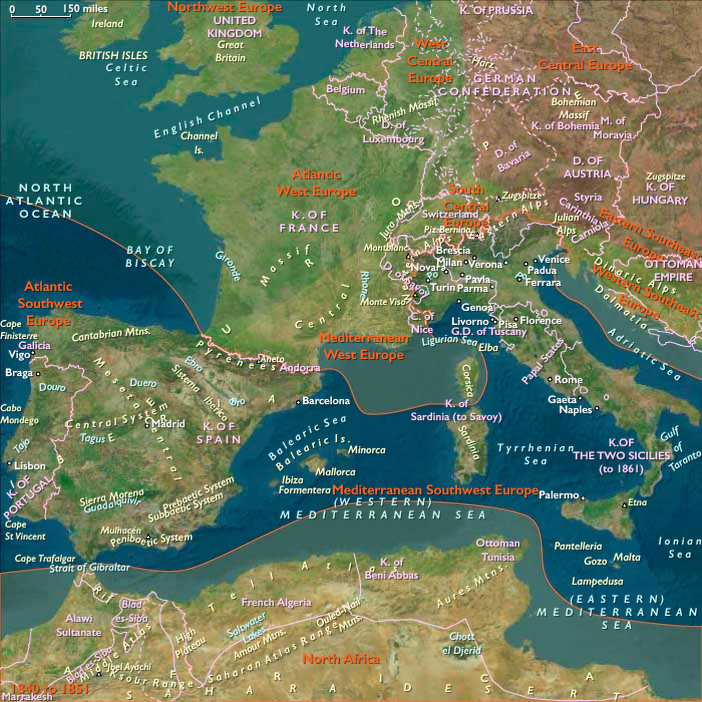
Subregions
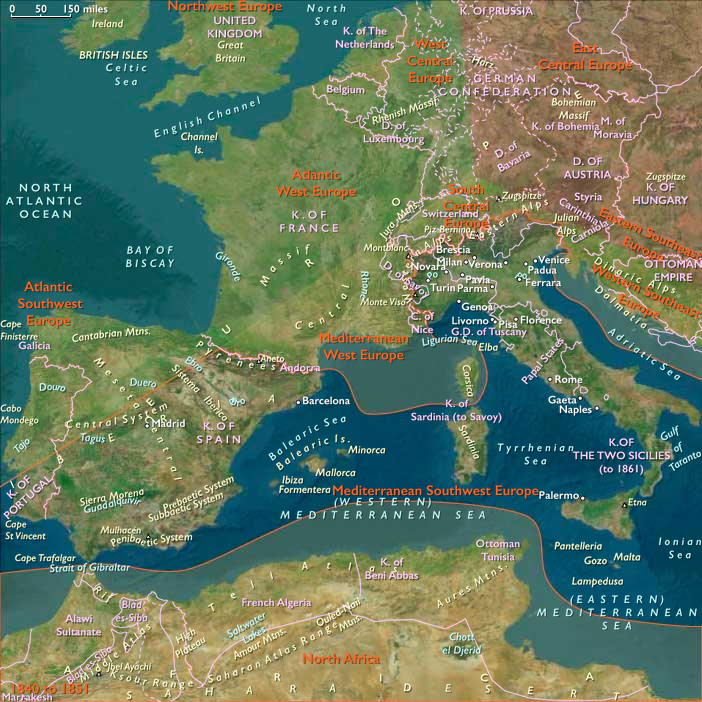
Years: 1840 - 1851
People
- Camillo Benso, Count of Cavour
- Ferdinand VII of Spain
- Giuseppe Garibaldi
- Giuseppe Mazzini
- Carlos María Isidro of Spain
- Isabella II of Spain
- Maria Christina of the Two Sicilies
Groups
- Andorra, Principality of
- Austria, Archduchy of
- Austrian Empire
- Spain, Bourbon Kingdom (first restoration) of
- Sardinia, Kingdom of
- Sicilies, Kingdom of the Two
Topics
- Young Italy
- Carlist War, Second
- Italian War of Independence, First, or Italian Revolution of 1849-49 (Italian War of Independence of 1848-49)
- 1848, Revolutions of
Subjects
Regions
Subregions