
Southwest Europe (1828–1971 CE) Nationhood, Civil …
Years: 1828 - 1971
Southwest Europe (1828–1971 CE)
Nationhood, Civil War, and the Making of Modern Iberia
Geography & Environmental Context
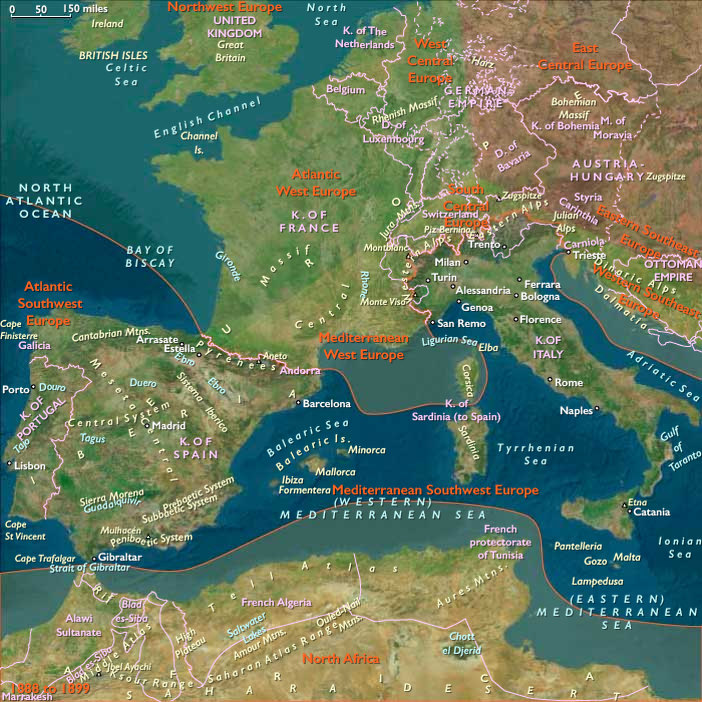
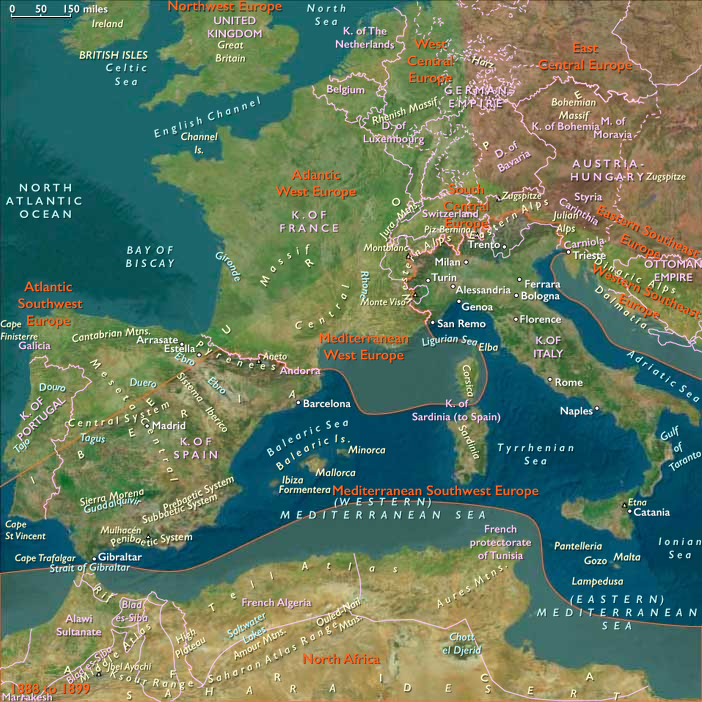
Southwest Europe comprises two fixed subregions:
-
Mediterranean Southwest Europe — Italy (including Sardinia and Sicily), Malta, southeastern Spain, and the Balearic Islands.
-
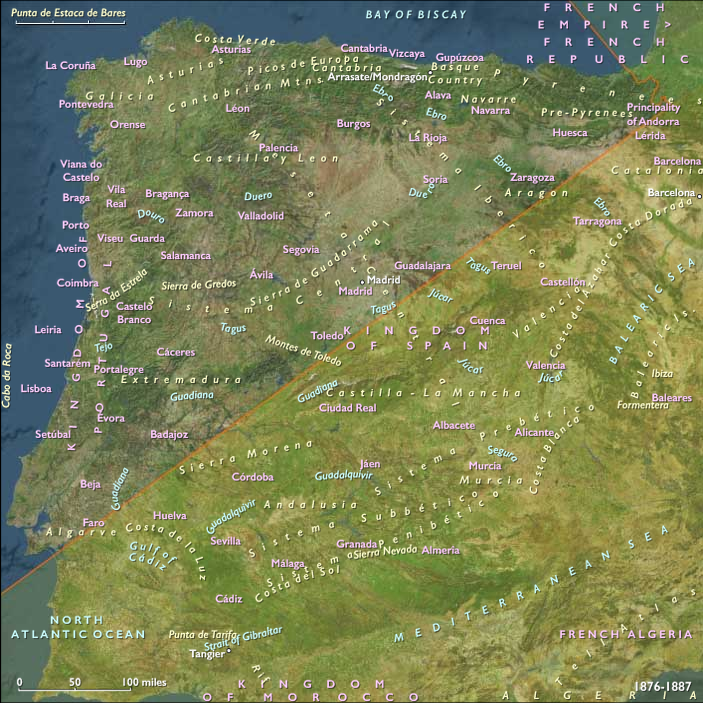
Atlantic Southwest Europe — northern Spain and central to northern Portugal, including Lisbon, the Tagus Valley, and the Cantabrian Mountains.
Anchors include the Apennines, the Po and Ebro valleys, the Italian Peninsula’s volcanic south, the Tagus, Douro, and Guadalquivir rivers, and key coastal and urban centers—Rome, Naples, Milan, Barcelona, Valencia, Lisbon, and Porto. The region bridges the Atlantic and Mediterranean, uniting maritime trade routes, mountain frontiers, and deep agricultural basins that have long sustained dense populations and layered civilizations.
Climate & Environmental Shifts
A Mediterranean climate of hot, dry summers and mild, wet winters dominated much of the south, while the northwest’s Atlantic façade received abundant rainfall. Deforestation and soil exhaustion from centuries of cultivation gave way to reforestation and terracing programs in the 19th century. Earthquakes occasionally struck southern Italy and Portugal’s coast. By the mid-20th century, irrigation and dam projects modernized agriculture, while industrialization, urban air pollution, and rural depopulation reshaped landscapes.
Subsistence & Settlement
-
Agriculture: Grain, olives, vines, and citrus remained staples; the 19th century saw agrarian reforms and consolidation under liberal monarchies. Mechanization and fertilizers expanded yields by mid-century, but sharecropping and land inequality persisted in southern Italy, Sicily, and Spain.
-
Urbanization: Lisbon, Barcelona, Milan, Rome, and Naples grew as administrative and industrial centers. Northern Italy industrialized rapidly after unification, while southern regions lagged.
-
Migration: Seasonal and transatlantic migration (to the Americas and later to northern Europe) served as economic safety valves. After WWII, internal migration filled factory towns in northern Italy and Catalonia.
-
Fishing and maritime trade: Coastal economies thrived on shipbuilding, sardine and tuna fisheries, and maritime commerce linking the Atlantic and Mediterranean basins.
Technology & Material Culture
Railways (Lisbon–Madrid, Milan–Turin, Naples–Rome) and telegraphs in the 19th century integrated national markets. Industrialization centered on textiles, steel, and shipbuilding, while southern agrarian zones remained semifeudal. After WWII, infrastructure and consumer industries (automobiles, household goods) expanded under European reconstruction aid. Architecture ranged from neoclassical state projects to fascist monumentalism and postwar modernism. Artistic modernism flourished: Gaudí’s Catalan designs, Marinetti’s Futurism, and Morandi’s minimalist painting exemplified divergent paths to modernity.
Movement & Interaction Corridors
-
Maritime corridors: The Mediterranean and Atlantic coasts connected ports like Genoa, Barcelona, and Lisbon to imperial routes across Africa and the Americas.
-
Rail and road networks: Bound the interior to ports; after 1950, highways and airports tied Iberia and Italy to Western Europe’s tourism boom.
-
Labor migration: Italians and Portuguese joined transatlantic migrations to Brazil, Argentina, and the U.S.; by the 1960s, many worked in France, Germany, and Switzerland.
-
Tourism routes: The French and Italian Rivieras, Spanish Balearics, and Portuguese Algarve became global tourist zones after WWII.
Cultural & Symbolic Expressions
Romantic nationalism merged with Catholic revival and liberal reform.
-
Italy: Giuseppe Verdi’s operas and Garibaldi’s campaigns symbolized unification (Risorgimento). Postwar cinema—Rossellini, De Sica, Fellini—portrayed social reconstruction.
-
Spain: Writers and artists such as Goya, Unamuno, and Picasso reflected political trauma and creative rebellion; Flamenco and Andalusian folk arts embodied enduring regional identities.
-
Portugal: Fado captured nostalgia under authoritarian rule; poets like Fernando Pessoa gave voice to existential modernism.
-
Malta and the Balearics: Maritime cultures blended Catholic ritual, seafaring craft, and multilingual exchange.
Catholicism remained culturally dominant, yet anticlerical movements and republicanism spurred secular education and reform.
Environmental Adaptation & Resilience
Irrigation and terrace maintenance stabilized fragile mountain agriculture; coastal marshes were drained; reforestation curbed erosion. Postwar hydroelectric and dam projects (notably on the Tagus and Po) modernized water and power supply. Cooperative farming and later Common Market integration improved productivity. Rural depopulation and emigration altered traditional village structures but relieved demographic pressure on marginal lands.
Political & Military Shocks
-
Liberal revolutions: Spain and Portugal alternated between monarchy and republic amid 19th-century liberal uprisings.
-
Italian Unification (Risorgimento, 1848–71) created a single kingdom under Victor Emmanuel II; regional disparities persisted.
-
Republics and dictatorships:
-
Spain’s First Republic (1873–74) failed amid instability; the Second Republic (1931–39) collapsed in the Spanish Civil War, leading to Francisco Franco’s dictatorship (1939–75).
-
Portugal’s Estado Novo, founded by António Salazar (1933), maintained corporatist authoritarianism until the Carnation Revolution (1974).
-
Italy’s Fascist regime under Mussolini (1922–43) joined the Axis powers; postwar reconstruction created a republic (1946).
-
-
World Wars: Italy fought on both sides; Spain and Portugal remained neutral in WWII but served as refuges and transit corridors.
-
Decolonization: Italy lost Libya, Eritrea, and Somaliland; Portugal clung to its African colonies; Spain withdrew from Morocco’s protectorate (1956).
-
Cold War: Italy and Portugal joined NATO (1949); Spain aligned with the U.S. (1953 agreements) despite Franco’s isolation.
Transition
Between 1828 and 1971, Southwest Europe traversed the arc from agrarian monarchies and fragmented kingdoms to industrial, authoritarian, and democratic states. The Risorgimento, Iberian revolutions, and postwar transitions forged modern nations marked by stark contrasts—prosperous industrial norths and impoverished rural souths, deep religiosity and militant secularism, dictatorship and democracy. The rebuilding after WWII brought integration into Western alliances and the first wave of tourism-led growth. By 1971, the region—its olive terraces, factory belts, and crowded ports—stood as both the southern pillar of Western Europe and a crossroads of lingering empires and emerging modern identities.
People
- Alfonso XII of Spain
- Alfonso XIII of Spain
- António de Oliveira Salazar
- Benito Mussolini
- Camillo Benso, Count of Cavour
- Dom Mintoff
- Francisco Franco
- Giorgio Borg Olivier
- Giuseppe Mazzini
- Guillem d' Areny-Plandolit
- Isabella II of Spain
- Marcello Caetano
- Victor Emanuel II
Groups
- Papal States (Republic of St. Peter)
- Andorra, Principality of
- Malta
- Austria, Archduchy of
- Portugal, Bragança Kingdom of
- Spain, Bourbon Kingdom (first restoration) of
- Sardinia, Kingdom of
- Sicilies, Kingdom of the Two
- Italy, Kingdom of
- Italy, Kingdom of
- Austria-Hungary
- Spain, Regency of
- Spain, Savoyard Kingdom of
- Italy, Kingdom of
- Spain, Bourbon Kingdom (second restoration) of
- Italian Eritrea
- Italian Somaliland
- Portugal, (First) Republic of
- Italian North Africa
- Portugal, (Second) Republic of
- Italian Tripolitania
- Italian Cyrenaica
- Vatican City
- Spain (Spanish Republic, Second)
- Portugal, (New) State of
- Spain, Franconian Regency of (Spanish State)
- Italian Social Republic (Salo Republic)
- Italy (Italian Republic)
- European Economic Community (EEC)
Topics
- Colonization of the Americas, Spanish
- Colonization of Asia, Spanish
- Spanish American wars of independence
- Italian unification
- Young Italy
- Carlist War, First
- Carlist War, Second
- Carlist War, Third
- Spanish-American War
- World War, First (World War I)
- World War, Second (World War II)
Subjects
Regions
Subregions
Years: 1828 - 1971
People
- Alfonso XII of Spain
- Alfonso XIII of Spain
- António de Oliveira Salazar
- Benito Mussolini
- Camillo Benso, Count of Cavour
- Dom Mintoff
- Francisco Franco
- Giorgio Borg Olivier
- Giuseppe Mazzini
- Guillem d' Areny-Plandolit
- Isabella II of Spain
- Marcello Caetano
- Victor Emanuel II
Groups
- Papal States (Republic of St. Peter)
- Andorra, Principality of
- Malta
- Austria, Archduchy of
- Portugal, Bragança Kingdom of
- Spain, Bourbon Kingdom (first restoration) of
- Sardinia, Kingdom of
- Sicilies, Kingdom of the Two
- Italy, Kingdom of
- Italy, Kingdom of
- Austria-Hungary
- Spain, Regency of
- Spain, Savoyard Kingdom of
- Italy, Kingdom of
- Spain, Bourbon Kingdom (second restoration) of
- Italian Eritrea
- Italian Somaliland
- Portugal, (First) Republic of
- Italian North Africa
- Portugal, (Second) Republic of
- Italian Tripolitania
- Italian Cyrenaica
- Vatican City
- Spain (Spanish Republic, Second)
- Portugal, (New) State of
- Spain, Franconian Regency of (Spanish State)
- Italian Social Republic (Salo Republic)
- Italy (Italian Republic)
- European Economic Community (EEC)
Topics
- Colonization of the Americas, Spanish
- Colonization of Asia, Spanish
- Spanish American wars of independence
- Italian unification
- Young Italy
- Carlist War, First
- Carlist War, Second
- Carlist War, Third
- Spanish-American War
- World War, First (World War I)
- World War, Second (World War II)
Subjects
Regions
Subregions