
Mediterranean Southwest Europe (616–627 CE): Ecclesiastical Turmoil, …
Years: 616 - 627
Mediterranean Southwest Europe (616–627 CE): Ecclesiastical Turmoil, Papal Reforms, and Missionary Influence
The era 616–627 CE in Mediterranean Southwest Europe is marked by ecclesiastical instability, papal reforms, and significant missionary activity extending from Rome to England, set against a backdrop of continued political unrest and external threats.
Ecclesiastical Turmoil and Papal Succession
In August 618 CE, Rome suffers a damaging earthquake, followed closely by an outbreak of a scab disease that claims the life of Pope Adeodatus I (Deusdedit). Adeodatus, a Roman priest elected pope in 615—the first priest elevated to the papacy since John II in 533—had notably reversed some Gregorian practices by restoring clerical administrators over monks in papal administration. Tradition also credits Adeodatus with introducing the use of lead seals (bullae) for papal documents, the earliest surviving example of which prominently depicts Christ as the Good Shepherd.
Following Adeodatus’s death, a prolonged papal vacancy of one year, one month, and sixteen days occurs amidst regional disturbances. Eventually, a Neapolitan is consecrated as Pope Boniface V (r. 619–625 CE).
Rebellion of Eleutherius and Political Instability
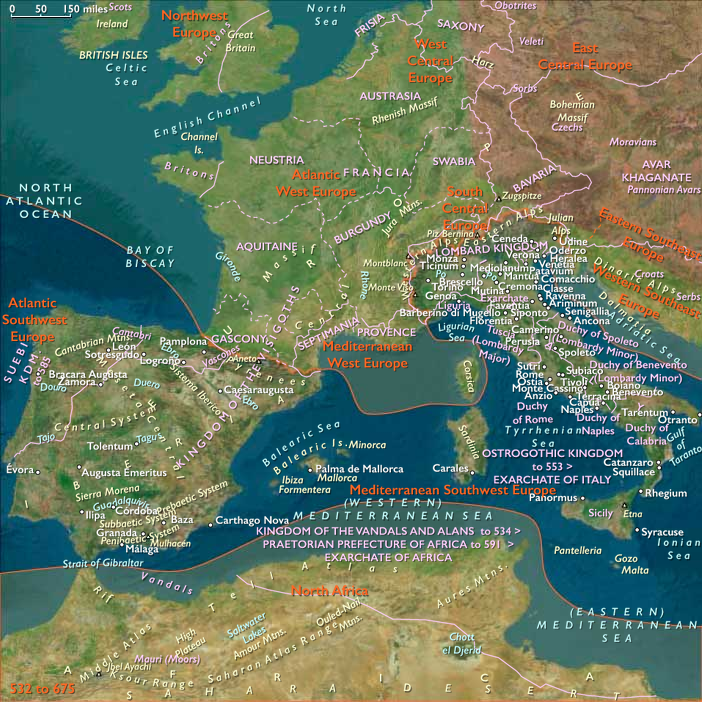
Prior to Boniface V’s consecration, Italy endures significant upheaval caused by the rebellion of Eleutherius, the eunuch Exarch of Ravenna. Eleutherius advances toward Rome, aiming to seize power, but is slain by his own troops before reaching the city. The incident underscores ongoing tensions and instability within the Byzantine administration in Italy, complicating ecclesiastical governance.
Papal Reforms under Boniface V
Pope Boniface V, remembered in the Liber Pontificalis as "the mildest of men," introduces key ecclesiastical reforms. He enacts measures clarifying rights of sanctuary, directs ecclesiastical notaries to adhere strictly to imperial laws regarding wills, and regulates the duties of acolytes, forbidding them from translating relics of martyrs or assuming deacon’s roles in baptismal ceremonies at the Basilica di San Giovanni in Laterano. Boniface also oversees the completion and consecration of the cemetery of Saint Nicomedes along Rome’s Via Nomentana.
Missionary Efforts and English Connections
Pope Boniface V notably fosters missionary enterprise, especially directed toward England. According to the Venerable Bede, Boniface V sends affectionate letters to the English Church, including exhortations to Mellitus, Archbishop of Canterbury, and Justus, Bishop of Rochester, although these letters are now lost. A surviving letter from Boniface to Justus, upon his elevation as Archbishop of Canterbury in 624, grants the pallium and authorizes him to ordain additional bishops as necessary.
Bede further records Boniface's letters encouraging King Edwin of Northumbria in 625 to embrace Christianity and to Queen Æthelburg of Kent, urging her to persuade her husband toward conversion. Pope Boniface V dies in October 625 and is interred in St. Peter’s Basilica.
Pontificate of Honorius and Liturgical Development
Following Boniface, Pope Honorius I (r. 625–638 CE), a Campanian by birth and son of the consul Petronius, ascends to the papacy. Honorius’s reign witnesses further ecclesiastical and missionary activity, particularly toward England, notably Wessex. He successfully aligns the Irish Easter celebrations with the broader Catholic Church and institutes the festival of the Elevation of the Cross, a key liturgical observance.
Cultural and Ecclesiastical Continuity
Despite political instability, the Church remains a resilient force of continuity and stability. Papal initiatives continue shaping liturgical practices and missionary outreach, influencing ecclesiastical structures across Europe, particularly in emerging Christian communities such as those in Anglo-Saxon England.
Legacy of the Era
The era 616–627 CE highlights the resilience and adaptability of the papacy in response to both internal ecclesiastical challenges and external political pressures. Papal reforms and missionary activities significantly shape the religious and cultural landscapes of both Italy and distant regions like England, reinforcing the spiritual authority and cultural influence of Rome in early medieval Europe.
People
Groups
- Christianity, Chalcedonian
- Roman Empire, Eastern: Justinian dynasty
- Rome, Duchy of
- Lombards (Italy), Kingdom of the
- Spoleto, Lombard Duchy of
- Benevento, Lombard Duchy of
- Ravenna, Exarchate of
Subjects
Regions
Subregions

Related Events
Showing 10 events out of 56989 total
Years: 616 - 627
People
Groups
- Christianity, Chalcedonian
- Roman Empire, Eastern: Justinian dynasty
- Rome, Duchy of
- Lombards (Italy), Kingdom of the
- Spoleto, Lombard Duchy of
- Benevento, Lombard Duchy of
- Ravenna, Exarchate of
Subjects
Regions
Subregions