
Mediterranean West Europe (388–531 CE): Decline of …
Years: 388 - 531
Mediterranean West Europe (388–531 CE): Decline of Roman Authority, Barbarian Settlements, and Religious Consolidation
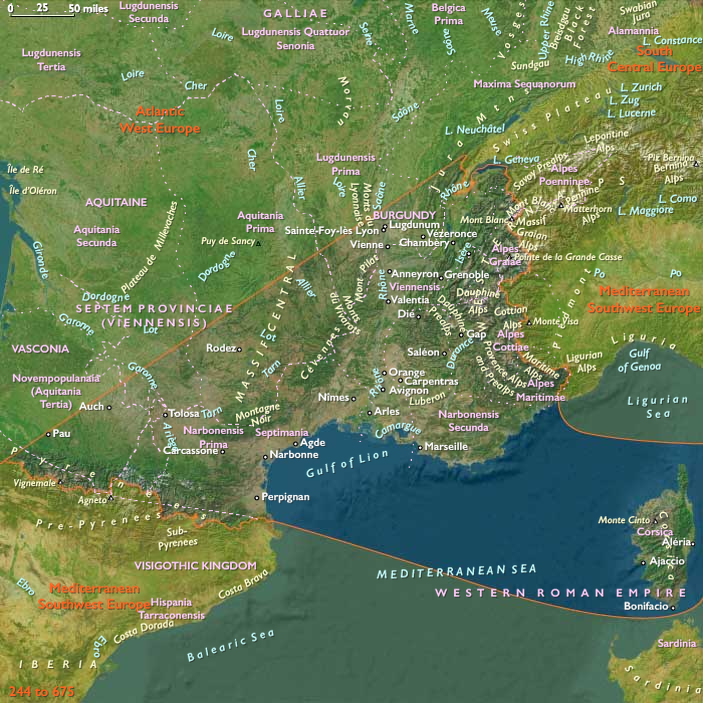
Between 388 and 531 CE, Mediterranean West Europe—comprising southern France (below an imaginary line from approximately 43.03476° N, 1.17208° W to 46.45234° N, 6.07689° E), Corsica, and Monaco—undergoes substantial upheavals characterized by the decline of Roman imperial power, the influx and settlement of barbarian groups, and the deepening of Christian influence across the region.
Decline of Roman Imperial Control
As the Western Roman Empire weakens, central authority begins to falter significantly throughout Mediterranean West Europe. Administrative inefficiency, economic disruptions, and the increasing burden of military expenses accelerate the erosion of Roman power. Local governance becomes increasingly autonomous, as provincial officials assume greater responsibilities to manage internal affairs independently of distant Rome.
Barbarian Invasions and Settlements
The period witnesses substantial incursions by various Germanic tribes, including the Visigoths and the Burgundians, who move into the region seeking new territories. In 412 CE, the Visigoths establish a significant presence in Aquitaine, and by the late fifth century, their kingdom encompasses much of southwestern France, influencing areas as far east as Provence. Meanwhile, Burgundian settlers establish themselves along the Rhône valley, significantly reshaping local societies and economies.
Socioeconomic Transformations
The integration of barbarian groups into local societies leads to profound socioeconomic changes. Rural areas increasingly rely on fortified villa complexes and self-sufficient communities to withstand the instability of the era. Urban centers, though reduced in economic prosperity compared to previous centuries, remain vital as administrative and religious hubs. Cities such as Arles, Massalia (Marseille), and Nemausus (Nîmes) continue to serve as important cultural and economic centers, albeit under shifting political authorities.
Consolidation and Expansion of Christianity
Christianity deepens its influence during this era, with the church becoming a central pillar of regional stability and continuity amid political turmoil. Bishops and monastic leaders, notably figures such as Caesarius of Arles, play crucial roles in maintaining social order, offering spiritual leadership, and providing charity and education. Monasticism expands significantly, with numerous monasteries founded across southern France and Corsica, further embedding Christian values and practices within local communities.
Cultural Adaptation and Fusion
Culturally, the region experiences a blending of Roman traditions with the customs and practices of incoming barbarian groups. Latin remains the dominant language, facilitating continuity in administrative, legal, and religious practices. However, new Germanic cultural elements integrate with Roman traditions, creating unique hybrid identities. Christian festivals increasingly supplant traditional Roman pagan celebrations, reinforcing the centrality of Christian rituals and symbols in everyday life.
Prelude to Early Medieval Stability
By 531 CE, Mediterranean West Europe transitions into the Early Middle Ages, having navigated a complex period marked by declining Roman imperial authority, significant population shifts due to barbarian settlements, and the definitive establishment of Christianity as the region’s dominant cultural force. These transformations lay the groundwork for the medieval societies that will characterize the region in subsequent centuries, emphasizing localized governance, Christian religious dominance, and the continued blending of diverse cultural traditions.
People
Groups
- Polytheism (“paganism”)
- Gauls
- Corsica et Sardinia (Roman province)
- Gallia Narbonensis (Roman province)
- Gallo-Roman culture
- Gallia Lugdunensis (Roman province)
- Gallia Aquitania (Roman province)
- Germans
- Christians, Early
- Burgundians (East Germanic tribe)
- Christianity, Nicene
- Roman Empire: Valentinian dynasty (Rome)
- Visigoths, Realm of the
- Roman Empire, Western (Milan)
- Roman Empire, Western (Ravenna)
- Burgundians, (first) Kingdom of the
- Visigothic Kingdom of Toulouse
- Burgundians, (second) Kingdom of the
- Corsica, Medieval
- Visigothic Kingdom of Spain
Topics
Subjects
Regions

Subregions
Years: 388 - 531
People
Groups
- Polytheism (“paganism”)
- Gauls
- Corsica et Sardinia (Roman province)
- Gallia Narbonensis (Roman province)
- Gallo-Roman culture
- Gallia Lugdunensis (Roman province)
- Gallia Aquitania (Roman province)
- Germans
- Christians, Early
- Burgundians (East Germanic tribe)
- Christianity, Nicene
- Roman Empire: Valentinian dynasty (Rome)
- Visigoths, Realm of the
- Roman Empire, Western (Milan)
- Roman Empire, Western (Ravenna)
- Burgundians, (first) Kingdom of the
- Visigothic Kingdom of Toulouse
- Burgundians, (second) Kingdom of the
- Corsica, Medieval
- Visigothic Kingdom of Spain
Topics
Subjects
Regions
Subregions