
West Europe (2637 – 910 BCE): Bronze …
Years: 2637BCE - 910BCE
West Europe (2637 – 910 BCE): Bronze and Early Iron — Maritime Gateways and Continental Frontiers
Regional Overview
Between the Atlantic and Mediterranean, Western Europe in the Bronze and Early Iron Ages became a hinge between northern and southern civilizations.
Its fertile river valleys, navigable coasts, and mountain corridors linked the emerging Atlantic seaways to the inland Rhone–Loire–Seine arteries.
Metalwork, megaliths, and maritime exchange bound farming hamlets, hillforts, and coastal entrepôts into one of the first truly integrated western European systems.
Geography and Environment
West Europe’s landscapes combined diversity and connectivity.
-
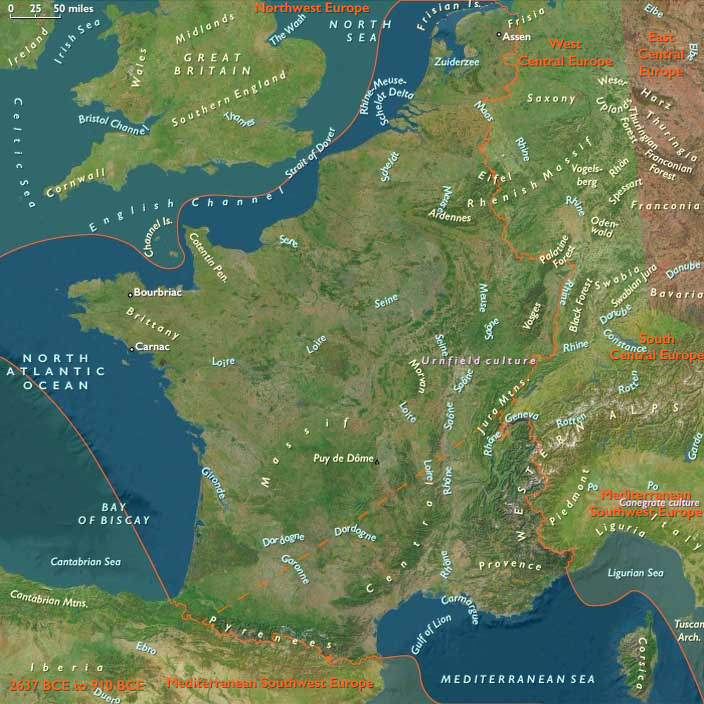
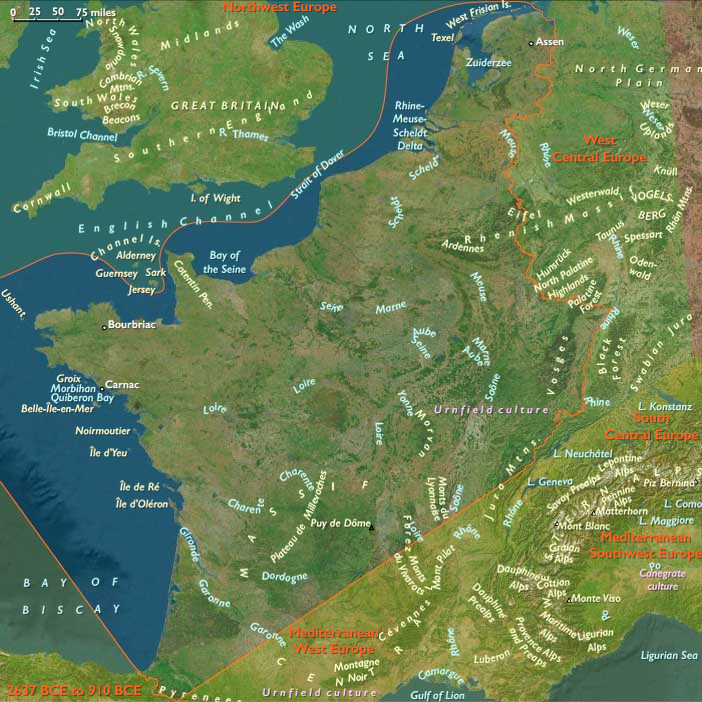
The Mediterranean south—from the Rhone delta to Corsica—joined mountains, fertile plains, and indented coasts.
-
The Atlantic north stretched from Brittany to Flanders, its wide estuaries and loess lowlands opening inland toward Burgundy and the Paris Basin.
-
Major rivers—the Rhone, Loire, Seine, and Scheldt—linked maritime harbors with upland resource zones and interior markets.
This complex geography made the region both a cultural corridor and an ecological mosaic.
Climate and Environmental Shifts
The later third and early second millennia BCE brought relatively stable, temperate conditions.
Warm phases favored viticulture and olive growing in the south, while the north’s maritime climate ensured regular rainfall for cereals and pasture.
Periodic cooler or wetter intervals fostered diversification: transhumant herding in uplands, irrigation and terracing along drier Mediterranean slopes, and mixed farming on the Atlantic plains.
Societies and Political Developments
Mediterranean Shores
Southern France and Corsica developed farming villages and herding communities linked to the wider Mediterranean world.
By the mid–second millennium BCE, copper and bronze industries flourished, and coastal towns in the Rhone delta and Gulf of Lion exchanged metals and ceramics with Iberia, Italy, and the Aegean.
Megalithic tombs gave way to fortified hilltop settlements controlling arable valleys and salt flats.
Atlantic Lowlands
In the north and west, riverine and coastal societies expanded around the Loire, Seine, and Scheldt.
Beaker-culture influences introduced metallurgy and new burial customs.
Communities grew larger and more permanent; chiefs oversaw exchange in bronze weapons, amber, and salt.
By the late second millennium BCE, Atlantic ports had become nodes in an ocean-wide circuit linking Britain, Ireland, Iberia, and Gaul.
Economy and Technology
-
Agriculture: Wheat, barley, pulses, olives, and grapes thrived in the south; mixed grain and livestock farming dominated in the north.
-
Pastoralism: Seasonal transhumance united coastal and upland economies.
-
Metallurgy: Bronze swords, axes, and ornaments displayed regional artistry; iron appeared near 1000 BCE.
-
Crafts: Pottery varied from burnished Rhone wares to decorated urns of the Atlantic barrow zones.
-
Trade: The Rhone–Saône–Rhine corridor carried amber, salt, and metalwork inland; coastal cabotage linked France, Iberia, and the British Isles.
Belief and Symbolism
Megalithic and post-megalithic monuments embodied collective memory.
Burial forms diversified: communal dolmens in the Pyrenees and Brittany, individual cists or barrows in northern France, and richly furnished chamber graves in the Rhone Valley.
Rock engravings, solar motifs, and weapon imagery reflected a warrior and pastoral ideology that balanced reverence for ancestors with cosmological symbolism of the sun and sea.
Movement and Interaction Corridors
-
Rhone–Loire–Seine rivers funneled Mediterranean goods toward the Atlantic.
-
Pyrenean and Alpine passes carried metals, salt, and pastoral herds.
-
Maritime routes around Brittany, Normandy, and the Ligurian coast bound Atlantic and Mediterranean spheres.
These overlapping routes created enduring patterns of exchange that would persist through the classical era.
Environmental Adaptation and Resilience
Diversified economies—grain, vines, livestock, and fisheries—offered buffers against droughts or floods.
Terrace farming stabilized soils; irrigation channels and seasonal herding reduced climate risk.
Settlement patterns adapted to water management: elevated storage barns in floodplains, stone villages in uplands, and protected harbors along estuaries.
Regional Synthesis and Long-Term Significance
By 910 BCE, Western Europe was both agricultural heartland and maritime crossroads.
Its southern valleys connected to Mediterranean commerce; its northern rivers and coasts opened to Atlantic exchange.
The spread of bronze, the emergence of iron, and the growth of fortified settlements unified these environments into one of the most dynamic cultural regions of prehistoric Europe—preparing the stage for the Celtic and classical worlds to follow.
Groups
Topics
- Neolithic Europe
- Subboreal Period
- Abrolhos Transgression
- 4.2 kiloyear BP aridification event
- Subatlantic Period
- Younger Subboreal Period
- Iron Age Europe
- Subatlantic Period
Commodoties
Subjects
Regions
Subregions

Years: 2637BCE - 910BCE
Groups
Topics
- Neolithic Europe
- Subboreal Period
- Abrolhos Transgression
- 4.2 kiloyear BP aridification event
- Subatlantic Period
- Younger Subboreal Period
- Iron Age Europe
- Subatlantic Period
Commodoties
Subjects
Regions
Subregions