Megara also colonizes northward and eastward on …
Years: 681BCE - 670BCE
Megara also colonizes northward and eastward on the Bosporus River and Sea of Marmara at Chalcedon (676) on a site so obviously inferior to that of Byzantium (on the opposite shore) that it is soon accorded the name of the “city of the blind.”
Locations
Groups
Topics
- Younger Subboreal Period
- Iron Age, Near and Middle East
- Greek colonization
- Iron Age Cold Epoch
- Classical antiquity
Commodoties
Subjects
Regions
Subregions
Related Events
Filter results
Showing 10 events out of 66254 total
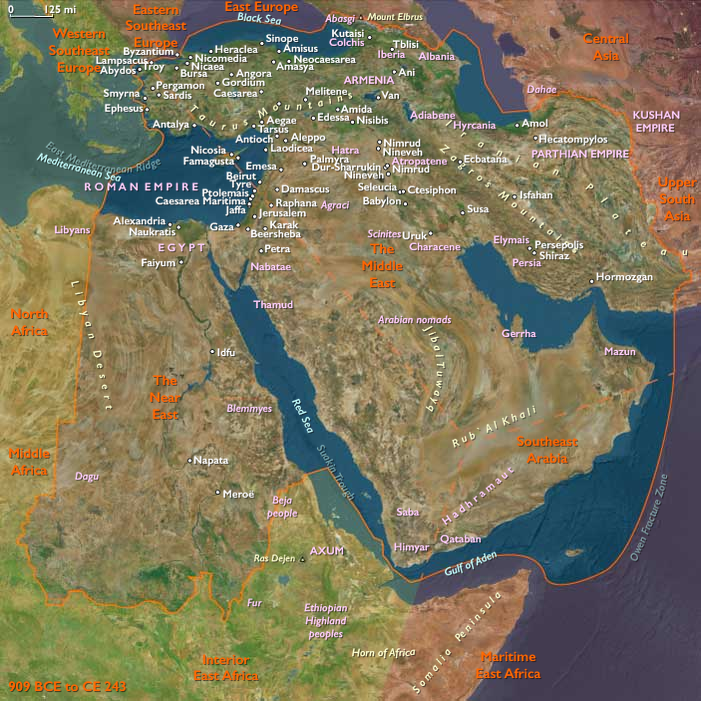
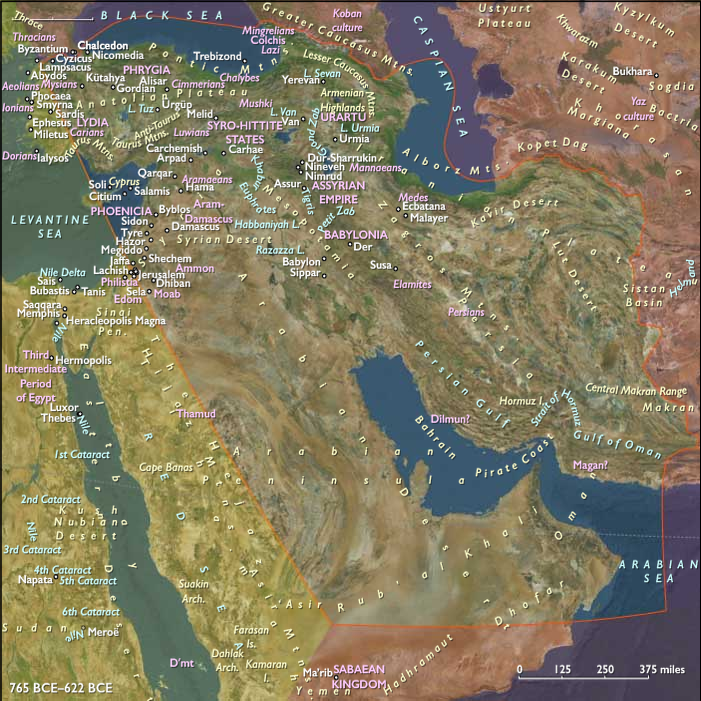
The Middle East: 681–670 BCE
Esarhaddon's Ascension and Consolidation
In 681 BCE, Assyrian king Sennacherib is assassinated by two of his sons following his conquest of Babylon. Esarhaddon, his loyal son, rapidly marches to Nineveh, defeating his rival brothers in a brief civil war. Formally declared king, Esarhaddon immediately takes measures to stabilize and expand his recently enlarged empire, especially guarding against invasions by the Cimmerians and Scythians, who threaten Assyrian possessions in Anatolia and Media.
Esarhaddon actively pursues religious and political policies designed to consolidate his rule. He initiates major construction projects in both Assyria and Babylonia, notably rebuilding the famed Esagila temple in Babylon and the Ekur temple at Nippur, sites traditionally identified with the Tower of Babel. Simultaneously, he reconstructs the sanctuary of Esharra in Ashur, underscoring his impartial stance toward both major Assyrian and Babylonian religious centers.
Sidonian Revolt and Its Suppression
In 680 BCE, Abdi-Milkutti, king of Sidon, leads a rebellion against Assyrian dominance, forming an alliance with Sanduarri of Kundu (western Cilicia) and Sizzu, a Lebanese prince. After a prolonged three-year siege, Esarhaddon defeats and executes Abdi-Milkutti in 677 BCE, utterly destroying Sidon and deporting its inhabitants. He rebuilds Sidon as Kar-Ashur-aha-iddina ("Harbor of Esarhaddon"). Sanduarri is also executed, with the severed heads of both kings publicly displayed in Nineveh. Loyal Assyrian vassals, including Baal I of Tyre, receive shares of the extensive plunder taken from Sidon.
Regional Diplomacy and Military Engagements
Esarhaddon undertakes extensive military campaigns to strengthen Assyrian influence. In 674 BCE, he campaigns in Bazu, identified with present-day Qatar near Dilmun (Bahrain), facing harsh desert conditions. Around 678 BCE, Esarhaddon campaigns against the rising power of the Medes, fortifying Assyrian control of critical trade routes and strategic regions along the Zagros Mountains.
In Anatolia, the Assyrians contend with significant challenges. In 679 BCE, the Cimmerians, led by Teushpa, invade Cilicia and the Neo-Hittite kingdom of Tabal. Esarhaddon confronts these threats and also besieges Melid in 675 BCE, though without immediate success. Diplomatic marriages, such as the union of Esarhaddon's daughter with the Scythian prince Bartatua, aim to stabilize relations with nomadic groups that posed recurring threats to Assyrian dominance.
Conflict with Elam and Urartu
Esarhaddon faces intermittent hostilities with Elam and Urartu. In 675 BCE, Humban-Haltash II of Elam launches an unsuccessful attack against Sippar but dies shortly thereafter. His successor, Urtaki, restores peaceful relations with Assyria. In 673 BCE, Esarhaddon wages war against Rusas II of Urartu, responding to Urartu's resurgence after earlier devastations by Sargon II and the Cimmerians.
Succession and Internal Politics
Internally, Esarhaddon carefully prepares the succession for his sons. Initially designating his eldest son, Sin-iddina-apla, as crown prince of Assyria and his second son, Shamash-shum-ukin, as ruler of Babylon, he is forced to adjust his plans after the death of the eldest son in 672 BCE. The younger Ashurbanipal, though initially unpopular with court elites, is elevated as crown prince. To secure his position, Esarhaddon negotiates loyalty agreements with Assyrian nobles, foreign rulers, and influential court members, setting the stage for Ashurbanipal's future reign.
Thus, from 681 to 670 BCE, Esarhaddon's dynamic leadership significantly reshapes the geopolitical landscape, reinforcing Assyria’s dominance, managing rebellions and invasions, and securing internal stability through strategic diplomacy and meticulous planning for succession.

Assyrian king Esarhaddon wages war in 674 in the land of Bazu, situated opposite the island of "Dilmun" (Bahrain), probably Qatar, "where snakes and scorpions cover the ground like ants”—a dry land of salt deserts.
The Sidonian king Abdi-Milkutti rises up against the Assyrian king in 680 BCE.
Unwilling to pay tribute to Assyria, he has formed an alliance with Sanduarri, king of Kundu (in western Cilicia), and Sizzu, a prince of the Lebanon, probably during the time of the civil war waged between Esarhaddon and two of his brothers who, after having murdered his father, dispute his succession.The two king swear to each other by the names of the great gods and revolt.
Abdi-Milkutti is defeated in 677 BCE after three years of siege, and beheaded.
The town of Sidon is destroyed and rebuilt as Kar-Ashur-aha-iddina, the "Harbor of Esarhaddon".
The population is deported to Assyria.
Sanduarri is also captured and decapitated and the heads of the two kings are hung around the necks of their nobles who are paraded through the streets of Nineveh.
A share of the plunder goes to the loyal king of rival Tyre, Baal I, himself an Assyrian puppet.
The partly conserved text of a treaty with Tyre mentions the kings of Judah, Edom, Moab, Gaza, Ashkelon, Ekron, Byblos, Arvad, Samsi-muruna, Ammon, Ashdod, ten kings from the coast of the sea, and ten kings from the middle of the sea (usually identified with Cyprus), as Assyrian allies.
Esarhaddon sends off to Assyria a rich treasure, including: “gold, silver, precious stones, elephant hides, ivory, maple and boxwood, garments of brightly colored wool and linen.”
He also takes away the king’s wife, his children, and his courtiers: “His people from far and near, which were countless.”
The defeated and executed king of Sidon is depicted on the Sam'al stele of Esarhaddon from Zenjirli.
The stele shows Abdi-Milkutti, dressed in his native costume and held with a coiled leash.
Although he is shown standing with his hands raised, he reaches only to about Esarhaddon's knee.
Next to him is shown a kneeling Egyptian prince.
Two of Sennacherib's sons conspire against him soon after his conquest of Babylon and assassinate him in 681.
The biblical account is that the brothers killed their father after the failed attempt to capture Jerusalem and fled (2 Kings 19:37).
The faithful son, Esarhaddon, who returns to the capital of Nineveh in forced marches and defeats his rival brothers in six weeks of civil war, is formally declared king in spring of 681 BCE.
His brothers flee the land, and their followers and families are put to death.
Esarhaddon, who is apparently a good general and administrator, strengthens the frontiers of his recently enlarged empire against repeated incursions by the Cimmerians and Scythians, who pose serious threats to Assyrian possessions in Anatolia and Media, the latter of which is a primary source of horses for the Assyrian army.
Crown prince Sin-iddina-apla, Esarhaddon’s oldest son, had been designated as king of Assyria, while the second son Shamash-shum-ukin was to become the ruler of Babylon.
With the death of the crown prince in 672 BCE, the younger Ashurbanipal becomes crown prince, but he is very unpopular with the court and the priesthood.
Contracts are made with leading Assyrians, members of the royal family and foreign rulers, to assure their loyalty to the thirteen-year-old crown prince.
Esarhaddon, in order not to appear too biased in favor of Babylonia, orders the reconstruction of the Assyrian sanctuary of Esharra in Ashur as well.
Foreigners are forbidden to enter this temple.
Both buildings are dedicated almost at the same date, in year two of his reign.
Esarhaddon begins in the year of his accession to rebuild Babylon, including the well-known Esagila and the Ekur at Nippur (structures sometimes identified with Tower of Babel) and attempts to appease the restive Babylonians.
The statues of the Babylonian gods are restored and returned to the city.
The most notable of the Syrian Neo-Hittite kingdoms in Anatolia and northern Syria that had succeeded the Hittite Kingdom are those at Carchemish and Milid (near the later Melitene).
These polities had gradually fallen under the control of the Assyrians, who had conquered Carchemish during the reign of Sargon II in the late eighth century BCE, and Milid several decades later.
A large and powerful state known as Tabal occupies much of southern Anatolia.
Their language may have been Luwian, testified to by monuments written using Luwian hieroglyphics.
The Cimmerians attack Cilicia and Tabal under their new ruler, Teushpa, in 679 BCE during the reign of Esarhaddon of Assyria.
The original population area of the Median people was western Iran and named after them as "Media".
At the end of the second millennium BCE the Median tribes arrived in the region (one of several Iranian tribes to do so) which they later called Media.
These tribes expanded their control over larger areas subsequently and over a period of several hundred years the boundaries of Media moved.
An early description of the territory of Media by the Assyrians dates from the end of ninth century until the beginning of the seventh century BCE.
The southern border of Media, in this period, is named as the Elamite region of Simaški in present day Lorestan.
From the west and northwest it is bounded by the Zagros mountains and from the east by Dašt-e Kavir.
The region of Media is known to the Assyrians and described by them thus: "extended along the Great Khorasan Road from just east of Harhar to Alwand, and probably beyond.
It was limited on the north by Mannaea, on the south by Ellipi.
The location of Harhar is suggested to be "the central or eastern" Mahidasht in Kermanshah province.
After ensuring the allegiance of Babylonia, Esarhaddon campaigns in around 678 against the Medes under Khshathrita (Phraortes).
Later, Assyrian hosts reach the border of the "salt-desert" near the mountain Bikni, that is, near Teheran.
A number of fortresses secure the Zagros: Bit-Parnakki, Bit-kari and Harhar (Kar-Sharrukin).
Esarhaddon takes the towns of Sissu and Kundu in the Taurus Mountains in 676 BCE.
The Mannaeans, the Scythians under their king Ishpakaia, and the "Gutians" of the Zagros prove to be a nuisance as well, as is attested by numerous oracle-texts.
The Mannaeans, former vassals of the Assyrians, are no longer restricted to the area around Lake Urmia, but have spread into Zamua, where they have interrupted the horse trade between Parsuash and Assyria and refused to pay further tribute.
A daughter of Esarhaddon had been wedded to the Scythian prince Bartatua of Sakasene after the fall of Phrygia in order to improve relations with the nomads.
A certain Mugallu has taken possession of parts of the Syro-Hittite state of Melid, and associated himself with the king of Tabal.
Esarhaddon besieges the city of Melid in 675 BCE, but without success.
Years: 681BCE - 670BCE
Locations
Groups
Topics
- Younger Subboreal Period
- Iron Age, Near and Middle East
- Greek colonization
- Iron Age Cold Epoch
- Classical antiquity