
Mehmed II builds the fortress of Bogazkesen…
January 1452 CE
Mehmed II builds the fortress of Bogazkesen (later Rumelihisari) in order to control the sea traffic on the Bosporus strait and prevent aid from the Black Sea to reach Constantinople during the planned Turkish siege of the city, particularly from the Genoese colonies such as Caffa, Sinop and Amasra.
The fortress is situated at the narrowest point of the Bosporus with 660 meters of the Bosporus strait, just opposite of Anadoluhisari (Anatolian Castle) on the Anatolian side, which is another Ottoman fortress that was built between 1393 and 1394 by Sultan Bayezid I.
In a previous Ottoman attempt to conquer the city, Sultan Murad II had encountered difficulties due to a blockade of the Bosporus by the imperial fleet.
The necessity of a fortress opposite of Anadoluhisari is thus well known to the Ottomans.
On the location of Rumelihisarı, there had been a Roman fortification in the past, which was used as a prison by the Empire and the Genoese.
Later on, a monastery had been built there.
In preparation for the conquest of Constantinople, Mehmed had started to realize the construction of the fortress immediately following his second ascent to the throne in 1451, refusing the plea for peace of Emperor Constantine XI, who understands the Sultan’s intention.
The construction begins on April 15, 1452.
Each one of the three main towers is named after the Pashas who supervises their construction.
The Sultan personally inspects the activities on the site.
Mehmed spends the year 1452 mainly in building the fortress, in building a fleet of 31 galleys, and in casting new cannon of large caliber.
He makes the Hungarian master gunsmith, Urban, cast guns of a size unknown even in Europe.
Meanwhile, the grand vizier Candarli argues against the enterprise.
The fortress is completed, with the help of thousands of masons and workers, in a record time of four months and sixteeen days on August 31, 1452.
Locations
Groups
Commodities
Subjects
Regions
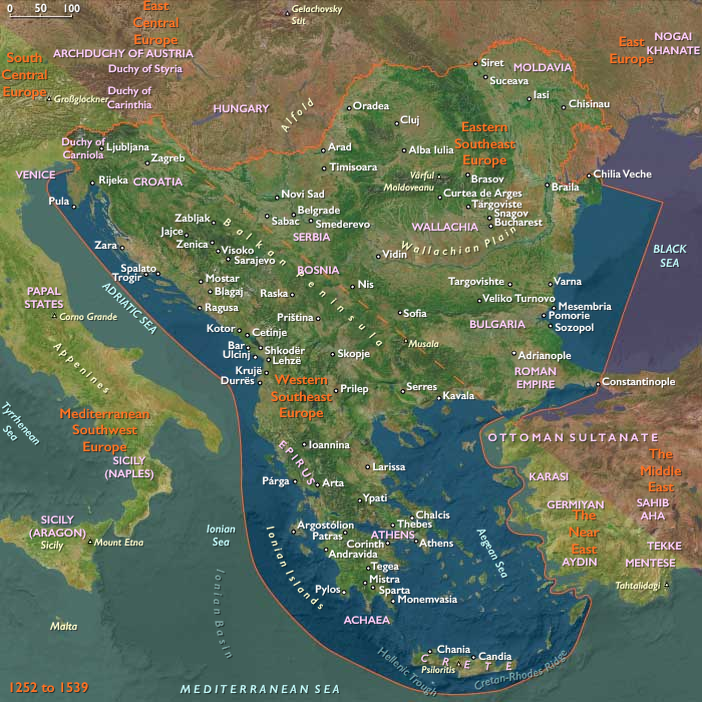
Southeast Europe
View →Subregions
