
Meiningen, first mentioned in 982 and chartered…
1583 CE
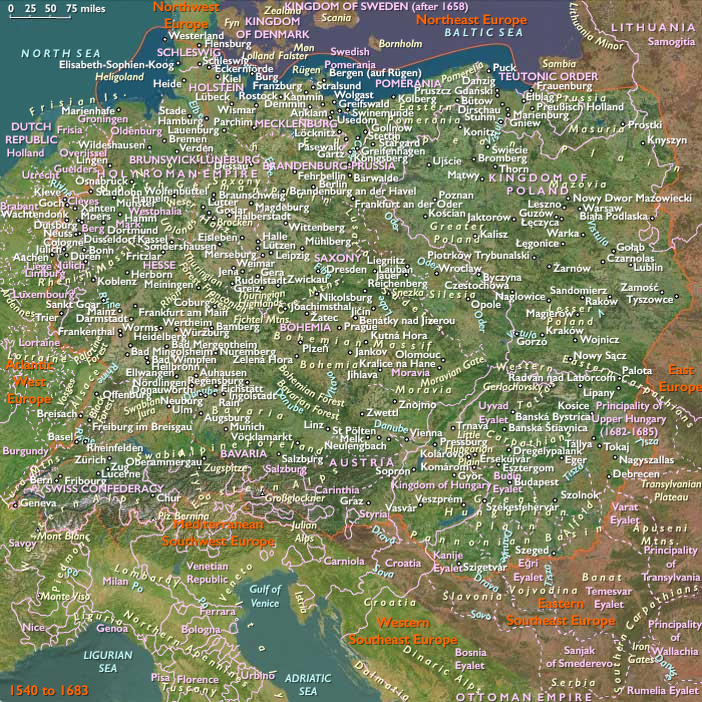
Meiningen, first mentioned in 982 and chartered in 1344, had belonged to the bishops of Würzburg (after 1008) and the counts of Henneberg (after 1542); it passes to Saxony in 1583.
Locations
Groups
Subjects
Regions
Central Europe
View →Subregions

East Central Europe
View →Related Events
No active filters.
Showing 10 events out of 34838 total
Antipolo is founded in 1578 by Franciscan missionaries, who build a church in Boso-Bos, twelve miles (nineteen kilometers) east of Manila in the Sierra Madre foothills.
Antipolo is today the eighth most populous city in the country with a population of 633,971 in 2007.
Hideyoshi, at a conference of the Oda family's chief retainers, had insisted that Nobunaga's grandson succeed as head of the Oda family in opposition to two powerful vassals of their late leader who support Nobunaga's third son.
Hideyoshi defeats one of these vassals in a battle in 1583, and allows him to commit suicide.
After subduing a number of important strongholds, Hideyoshi in the same year builds Osaka Castle on the ruins of the fortress-monastery of Hongan-ji; it still stands today.
He now embarks on his attempt to conquer the whole of Japan in an effort to complete Nobunaga's work of unifying the country after more than two centuries of feudal warfare.
The prolonged and unsuccessful Livonian War has overextended Russia's resources and helped bring the state to the verge of economic collapse.
An armistice with Sweden in 1583 compels Russia to give up towns on the Gulf of Finland.
Tycho, putting forward his scheme for the structure of the solar system in 1583, retains from the ancient Ptolemaic system the idea of Earth as a fixed center of the universe around which the Sun and Moon revolve, but he holds that, as in the newer system of Copernicus, all other planets revolve around the Sun.
In both the Tychonic and the Ptolemaic systems, an outer sphere containing the fixed stars is considered to revolve every day around the Earth.
The Tychonic theory explains the observed variations of phase of Venus, for which the Ptolemaic system had no explanation.
A system somewhat similar to Tycho's had been proposed in the 4th century BC by the Greek philosopher Heracleides Ponticus, who thought that at least Mercury and Venus (it is uncertain if Heracleides included other planets) went around the Sun.
English merchant Ralph Fitch, together with John Newberry, John Eldred, William Leedes, and James Story, embarks in February, 1583, in the Tiger and reaches Syria in late April.
(Act I, scene 3 of William Shakespeare's Macbeth alludes to the trip.)
From Aleppo, ...
...Fitch and his companions travel overland to the Euphrates, which they descend to Al-Fallujah, now in Iraq, and thence ...
...the merchant-adventurers cross over to Baghdad and sail down the Tigris to ...
...Basra (May–July 1583).
Eldred remains, but ...
...Fitch and the others sail down the Persian Gulf to the trading center of Hormuz, a client state of Portugal, who guards very carefully her new found routes to Asia.
Arriving in July 1583, they are arrested for spying at the instigation of Venetian merchants and transported to Goa.
Another Ottoman army, under great odds, completes the conquest of Dagestan and seizes the Shirvan (Samaxi) region of Azerbaijan in 1583.