Charles Messier's occupation as a comet hunter…
March 1781 CE
Charles Messier's occupation as a comet hunter has led him to continually come across fixed diffuse objects in the night sky which could be mistaken for comets.
He had compiled a list of them, in collaboration with his friend and assistant Pierre Méchain (who may have found at least twenty of the objects), to avoid wasting time sorting them out from the comets they are looking for.
The entries are now known to be galaxies thirty-nine), planetary nebulae (five), other types of nebulae (seven), and star clusters (fifty-five).
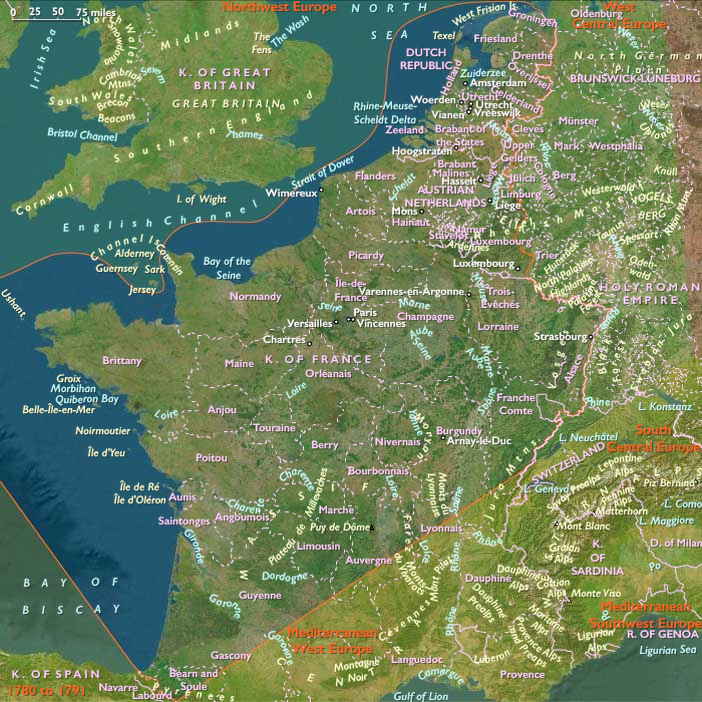
Messier does his observing with a one hundred millimeter (four inch) refracting telescope from Hôtel de Cluny (now the Musée national du Moyen Âge), in downtown Paris, France.
The list he compiles contains only objects found in the area of the sky he can observe, from the north celestial pole to a declination of about −35.7°.
They are not organized scientifically by object type, or even by location.
The first version of Messier's catalogue contained forty-five objects and was published in 1774 in the journal of the French Academy of Sciences in Paris.
In addition to his own discoveries, this version includes objects previously observed by other astronomers, with only seventeen of the forty-five objects being Messier’s.
By 1780 the catalog had increased to eighty objects.
The final version of the catalogue is published in 1781, in the 1784 issue of Connaissance des Temps.
The final list of Messier objects has grown to one hundred and three.
On several occasions between 1921 and 1966, astronomers and historians will discover evidence of another seven objects that had been observed either by Messier or by Méchain, shortly after the final version was published.
These seven objects, M104 through M110, will be accepted by astronomers as "official" Messier objects.
The objects' Messier designations, from M1 to M110, are still used by professional and amateur astronomers today and their relative brightness makes them popular objects in the amateur astronomical community.
Locations
Subjects
Regions

West Europe
View →Subregions