Michael Faraday, best known today for his…
1813 CE
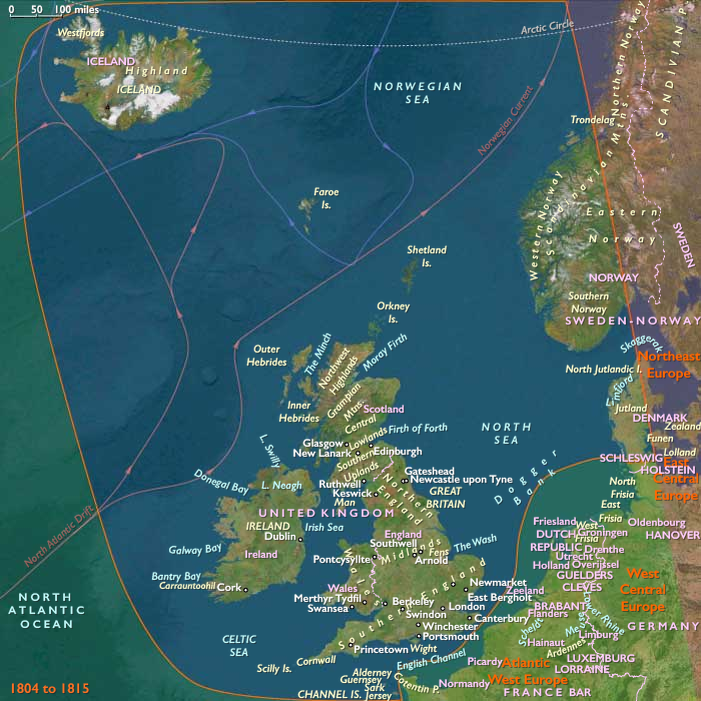
Michael Faraday, best known today for his work regarding electricity and magnetism, was born in Newington Butts, which is now part of the London Borough of Southwark, but which was then a suburban part of Surrey.
His family is not well off; his father, James, who is a member of the Glassite sect of Christianity, moved his wife and two children to London during the winter of 1790 from Outhgill in Westmorland, where he had been an apprentice to the village blacksmith.
Michael was born the autumn of that year.
The third of four children, having only the most basic school education, Michael had had to educate himself.
At fourteen, he became the apprentice to George Riebau, a local bookbinder and bookseller in Blandford Street.
During his seven-year apprenticeship he had read many books, including Isaac Watts' The Improvement of the Mind, and has enthusiastically implemented the principles and suggestions contained therein.
At this time he had also developed an interest in science, especially in electricity.
Faraday was particularly inspired by the book Conversations on Chemistry by Jane Marcet.
In 1812, at the age of twenty, and at the end of his apprenticeship, Faraday had attended lectures by the eminent English chemist Humphry Davy of the Royal Institution and Royal Society, and John Tatum, founder of the City Philosophical Society.
Many of the tickets for these lectures had been given to Faraday by William Dance, who was one of the founders of the Royal Philharmonic Society.
Faraday subsequently sent Davy a three-hundred-page book based on notes that he had taken during these lectures.
Davy's reply was immediate, kind, and favorable.
When Davy damaged his eyesight in an accident with nitrogen trichloride, he decided to employ Faraday as a secretary.
When one of the Royal Institution's assistants, John Payne, was sacked, Davy was asked to find a replacement, and appointed Faraday as Chemical Assistant at the Royal Institution on March 1, 1813.
His first recorded experiment had been the construction of a voltaic pile with seven halfpence pieces, stacked together with seven disks of sheet zinc, and six pieces of paper moistened with salt water.
With this pile he had decomposed sulphate of magnesia (first letter to Abbott, July 12, 1812).
As an assistant to Davy, Faraday is specifically involved in the study of chlorine; he discovers two new compounds of chlorine and carbon.
He also conducts the first rough experiments on the diffusion of gases, a phenomenon that was first pointed out by John Dalton, and the physical importance of which will more fully be brought to light by Thomas Graham and Joseph Loschmidt.
Faraday succeeds in liquefying several gases, investigates the alloys of steel, and produces several new kinds of glass intended for optical purposes.
A specimen of one of these heavy glasses subsequently will become historically important; when the glass is placed in a magnetic field, Faraday determines the rotation of the plane of polarization of light.
This specimen is also the first substance found to be repelled by the poles of a magnet.
Locations
Subjects
Regions
North Europe
View →Subregions