
Mircea, helped by Sigismund of Luxembourg, manages…
1397 CE
Mircea, helped by Sigismund of Luxembourg, manages to get rid of the usurper Vlad in 1397, and stops another Ottoman expedition that crosses the Danube into Wallachian territory.
Locations
Commodities
Subjects
Regions
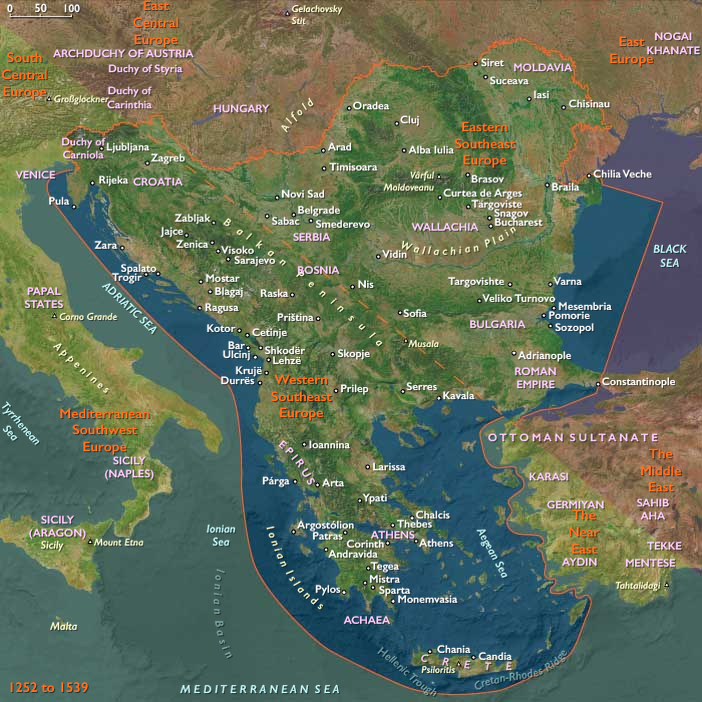
Southeast Europe
View →Subregions
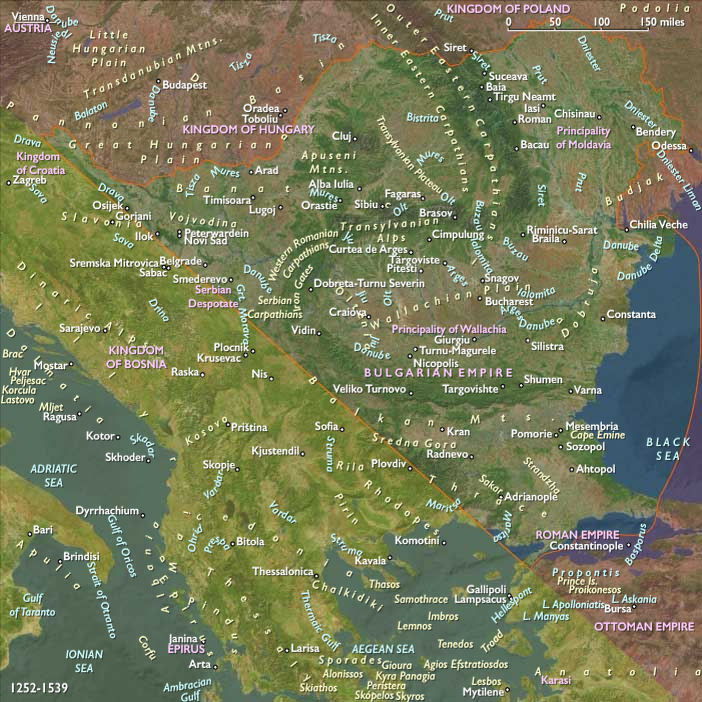
Eastern Southeast Europe
View →Related Events
No active filters.
Showing 10 events out of 42870 total
Temür Qutlugh, a son of Timur-Malik, khan of the White Horde, who had struggled against Toqtamysh and lost his life in 1379, had been reared at Toqtamysh's court.
After an unsuccessful revolt against Toqtamysh in 1388, he, along with Edigu, the son of Baltychak, a Mongol noble who had been defeated and killed by Toqtamysh, fled to Timur.
During the Tokhtamysh-Timur war in 1391-1395, they had founded an independent ulus in the region of the lower Volga and Ural Rivers, placing their capital in Saray-Jük.
After the defeat of Tokhtamysh, Qutlugh, with Edigu's help, had been crowned as Khan of the Golden Horde, although Edigu is the real holder of power.
Kirillo-Belozersky Monastery, loosely translated in English as the Assumption monastery of St. Cyril, is founded in 1397; it will one day be the largest monastery of Northern Russia.
Its founder, Saint Kirill of Beloozero, following the advice of his teacher, Saint Sergius of Radonezh, had first dug a cave here, then builds a wooden Assumption chapel and a loghouse for other monks.
Being a member of the influential Velyaminov clan of boyars, Kirill relinquishes the office of father superior of the greatest cloister in medieval Moscow—the Simonov monastery.
His ties with the ruling elite are still close, however, as his letters to sons of Dmitri Donskoi clearly demonstrate.
It seems that the Muscovite rulers regard Kirill's monastery as an important strategic point, both for Northern trade and in their struggle with the Novgorod Republic.
Sretensky Monastery is founded in Moscow by Grand Prince Vasili I in 1397 on the spot where the Muscovites and the ruling Prince had met the icon of Our Lady of Vladimir on August 26, 1395, moved from Vladimir to Moscow to protect the capital from the imminent invasion of Timur.
Soon thereafter, the armies of Timur had retreated and the grateful monarch had founded the monastery to commemorate the miracle.
Lithuania’s Grand Duke Vytautas, also known in English by the traditional Polish and German name Witold, has continued the vision of his predecessor, Algirdas, to control as many Muscovy lands as possible. (Revered as a national hero in Lithuania, Vytautas the Great is to be an important figure in the national rebirth in the early twentieth century.)
In the later part of the fourteenth century, Vytautas and Dmitri Donskoi of Moscow had begun a rivalry for the fertile southern lands of modern day Ukraine, controlled (if only nominally) by the Blue Horde.
As the Tatar power was on the wane, Dmitri had soundly defeated the Horde at the Battle of Kulikovo in 1380, only to be besieged in Moscow and defeated in 1382 by the new Khan Tokhtamysh, who had taken over the Blue Horde with Timur's backing, forming the Golden Horde.
Many lands are already under the Grand Duke's rule, but the rest are controlled by the Mongols.
The power of the Golden Horde had begun to rise, but in 1389, Tokhtamysh had made the disastrous decision of waging war on his former master, the great conqueror Timur, whose armies had rampaged through modern-day southern Russia, crippling the Golden Horde's economy and practically wiping out its defenses in those lands.
After losing the war, Tokhtamysh had then been dethroned by the party of Khan Temur Qutlugh and Emir Edigu, supported by Timur.
When Tokhtamysh asks Vytautas for assistance in retaking the Horde, the latter readily gathers a huge army which includes Lithuanians, Tatars, Ruthenians, Russians, Poles, Moldavians, Wallachians, and five hundred Teutonic Knights.
An agreement had been reached that the Horde would cede more lands to the Grand Duchy of Lithuania in return for Vytautas’ aid.
Queen Margaret of Denmark joins Sweden, Denmark, and Norway into a single realm under her grandnephew, Eric of Pomerania, by the Treaty of Kalmar, signed on June 17, 1397, in the Swedish castle of Kalmar, on Sweden's southeast coast.
The eternal union stipulates that the Swedish crown shall remain elective and that each country shall retain its own laws and customs.
Although Eric is crowned monarch of all three kingdoms as Erik VII, he remains merely a figurehead for his powerful grandmother, who has dominated Scandinavian affairs, quelled internal violence in Sweden, expanded the royal domain, brought the dukes of Schleswig and Holstein in line, patronized religious institutions, and fostered Danish influence. (The Union of Kalmar, which will last nearly throughout the age, will in fact never formally be dissolved—some argue that its conception was never actually ratified, either. It has been doubted that several of the signatories were personally present—for example, the entire Norwegian "delegation"—and it has been argued that the Treaty was only a draft document. Norway and her overseas dependencies, however, will continue to remain a part of the realm of Denmark-Norway under the Oldenburg dynasty for several centuries after the dissolution.)
Charles IV, born Wenceslaus (Václav), the eleventh king of Bohemia from the House of Luxembourg, and Holy Roman Emperor, had died in 1378 after dividing his holdings among his sons and other relatives.
Although Wenceslas, his son by his third wife Anne of Świdnica, had retained Bohemia as Wenceslas IV, his younger half-brothers Sigismund and John had received Brandenburg and Lusatia.
Moravia had been divided between his cousins Jobst and Procopius, and his uncle Wenceslas had been made Duke of Luxembourg.
Hence the young king had been left without the resources his father had enjoyed.
In 1386, Sigismund had become king of Hungary, and had become involved in affairs further east.
Wenceslas had also faced serious opposition from the Bohemian nobles and from Jan z Jenštejna, Archbishop of Prague.
The torture and murder of the Vicar General of Prague, John of Nepomuk, by royal officials in 1393 had sparked a noble rebellion.
In 1394 his cousin Jobst of Moravia had been named regent and Wenceslas had been imprisoned.
Sigismund, deprived of his authority in Hungary after his failure at Nicopolis, now turns his attention to securing the succession in Germany and Bohemia; having arranged a truce in 1396, he is recognized for his efforts by his childless half-brother as vicar-general of the whole Empire.
The victorious Ottomans, having in 1396 annexed Bulgaria, which ceases to exist as an independent state, have made Sofia, as the city of Triaditsa has been called for some decades, the administrative center of their Balkan territories.
The Turks, by their victory at Nicopolis, have discouraged the formation of future European coalitions against them.
They maintain their pressure on Constantinople, tighten their control over the Balkans, and become a greater menace to central Europe.
Europe is terrorized and Ottoman rule south of the Danube is assured; Bayezid's prestige in the Islamic world is so enhanced that he is given the title of sultan by the shadow 'Abbasid caliph of Cairo, despite the opposition of the caliph's Mamluk masters (the rulers of Egypt, Syria, and the holy cities of Mecca and Medina), who want to retain the title only for themselves.
Bayezid, after his victory at Nikopol, contents himself with raiding Hungary, Wallachia, and Bosnia.
He conquers most of Albania and forces the remaining northern Albanian lords into vassalage.
A new, halfhearted siege of Constantinople is undertaken but lifted in 1397 after Emperor Manuel, Bayezid’s vassal, agrees that the sultan should confirm all future emperors.
Bayezid is soon called back to Anatolia to deal with continuing problems with the Ottomans’ Turkish rivals, taking with him an army composed primarily of Balkan vassal troops, including Serbs led by his vassal, Prince Stefan Lazarevic; he is never to return to the Balkans.
Sultan Bayezid, turning back to Anatolia to complete the conquests aborted by his move against the crusaders, and to build a strong Islamic and Turkish base for his domain, begins to widen Ottoman suzerainty over the Turkish-Muslim rulers in Anatolia.
He has annexed various Turkmen emirates in Anatolia and ...