
March 20 had been calm in Stockholm.…
March 1848 CE
On 21 March, reinforcements from the army arrive to the capital to be at hand in case of further riots, but none occur.
Locations
People
Topics
Regions
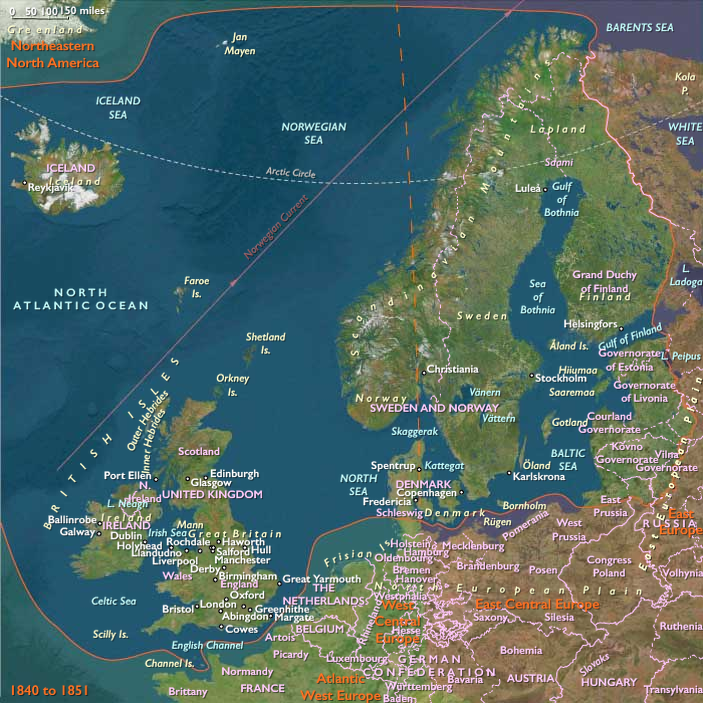
North Europe
View →Subregions
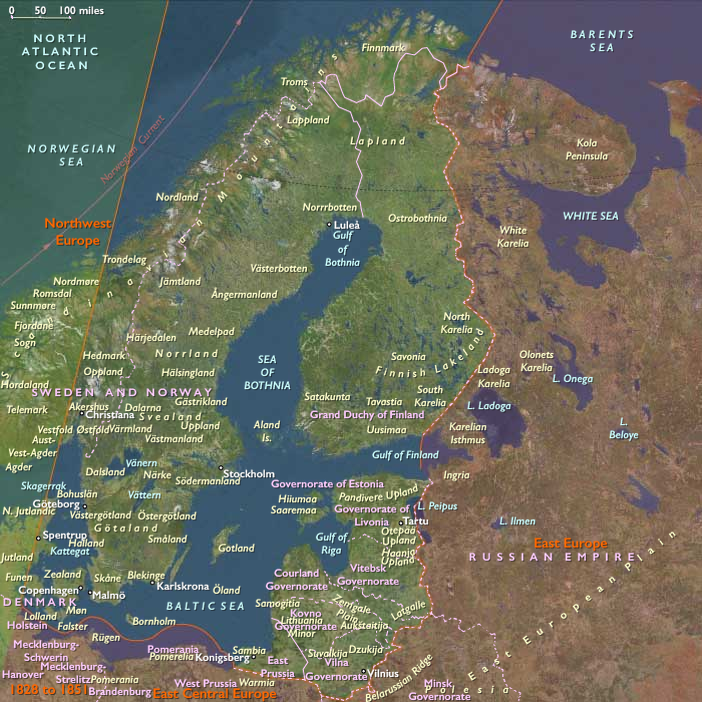
Northeast Europe
View →Related Events
No active filters.
Showing 10 events out of 16793 total
"Tartary" is an older name used by Europeans to refer to a vast region covering Inner Asia, Central Asia and North Asia.
The toponym is derived from the Medieval ethnonym "Tartars", which was applied to various Turco-Mongol semi-nomadic empires.
Since the Manchus' rise to prominence in 1644, the name "Tartars" had become applied to them as well, and Manchuria (and Mongolia) have become known to the Europeans as the "Chinese Tartary".
Accordingly, when La Pérouse charted most of the strait between Sakhalin and the mainland "Chinese Tartary" in 1787, the body of water had received the name of the Strait (or Channel, or Gulf) of Tartary.
In Japan, the strait is named after Mamiya Rinzō, who had traveled to the strait in 1808, whereof the name will be introduced by Philipp Franz von Siebold in his book Nippon: Archiv zur Beschreibung von Japan (1832–54).
On Russian maps, the short narrowest section of the strait (south of the mouth of the Amur) is called Nevelskoy Strait, after Admiral Gennady Nevelskoy, who explores the area in 1848; the body of water north of there, into which the Amur River flows, is the Amur Liman; and the name of "Strait of Tartary" is reserved for the largest section of the body of water, south of Nevelskoy Strait.
The Tartar Strait had been a puzzle to European explorers since, when approached from the south, it becomes increasingly shallow and looks like the head of a bay.
In 1787 La Perouse had decided not to risk it and turned south even though locals had told him that Sakhalin was an island.
In 1797 William Broughton had also decided that the Gulf of Tartary was a bay and turned south.
In 1805 Adam Johann von Krusenstern had failed to penetrate the strait from the north.
Mamiya Rinzō's journey of 1808 is little known to Europeans.
Admiral Nevelskoy passes the strait from the north in 1848.
The Russians will keep this a secret and use it to evade a British fleet during the Crimean War.
An all-male group of German Lutheran missionaries had arrived in the Chatham Islands in 1843.
When a group of women are sent out to join them three years later, several marriages ensue, and many members of the present-day population can trace their ancestry back to the missionary families.
George Grey is made a Knight Commander of the Order of the Bath in 1848 for his efforts as a colonial administrator.
Ludwig Leichhardt disappears in 1848 while exploring central Australia in a second crossing attempt.
Leichhardt had again set out from the Condamine River to reach the Swan River.
The expedition consists of Leichhardt, four Europeans, two Aboriginal guides, seven horses, twenty mules and fifty bullocks.
The Europeans are Adolph Classen, Arthur Hentig, Donald Stuart and Thomas Hands, a ticket of leave holder who had replaced Kelly at Henry Stuart Russell's Cecil Plains station.
The Aboriginal guides are Wommai and Billy Bombat, from Port Stephens.
The party is last seen on April 3, 1848 at Allan Macpherson's station, Cogoon, on the Darling Downs. Leichhardt's disappearance after moving inland, although investigated by many, remains a mystery.
The expedition had been expected to take two to three years, but after no sign or word is received from Leichhardt it will be assumed that he and the others in the party had died.
The latest evidence suggests that they may have perished somewhere in the Great Sandy Desert of the Australian interior.
Nikolai Gogol, stung by the critical attacks on his Selected Passages, has gradually fallen into religious obsessions and in 1848 returns to Russia.
Russia's Tsar Nicholas I intervenes on behalf of the Habsburgs and helps suppress an uprising in Hungary when a series of revolutions convulses Europe in 1848; he also urges Prussia not to accept a liberal constitution.
Having helped conservative forces repel the specter of revolution, Nicholas seems to dominate Europe.
The revolutionary movement manifests itself in Belgium, The Netherlands, and Denmark in peaceful reforms of existing institutions.
Franz Liszt had retired from the concert stage in 1847 after touring Europe’s capitals, and in the following year the Hungarian virtuoso composer finally takes up the invitation of Grand Duchess Maria Pavlovna of Russia to settle at Weimar, where he had been appointed Kapellmeister Extraordinaire in 1842.
German nationalists believe that Schleswig, Holstein, and Lauenburg should remain united, and their belief that Schleswig and Holstein should not be separated has led to the two duchies being referred to as Schleswig-Holstein.
Schleswig has become a particular source of contention, as it contains a large number of Danes, Germans and North Frisians.
Another cause of the war is the legally questionable change to the rules of ducal succession in the duchies.