Separate sources and multiple authors underlie the…
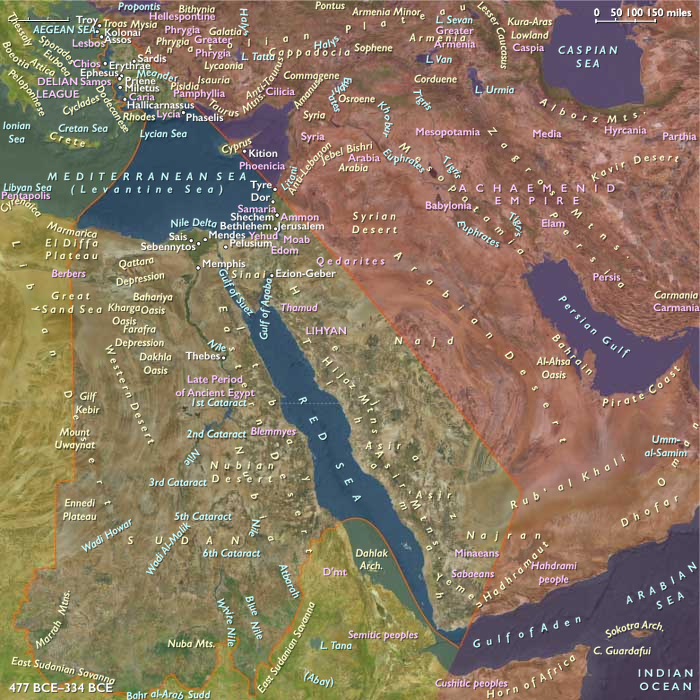
477 BCE to 334 BCE
Separate sources and multiple authors underlie the Pentateuch but there is much disagreement among modern scholars on how these sources were used to write the first five books of the Bible.
The explanation called the documentary hypothesis will dominate much of the twentieth century, but the twentieth century consensus surrounding this hypothesis will break down in the twenty-first century.
Those who uphold it now tend to do so in a strongly modified form, giving a much larger role to the redactors (editors), who are now seen as adding much material of their own rather than as simply passive combiners of documents.
The Jahwist, also referred to as the Jehovist, Yahwist, or simply as J, is one of the sources of the Torah.
It gets its name from the fact that it characteristically uses the term Yahweh (more accurately, YHWH) for God in the book of Genesis.
In most English Bibles it is replaced with "the LORD", or sometimes "GOD", but in fact it is simply God's name.
Drawing heavily on Mesopotamian tradition, “J” traces the gradual expansion of humankind and the development of human culture as well as humankind’s growing alienation from God and one another.
It will be believed in the first half of the twentieth century that the Yahwist could be dated to about 950 BCE, but later study will demonstrate that J could not be earlier than the seventh century.
Current theories place it in the exilic and/or post-exilic period (sixth to fifth centuries BCE), but the date and even the existence of J are currently the subject of vigorous discussion.
Another source, from the northern kingdom, Israel, begins to be woven into the Pentateuch (historians will call it "Ephraim," or the book of "E").
The Elohist (E) is one of four sources of the Torah described by the Documentary Hypothesis.
Its name comes from the term it uses for God: Elohim; it is characterized by, among other things, an abstract view of God, using "Horeb" instead of "Sinai" for the mountain where Moses received the laws of Israel, and the use of the phrase "fear of God".
Its habit of locating ancestral stories in the north, especially Ephraim, and the Documentary Hypothesis holds that it must have been composed in that region, possibly in the second half of the ninth century BCE.
Recent reconstructions leave out the Elohist altogether, proposing a DJP sequence written from the reign of Josiah into post-exilic times.
The Priestly Source (P) is primarily a product of the post-Exilic period when Judah was a province of the Persian empire (in the fifth century BCE).
It was written to show that even when all seemed lost, God remained present with Israel.
Its characteristics include a set of claims that are contradicted by non-Priestly passages and therefore uniquely characteristic: no sacrifice before the institution is ordained by God at Sinai, the exalted status of Aaron and the priesthood, and the use of the divine title El Shaddai before God reveals his name to Moses, to name a few.
The most significant revisions made by those who reject the documentary approach altogether have been to combine E with J as a single source, and to see the Priestly source as a series of editorial revisions to that text.
Groups
Topics
Subjects
Regions
The Near and Middle East
View →Subregions