Monet begins a series of Water Garden…
1899 CE
Monet begins a series of Water Garden paintings.
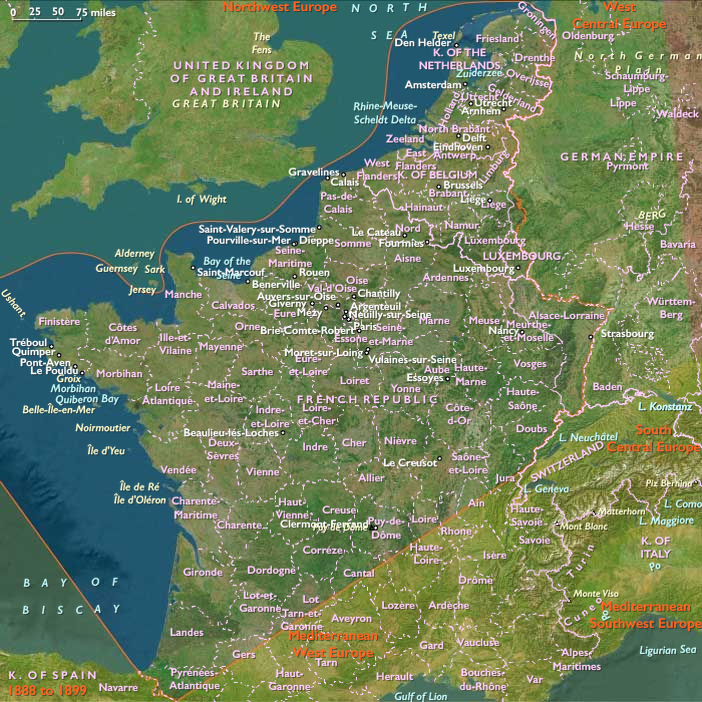
Monet had rented and eventually purchased a house and gardens in Giverny.
At the beginning of May 1883, Monet and his large family had rented the home and two acres (0.81 hectares) from a local landowner.
The house is situated near the main road between the towns of Vernon and Gasny at Giverny.
There is a barn that doubles as a painting studio, orchards and a small garden.
The house is close enough to the local schools for the children to attend, and the surrounding landscape offers many suitable motifs for Monet's work.
The family has worked and built up the gardens, and Monet's fortunes hadbegun to change for the better as his dealer, Paul Durand-Ruel, had increasing success in selling his paintings.
By November 1890, Monet was prosperous enough to buy the house, the surrounding buildings and the land for his gardens.
During the 1890s, Monet has built a greenhouse and a second studio, a spacious building well lit with skylights.
Monet writes daily instructions to his gardener, precise designs and layouts for plantings, and invoices for his floral purchases and his collection of botany books.
As Monet's wealth grows, his garden evolves.
He remains its architect, even after he hires seven gardeners.
Monet had purchased additional land with a water meadow.
In 1893 he began a vast landscaping project which included lily ponds that wil become the subjects of his best-known works.
White water lilies local to France are planted along with imported cultivars from South America and Egypt, resulting in a range of colors including yellow, blue and white lilies that turn pink with age.
In 1899 he begins painting the water lilies, first in vertical views with a Japanese bridge as a central feature, and later in the series of large-scale paintings that is to occupy him continuously for the next twenty years of his life.
Images

Claude Monet Claude Monet: White Water Lilies (1899); oil on canvas 89 cm (35 ″) x 93 cm (36.6 ″); Pushkin Museum of Fine Arts.
Locations
Subjects
Regions
West Europe
View →Subregions