
The Struggle for Montlhéry and Its Absorption…
1118 CE
The Struggle for Montlhéry and Its Absorption into the Royal Domain (1118 CE)
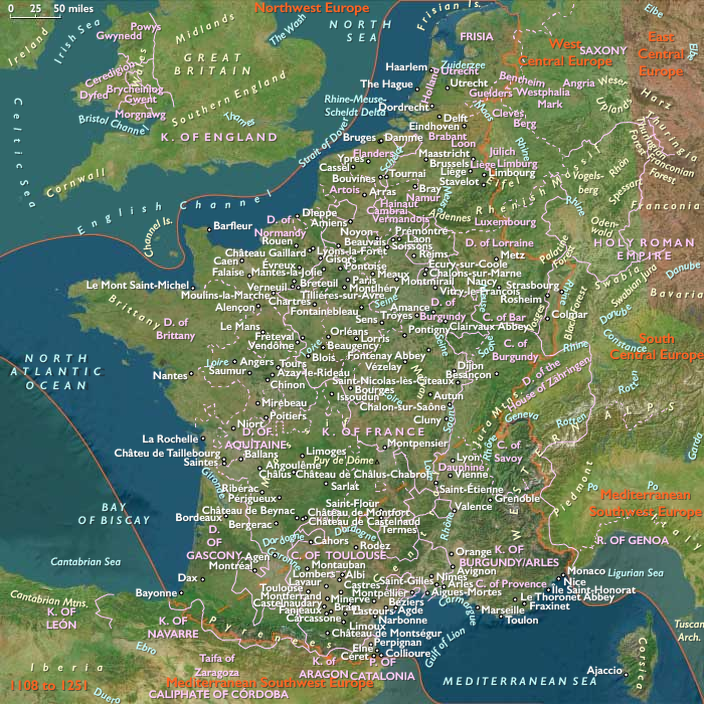
Montlhéry, a strategically significant stronghold on the road between Paris and Orléans, had long been a contested site between the Capetian monarchy and the local nobility. By 1118, the town and its fortress had played a pivotal role in several feudal conflicts, culminating in its absorption into the royal domain under King Louis VI of France.
The Lords of Montlhéry and Their Crusader Legacy
- Montlhéry was originally a Gallic settlement, later Romanized as Mons Aetricus, before passing into Merovingian and Carolingian ecclesiastical control.
- Under the Capetians, Montlhéry became a center of noble resistance, frequently opposing royal authority.
- The House of Montlhéry, founded by Thibaud (r. 970–1031), was deeply connected to the Montmorency family and the Crusader States:
- Melisende of Montlhéry married Hugh, Count of Rethel, making her the mother of King Baldwin II of Jerusalem.
- Elizabeth of Montlhéry married Joscelin of Courtenay, linking Montlhéry to the County of Edessa.
- These alliances placed Montlhéry at the heart of Crusader nobility, ensuring its influence extended far beyond France.
Milo II’s Revolt and the Struggle for Montlhéry
By the early 12th century, Montlhéry had passed to Milo II, who had:
- Previously held Bray-sur-Seine in Champagne before claiming Montlhéry in 1105.
- Attacked his brother's castle, attempting to seize control, but was repelled when Louis VI arrived to relieve the siege.
- Gained the lordship of Montlhéry in 1113, when Louis VI sided with him over his cousin Hugh of Crécy, but later rebelled against the king alongside Theobald IV of Blois.
Milo’s rebellion deepened his ties to the House of Blois:
- He married Adela of Blois, daughter of Count Stephen of Blois and Adela of Normandy, in a treaty orchestrated by her widowed mother.
- This alliance temporarily strengthened his position, as he was made Viscount of Troyes.
- However, the marriage ended in divorce in 1115, weakening his political standing.
The Assassination of Milo II and the Royal Seizure of Montlhéry (1118 CE)
In 1118, Milo’s cousin and rival, Hugh of Crécy, seeking revenge for the loss of Montlhéry, had him assassinated. This destabilized the local power structure, providing Louis VI with an opportunity to intervene decisively.
- Louis incorporated Montlhéry into the royal domain, eliminating it as an independent noble power base.
- He ordered the dismantling of the castle, preventing future rebellions from the fortress.
- The town was transformed into a royal residence, strengthening Capetian control over the Paris-Orléans route.
After its absorption into the royal domain, Montlhéry became part of the territory governed by the Viscount of Paris, further solidifying Capetian authority in the Île-de-France.
Significance of Montlhéry’s Fall
- Royal Consolidation – The seizure of Montlhéry was part of Louis VI’s broader effort to curb the power of feudal lords and extend Capetian royal control.
- End of a Rebel Stronghold – The Montlhéry family had been a persistent threat to the monarchy; its absorption eliminated a key center of resistance.
- Strategic Importance – Controlling Montlhéry ensured safe passage between Paris and Orléans, strengthening the Capetian heartland.
Montlhéry’s incorporation into the Capetian royal domain marked another step in Louis VI’s long campaign to consolidate royal power, reinforcing his emerging authority over the feudal aristocracy.
Locations
Topics
Commodities
Subjects
Regions
West Europe
View →Subregions
