
Saint-Domingue's flourishing economy is based on slavery. …
Years: 1684 - 1827
Saint-Domingue's flourishing economy is based on slavery.
The first African slaves had been brought from Portugal and Spain, but by 1513, shipping lines had been established exclusively for slaving, and its victims were imported directly from Africa.
Although most of the slaves come from West Africa, their origins are diverse, representing at least thirty-eight regions in Africa and one hundred tribes.
With time, Saint-Domingue becomes the principal slave-importing island in the West Indies.
According to historian Moreau de St. Mery, who writes in 1797, based on census figures there are four hundred and fifty-two thousand slaves in Saint-Domingue in 1789 out of a total population of five hundred and twenty thousand— the remainder consists of forty thousand whites and twenty-eight thousand affranchis (free men and women of color) or descendants of affranchis.
Between 1764 and 1771, ten thousand to fifteen thousand new slaves arrive in Saint-Domingue annually, while countless others die at sea en route.
Most who survive the crossing subsequently perish in Saint-Domingue, some because of the island's tropical heat, humidity, and diseases, and others as the result of brutal treatment by plantation owners.
Statistics show that there is a complete turnover of slaves every twenty years.
Two-thirds of all the slaves in the colony in 1789 had been born in Africa.
Locations
Groups
- French people (Latins)
- Spaniards (Latins)
- Spain, Habsburg Kingdom of
- France, (Bourbon) Kingdom of
- Saint Domingue, French Colony of
- Santo Domingo, Captaincy General of
Topics
Commodoties
Subjects
Regions
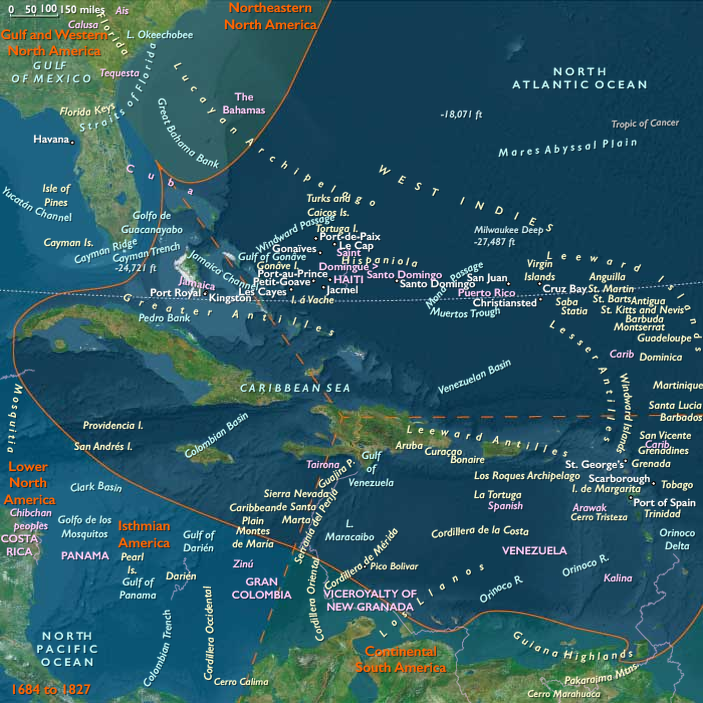
Subregions
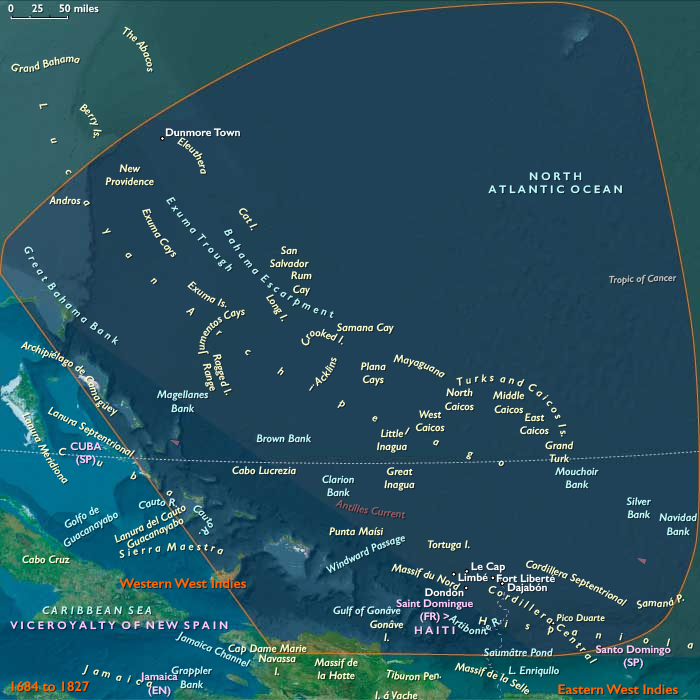
Years: 1684 - 1827
Locations
Groups
- French people (Latins)
- Spaniards (Latins)
- Spain, Habsburg Kingdom of
- France, (Bourbon) Kingdom of
- Saint Domingue, French Colony of
- Santo Domingo, Captaincy General of
Topics
Commodoties
Subjects
Regions
Subregions