
The Persian occupation of Egypt ends when …
Years: 333BCE - 190BCE
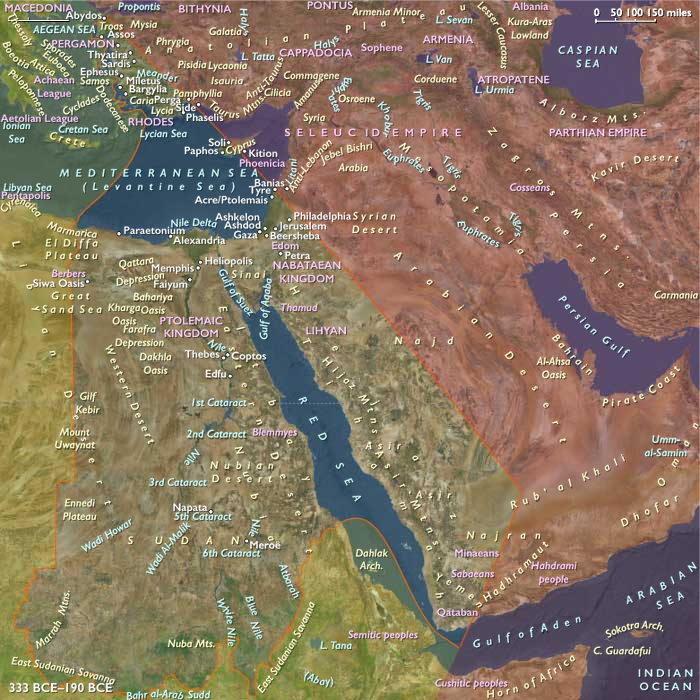
The Persian occupation of Egypt ends when Alexander the Great defeats the Persians at the Battle of Issus (near present-day Iskenderun in Turkey) in November 333 BCE.
The Egyptians, who despise the monotheistic Persians and chafe under Persian rule, welcome Alexander as a deliverer.
In the autumn of 332 BCE Alexander enters Memphis, where, like a true Hellene, he pays homage to the native gods and is apparently accepted without question as king of Egypt.
Also like a true Hellene, he celebrates the occasion with competitive games and a drama and music festival at which some of the leading artists of Greece are present.
From Memphis, Alexander marches down the western arm of the Nile and founds the city of Alexandria.
He next goes to the oasis of Siwa (present-day Siwah) to consult the oracle at the Temple of Amun, the Egyptian god whom the Greeks identify with their own Zeus.
After Alexander's death of malarial fever in 323 BCE, the Macedonian commander in Egypt, Ptolemy, who is the son of Lagos, one of Alexander's seven bodyguards, manages to secure for himself the satrapy (provincial governorship) of Egypt.
Another of Alexander's generals, Antigonus, citing the principle that the empire Alexander created should remain unified, takes the royal title in 306 BCE.
In reaction, his rivals for power, Ptolemy of Egypt, Cassander of Macedonia, and Seleucus of Syria, counter by declaring themselves kings of their respective dominions.
Thus comes into existence the three great monarchies that are to dominate the Hellenistic world until they are absorbed, one by one, into the Roman Empire.
The dynasty Ptolemy founds in Egypt is known as the line of Ptolemaic pharaohs and will endure until the suicide of Cleopatra in 30 BCE, at which time direct Roman control will be instituted.
The early Ptolemies are hardheaded administrators and business people, anxious to make the state that they have created stable, wealthy, and influential.
The Ptolemies have their eyes directed outward to the eastern Mediterranean world in which they seek to play a part.
Egypt is their basis of power, their granary, and the source of their wealth.
Under the early Ptolemies, the culture is exclusively Greek.
Greek is the language of the court, the army, and the administration.
The Ptolemies found the university, the museum, and the library at Alexandria and build the lighthouse at Pharos.
A canal to the Red Sea is opened, and Greek sailors explore new trade routes.
Whereas many Egyptians adopt Greek speech, dress, and much of Greek culture, the Greeks also borrow much from the Egyptians, particularly in religion.
In this way, a mixed culture is formed along with a hybrid art that combines Egyptian themes with elements of Hellenistic culture.
Examples of this are the grandiose temples built by the Ptolemies at Edfu (present-day Idfu) and Dendera (present-day Dandarah).
Locations
People
Groups
- Egyptians
- Polytheism (“paganism”)
- Persian people
- Greeks, Classical
- Egypt (Ancient), Late Period of
- Zoroastrians
- Achaemenid, or First Persian, Empire
- Alexander, Empire of
- Egypt, Alexandrine
- Greeks, Hellenistic
- Egypt, Ptolemaic Kingdom of
Topics
Commodoties
Subjects
Regions
Subregions
Related Events
Showing 9 events out of 9 total
Years: 333BCE - 190BCE
Locations
People
Groups
- Egyptians
- Polytheism (“paganism”)
- Persian people
- Greeks, Classical
- Egypt (Ancient), Late Period of
- Zoroastrians
- Achaemenid, or First Persian, Empire
- Alexander, Empire of
- Egypt, Alexandrine
- Greeks, Hellenistic
- Egypt, Ptolemaic Kingdom of
Topics
Commodoties
Subjects
Regions
Subregions