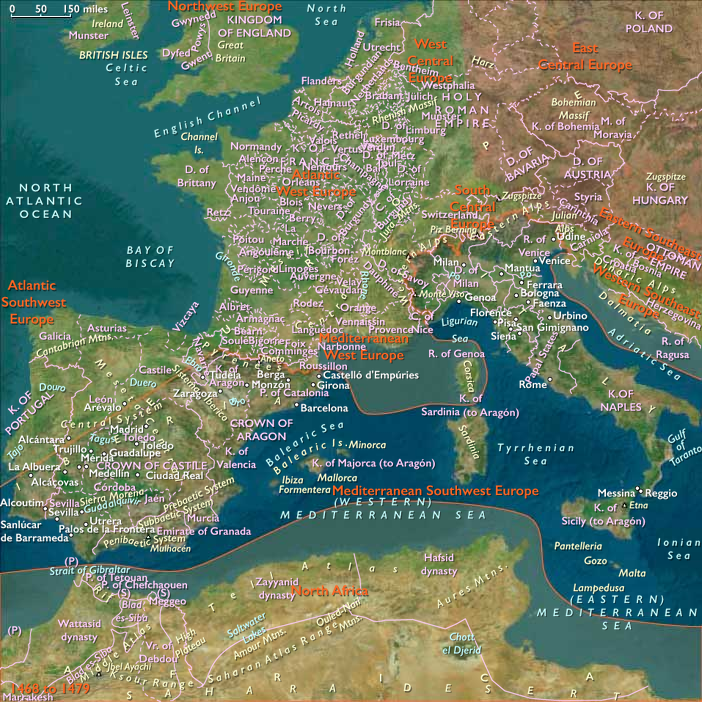
Much of Albania had been lost to …
Years: 1475 - 1475
Much of Albania had been lost to the Ottomans after Skanderbeg's death.
However, the heroic resistance of Scutari under Antonio Loredan had forced the Ottomans to retire from Albania, while a revolt in Cyprus had given back the island to the Cornaro family and, subsequently, to Venice in 1473.
The Serenissima’s prestige seems reassured, but Scutari falls anyway two years later, and Friuli is again invaded and ravaged.
Locations
People
Groups
- Venice, (Most Serene) Republic of
- Karamanids
- Ag Qoyunlu (White Sheep Turks), (Turkmen) Emirate of the
- Ottoman Empire
Topics
Commodoties
Subjects
Subregions
Related Events
Filter results
Showing 10 events out of 40831 total
Prince Isaac of Theodroro, the final rump state of the Eastern Roman Empire, had engaged in a rapprochement with the Genoese at Caffa in the face of the mounting Ottoman danger, and has wed his sister Maria Asanina Palaiologina to Stephen the Great, ruler of Moldavia.
His increasingly pro-Ottoman stance in later years, however, leads to his overthrow by his brother Alexander, with Stephen’s backing.
This comes too late to save Theodoro: Gedik Ahmed Pasha, who also fought against Venetians in the Mediterranean, is dispatched in 1475 by the Sultan to aid the Crimean Khanate against Genoese forces.
He conquers Caffa, Soldaia, Cembalo and other Genoese castles as well as the Principality of Theodoro, after a three-month siege of its capital, Mangup.
Alexander and his family are taken captive to Constantinople, where the prince is beheaded, his son is forcibly converted to Islam, and his wife and daughters become part of the Sultan's harem.
Gedik Ahmed Pasha also rescues the Khan of Crimea, Meñli I Giray, from Genoese forces.
As a result of this campaign, Crimea and Circassia enter into the Ottoman sphere of influence.
The Crimean Khanate originated in the early fifteenth century when certain clans of the Golden Horde Empire ceased their nomadic life in the the Kipchak Steppes of today's Ukraine and southern Russia and decided to make Crimea their yurt (homeland).
At that time, the Golden Horde of the Mongol empire had governed the Crimean peninsula as an ulus since 1239, with its capital at Qirim (Staryi Krym).
The local separatists had invited a Genghisid contender for the Golden Horde throne, Hacı Giray, to become their khan.
Accepting their invitation, Hacı Giray had traveled from exile in Lithuania and warred for independence against the Horde from 1420 to 1441, in the end achieving success.
He then had to fight off internal rivals before he could ascend the throne of the khanate in 1449, after which he moved its capital to Qırq Yer (today part of Bahçeseray).
The khanate includes the Crimean Peninsula (except the south and southwest coast and ports, controlled by the Republic of Genoa) as well as the adjacent steppe.
Following the death of Hacı I Giray in 1466, his sons have contended against each other to succeed him.
The Ottomans had intervened and installed one of them, Meñli I Giray, on the throne for some months until he was deposed by his brother Nur Devlet.
Meñli had been restored to the throne in January 1469, but loses power again in March 1475 as a result of a rebellion of the rival brothers and nobility.
In 1475 the Ottoman forces, under the command of Gedik Ahmet Pasha, conquer the Greek Principality of Theodoro and the Genoese colonies at Cembalo, Soldaia, and Caffa (modern Feodosiya).
The Empire annexes the Crimean coast, but recognizes the legitimacy of the khanate rule of the steppes, as the khans are descendants of Genghis Khan.
Henceforth the khanate is a protectorate of the Ottoman Empire.
The Ottoman sultan will wield veto power over the selection of new Crimean khans.
Menli I Giray, now become a vassal of the sultan, takes the imperial title "Sovereign of Two Continents and Khan of Khans of Two Seas."
Ottoman scouts report to Suleiman that there are untouched villages near Vaslui, and the Ottomans head for that region.
The winter makes it difficult to set camp, which forced the Ottomans to move quickly and head for the Moldavian capital, Suceava.
In order to reach Vaslui, where the Moldavian army had its main camp, they need to cross Podul Înalt over the Bârlad River.
The bridge is made of wood and not suitable for heavy transportation of troops.
Stephen chooses this area for the battle—the same location where his father, Bogdan II, had defeated the Poles in 1450; and where he, at seventeen, had fought side-by-side with Vlad 'the Impaler'.
The area is ideal for the defenders: the valley is a semi-oval surrounded on all sides by hills covered by forest.
Inside the valley, the terrain is marshy, which restricts troop movement.
Suleiman has full confidence in his troops and makes few efforts to scout the area.
The battle begins on the rainy morning of January 10.
The weather is frigid, and a dense fog limits vision.
The Ottoman troops are exhausted.
Stephen fortifies the bridge, while setting and aiming his cannons at the structure.
Peasants and archers are hidden in the forest, together with their Prince and his boyar cavalry.
The Moldavians make the first move by sending musicians to the middle of the valley.
The sound of drums and bugles makes Suleiman think that the entire Moldavian army awaits him there.
Instead, the center of the valley holds the Székely forces and the Moldavian professional army, which have been instructed to make a slow retreat when they encountered the enemy.
Suleiman orders his troops to advance and, when they make enough progress, the Moldavian artillery startd to fire, followed by archers and handgunners firing from three different directions.
The archers cannot see the enemy for the fog, and, instead, have to follow the noise of their footsteps.
The Moldavian light cavalry then helps to lure the Ottoman troops into the valley by making hit-and-run attacks.
Ottoman cavalry try to cross the wooden bridge, causing it to collapse Those Ottoman soldiers who have managed to survive the attacks from the artillery and the archers, and who have not become caught in the marshes, have to confront the Moldavian army, together with the Székely soldiers further up the valley.
The five thousand Székely soldiers are successful in repelling the seven thousand Ottoman infantrymen.
They then make a slow retreat, as instructed by Stephen, but are later routed by the Ottoman sipahi, while the remaining Ottoman infantry attacks the Moldavian flanks.
Suleiman tries to reinforce his offensive, not knowing what had happened in the valley, but then Stephen, with the full support of his boyars, orders a major assault.
All his troops, together with peasants and heavy cavalry, attack from all sides.
Simultaneously, Moldavian buglers concealed behind Ottoman lines start to sound their bugles, and in great confusion some Ottoman units change direction to face the sound.
When the Moldavian army hits, Suleiman loses control of his forces.
He desperately tries to regain control, but is later forced to signal a retreat.
The battle lasts for four days; with the last three days seeing the fleeing Ottoman army being pursued by the Moldavian light cavalry and the two thousand-strong Polish cavalry until they reach the town of Obluciţa (now Isaccea, Romania), in Dobruja.
The Ottoman casualties are counted as forty-five thousand including four Pashas killed and a hundred standards taken.
Jan Długosz writes that "all but the most eminent of the Turkish prisoners are impaled", and their corpses burned.
Only one is spared—the only son of the Ottoman general Isaac Bey, of the Gazi Evrenos family, whose father had fought with Mircea the Old.
Another Polish chronicler reported that on the spot of the battle huge piles of bones rested upon each other, next to three immured crosses.

The Wallachians had fled the field without joining battle and Laiotă now turns his sword against the Turks, who had hoped for a safe passage in Wallachia; on January 20, he exits his castle and confronts some of the Turks that are lurking on his land.
He takes one of their flags and sends it to a Hungarian friend as proof of his bravery.
After the battle, Stephen sends four of the captured Turkish commanders, together with thirty-six of their standards and abundant booty, to King Casimir, and implores him to provide troops and money to support the Moldavians in the struggle against the Ottomans.
He also sends letters and a few prisoners and Turkish standards to the Pope and Hungarian King Matthias Corvinus, asking for support.
The Pope's reply to Stephen denies him help, but awards him with the "Athleta Christi", while King Casimir pleads poverty and does nothing; his own men then accuse him of sloth, and advise him to change his shameful behavior or hand over his rule to someone else.
Uzun Hasan of Ak Koyunlu tries to create a new coalition with the European powers, arguing that Mehmed's best troops had been lost at Vaslui.
Mehmed, upon hearing of the devastating defeat, refuses for several days to give audience to anyone; his other plans of expansion are put to rest as he plans revenge on Stephen.
Kasım has allied himself with Republic of Venice, and with the help of Venetian navy, he had briefly been able to keep Silifke and the Mediterranean coast of the beylik.
However, following the campaigns of Gedik Ahmed Pasha of the Ottoman Empire, he loses all of his possessions in 1475.
The Ottoman Turks, having knocked the Ak Koyunlu Turkmen confederation out of the Venetian-Turkish war in 1473, overrun Albania and raid the outskirts of core Venetian territory.
John had returned to Barcelona triumphant, but had failed to raise the necessary funds.
In the summer of 1474 the French had conquered Roussillon and March 1475 Perpignan falls to them.
Antonello da Messina, schooled in the Flemish tradition (although, in all likelihood, he never leaves Italy) introduces oil painting to Venice when working there in 1475-76.
His works of this period begin to show a greater attention to the human figure, regarding both anatomy and expressivity, indicating the influence of Piero della Francesca and Giovanni Bellini.
His most famous pictures from this period include the Condottiero (Louvre), the San Cassiano Altarpiece and the St. Sebastian.
The San Cassiano Altarpiece is especially influential on Venetian painters, as it is one of the first of the large compositions in the sacra conversazione format, which is perfected by Giovanni Bellini (Antonello's surviving work in Vienna is only a fragment of a much larger original).
While in Venice he is offered, but does not accept, the opportunity to become the court portrait painter to the Duke of Milan.
His Crucifixion, painted in 1475, displays, like his earlier Salvator Mundi, the influence on Antonello of Netherlandish painting, this time in landscape.
Years: 1475 - 1475
Locations
People
Groups
- Venice, (Most Serene) Republic of
- Karamanids
- Ag Qoyunlu (White Sheep Turks), (Turkmen) Emirate of the
- Ottoman Empire