
Muhammad, after Abu Sufyan’s departure, had immediately…
630 CE
Muhammad, after Abu Sufyan’s departure, had immediately ordered the assembly of a large army.
The objective of the operation is kept secret and even Muhammad's close friends and commanders do not know his plans.
Muhammad intends to assemble and attack the Quraysh using the element of surprise.
For further secrecy, Muhammad sends Abu Qatadah towards "Batan Izm" to give the impression that he wanted to go there.
The Muslim army sets out for Mecca on Wednesday, November 29, 630.
Volunteers and contingents from allied tribes joins the Muslim army on the way, swelling its size to about ten thousand strong.
This is the largest Muslim force ever assembled.
The army stays at Marr-uz-Zahran, located ten miles northwest of Mecca.
Muhammad orders every man to light a fire so as to make the Meccans overestimate the size of the army.
Meanwhile, Abu Sufyan travels back and forth between Mecca and Muhammad, still trying to reach a settlement.
Mecca lies in the Valley of Ibrahim, surrounded by black rugged hills reaching heights of one thousand feet (three hundred meters) at some places.
There are four entry routes through passes in the hills.
These are from the northwest, the southwest, the south, and the northeast.
Muhammad divides the Muslim army into four columns: one to advance through each pass.
The main column in which Muhammad is present, commanded by Abu Ubaidah ibn al Jarrah, is tasked to enter Mecca through the main Madina route, from the northwest near Azakhir.
Muhammad’s cousin Az Zubayr commands the second column and it will enter Mecca from the southwest, through a pass west of Kuda hill.
The column entering from the south through Kudai is under the leadership of Muhammad’s cousin Ali.
The last column, under Khalid ibn al-Walid, is tasked to enter from the northeast, through Khandama and Lait.
Their tactic is to advance simultaneously from all sides targeting a single central objective.
This will lead to the dispersion of enemy forces and prevent their concentration on any one front.
Another important reason for this tactic is that even if one or two of the attacking columns face stiff resistance and become unable to break through, then the attack can continue from other flanks.
This will also prevent any of the Quraysh from escaping.
Muhammad emphasizes on refraining from fighting unless Quresh attacks.
The Muslim army enters Mecca on Monday, December 11, 630.
The entry is peaceful and bloodless on three sectors except for that of Khalid’s column.
Such hardened anti-Muslims as Ikrimah ibn Abi-Jah and Abu Sufyan gather a band of Quraysh fighters and face Khalid’s column.
The Quraysh attack the Muslims with swords and bows, and the Muslims charge the Quraysh positions.
After a short skirmish, the Quraysh give ground after losing twelve men.
Muslim losses are two warriors.
On the eve of the conquest, Abu Sufyan adopts Islam.
When asked by Muhammad, he concedes that the Meccan gods had proved powerless and that there is indeed "no god but Allah", the first part of the Islamic confession of faith.
His son twenty-eight-year-old son Muawiyah also converts.
In turn, Muhammad declares Abu Sufyan's house a sanctuary because he is the present chief, and that all the others are gathered over his territory.
He magnanimously accepts the Quraysh’s offer of surrender with a promise of general amnesty.
However, he orders ten people to be killed, including four women who had been guilty of murder or other offenses or had sparked off the war and disrupted the peace.
However, they were not all killed; Ikrimah lives to adopt Islam and fight in future battles among the Muslim ranks.
Ibn Abi Sarh had been granted protection under his foster brother Uthman ibn Affan, and when he initially refuses to take the mandatory oath of allegiance to Muhammad, the bystanders still do not kill him, much to the regret of Muhammad.
Of the two singing girls who were condemned by Muhammad, one is slain but the other spared because she converts to Islam.
People
Topics
Commodities
Subjects
Regions
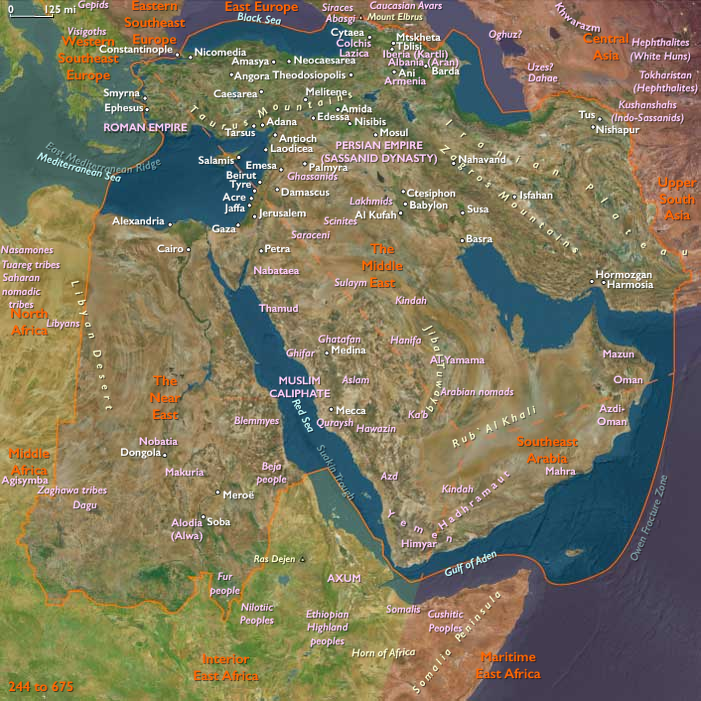
The Near and Middle East
View →Subregions
