"Mycenaean", the term for the civilization that…
1629 BCE to 1486 BCE
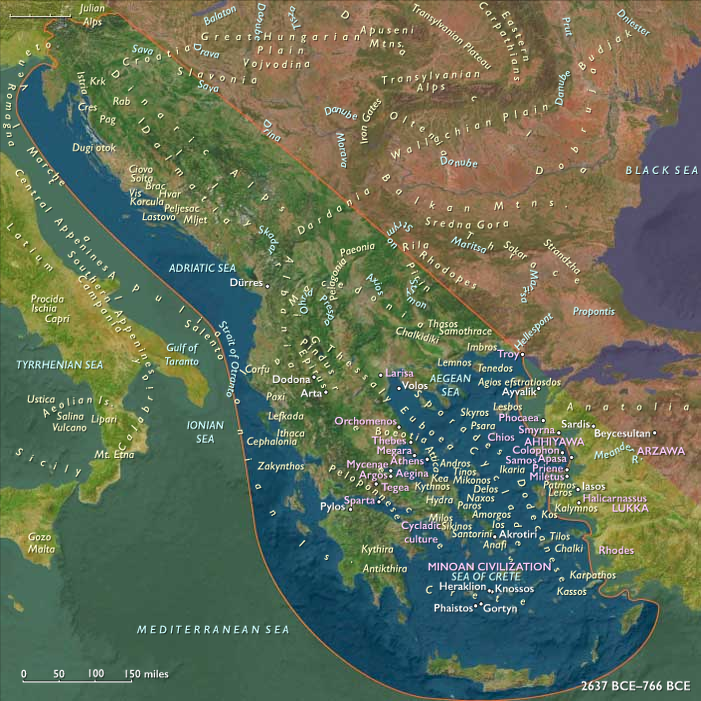
"Mycenaean", the term for the civilization that takes root on the Greek mainland in the eastern Peloponnesus, is named after the first major archaeological site where this culture was identified.
The Mycenaeans, an Indo-European group, are the first speakers of the Greek language.
They may have entered Greece at the end of the early Bronze Age, in the middle Bronze Age, or in the Neolithic period.
The influence of the Minoan civilization outside Crete manifests itself in the presence of valuable Minoan handicraft items on the Greek mainland.
It is likely that the ruling house of Mycenae is connected to the Minoan trade network.
The material culture on the Greek mainland after around 1700 BCE achieves a new level due to Minoan influence.
The proto-Greeks have by around 1630 begun to encroach upon the domains of the mainland Pelasgians and the Minoans on Crete. (Most scholars place both the Pelasgians and the Minoans in the Hittite group. The Pelasgi—a name used only by ancient Greeks—will later be mentioned as a specific people by several Greek authors, including Homer, Herodotus, and Thucydides, and were said to have inhabited various areas, such as Thrace, Argos, Crete, and Chalcidice. The surviving villages apparently preserved a common non-Greek language in the fifth century BCE.)
Mycenaean civilization begins to evolve on mainland Greece.
The newcomers have by the end of the seventeenth century taken their full place on a newly emerging international scene and are always to be in a special relation with the Cycladic islands, Crete, and, probably, Troy.
The period of Greek history from about 1600 BCE to about 1100 BCE is called Mycenaean in reference to Mycenae, which becomes the most important center of Aegean civilization.
Mycenae, located about ninety kilometers southwest of Athens, in the northeastern Peloponnesus, in the second millennium BCE becomes one of the major centers of Greek civilization, a military stronghold that dominates much of southern Greece.
Only scattered sherds from disturbed debris have been found datable to the period before about 3500 BCE; the site was inhabited but the stratigraphy has been destroyed by later construction.
It is believed that Indo-Europeans who practiced farming and herding settled Mycenae close to 2000 BCE.
Scattered sherds have been found from this period, 2100 BCE to 1700 BCE.
The first burials in pits or cist graves had begun to the west of the acropolis at about 1800-1700 BCE.
The earliest circuit wall at least partially enclosed the acropolis.
Since the translation of the Linear B tablets, it has been known that the people incorrectly called Mycenaeans were Greeks.
Linguistic analysis of Linear B texts ties the Mycenaean language to the Ionian, Attic, and Aeolian dialects of subsequent ages.
Although Greeks built the citadel, the name, reconstructed as Mukanai, is not thought to be Greek, but is rather one of the many pre-Greek place names the immigrant Hellenes inherited.
Its situation on a hill dominating the Argive plain and the pass to Corinth in the eastern Peloponnesus probably contributes to Mycenae's rise to wealth and prominence from about 1600, when the city becomes the most important center of Aegean civilization on the Greek mainland.
The settlement pattern at Mycenae during the Bronze Age is a fortified hill surrounded by hamlets and estates.
Missing is the dense urbanity present on the coast (such as at Argos).
Since Mycenae is the capital of a state that rules, or dominates, much of the eastern Mediterranean world, the rulers must have placed their stronghold in this less populated and more remote region for its defensive value.
Mycenaean foot soldiers, or hoplites, begin to wear protective equipment consisting of a round shield large enough to hide the body when kneeling, a bronze helmet, a cuirass (breastplate and backplate), and greaves (shin guards).
Minoan culture and associated jewelry styles spread to Mycenaean Greece around 1550.
Bronze knives and gold ornaments are found with some burials, and, by the time of the Mycenae Shaft Graves in the sixteenth century, a luxuriant style of native goldwork has been created.
The excavation of exceptionally wealthy graves, and the size and spacing of palace foundations, indicates that the Mycenaeans of the Late Bronze Age form an elite and a chieftain-level society: one organized around the judicial and executive authority of a single figure, with varying degrees of power.
Mycenaeans bury their royalty in shaft graves accompanied by fabulous gold treasures.
One such treasure, a death mask of beaten gold found over the face of a mummified king, portrays a man with a long, straight nose wearing a full beard and mustache.
Wall paintings in the Cretan style from about 1500 decorate mainland Mycenaean palaces.
Mainland Greek artisans begin to manufacture seals, jewelry, and gold and silver vases barely distinguishable from Cretan examples.
Locations
Groups
Subjects
Regions
Southeast Europe
View →Subregions