Mycenaean Greeks use writing from at least…
1485 BCE to 1342 BCE
Mycenaean Greeks use writing from at least 1400 BCE; records in the Mycenaean Greek language begin in the fourteenth century BCE.
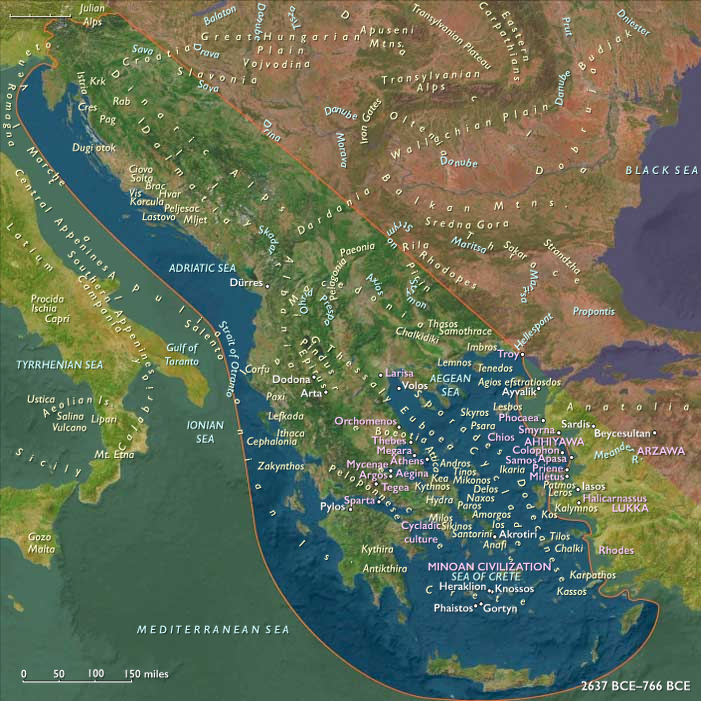
Mycenaeans inscribe tablets in Linear B, a form of Greek with some Semitic and other loanwords, to form the archives of palaces at Pylos, Mycenae, and Tiryns in the Peloponnesus and at Thebes in Boeotia, as well as at Knossos on Crete, where Linear B replaces Linear A.
The tablets list inventories of personnel, livestock, agricultural produce, and manufactured goods such as textiles, storage vessels, furniture, weapons, and chariots.
Of the more than one hundred signs used as abbreviations for these commodities, many are simple pictures, though some have evolved into stylized patterns.
Other tablets deal with landholdings and religious offerings.
The tablets mention several such deities as Zeus, Hera, Poseidon, Athena, Hermes, and Dionysus (along with names unfamiliar to moderns).
It appears that the Mycenaeans use writing not to keep historical records but strictly as a device to register the flow of goods and produce into the palaces from a complex, highly centralized economy featuring regional networks of collection and distribution.
Besides being at the center of such networks, palaces also control craft production and are the seat of political power.
Each palace on the mainland seems to have been an autonomous political entity, but the lack of historical records precludes knowledge about the interaction of the palatial centers.
These small-scale polities stand in marked contrast to the huge contemporaneous states of the Near East.
The great Mycenaean palaces of the mainland, built in the fourteenth century BCE, are enclosed in fortified citadels defended by strong walls.
At a conventional date of 1350 BCE, the fortifications on Mycenae’s acropolis, and other surrounding hills, are rebuilt in a style known as cyclopean because the blocks of stone used were so massive that they were thought in later ages to be the work of the one-eyed giants known as the cyclopes.
Within these walls, much of which can still be seen, successive monumental palaces were built.
The final palace, remains of which are currently visible on the acropolis of Mycenae, dates to the start of LHIIIA:2.
Earlier palaces must have existed, but they had been cleared away or built over.
The construction of palaces at this time with a similar architecture is general throughout southern Greece.
They all feature a megaron, or throne room, with a raised central hearth under an opening in the roof, which is supported by four columns in a square around the hearth.
A throne is placed against the center of a wall to the side of the hearth, allowing an unobstructed view of the ruler from the entrance.
Frescos adorn the plaster walls and floor.
The room is accessed from a courtyard with a columned portico.
A grand staircase leads from a terrace below to the courtyard on the acropolis.
From about 1500, wall paintings in the Cretan style decorate mainland Mycenaean palaces.
Mainland Greek artisans begin to manufacture seals, jewelry, and gold and silver vases barely distinguishable from Cretan examples.
A mixed art—known as Mycenaean, after the principal mainland center—develops throughout the Aegean after 1420 BCE, based on Minoan traditions but more grandiose, less lifelike, and with a greater emphasis on scenes of warfare and hunting.
Archaeological findings in Egypt and the countries bordering the eastern Mediterranean Sea show that the Mycenaeans reached those points.
Nevertheless, the Mycenaeans seemingly are able to avoid entanglement in the conflicts of the superpowers of the eastern Mediterranean, such as the Hittites and the Egyptians.
They are content to be lords of the Aegean for a time.
Mycenaeans of the fifteenth and fourteenth centuries BCE evidently bury their princes in “tholoi,” or tholos tombs, circular, beehive-shaped stone-built chambers with high corbelled vaults.
Locations
Topics
Subjects
Regions
Southeast Europe
View →Subregions