
Slavery, according to the poems of Homer,…
1197 BCE to 1054 BCE
Slavery, according to the poems of Homer, is evidently an integral part of ancient Greek society by 1200.
The Mycenaean citadel of Pylos had counted among its female slaves "Mil[w]atiai,” women from Miletus, in the last stage of LHIIIB, which ended around 1200.
Locations
Groups
Commodities
Subjects
Regions
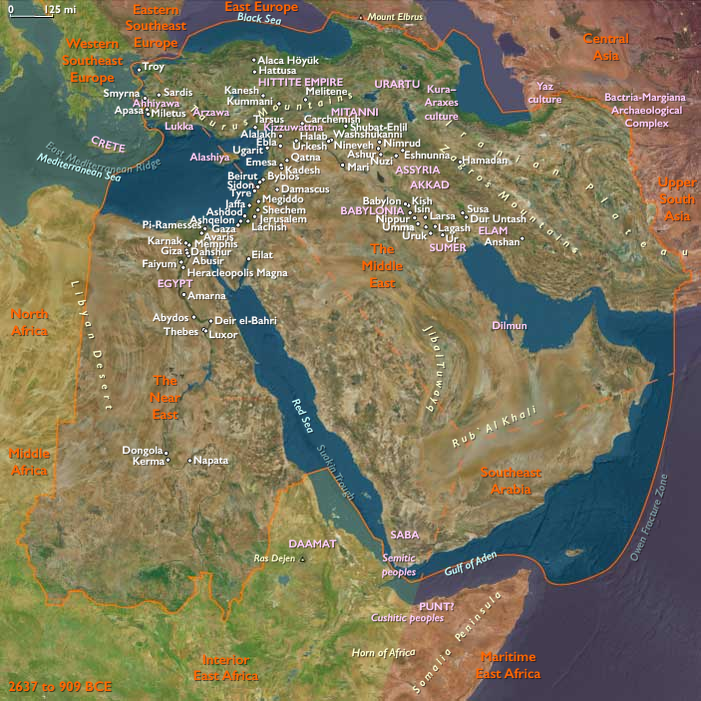
The Near and Middle East
View →Subregions
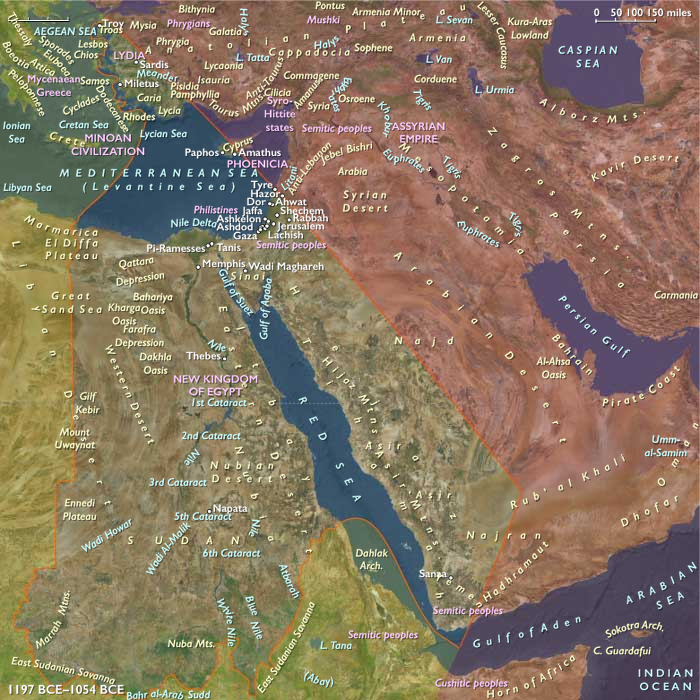
Near East
View →Related Events
Showing 10 events out of 17 total
The first royal judicial body established in New Spain in 1527 is the audiencia of Mexico City.
The audiencia consists of four judges, who also hold executive and legislative powers.
The crown, however, is aware of the need to create a post that will carry the weight of royal authority beyond local allegiances.
Control of the bureaucracy is handed over in 1535 to Antonio de Mendoza, who is named the first viceroy of New Spain (1535-50).
His duties are extensive but exclude judicial matters entrusted to the audiencia.
The Spanish crown awards the followers of Hernán Cortés “encomiendas,” grants of native villages from which they can collect tribute.
These grants give the colonists control over native labor and produce.
Many of the clergy object to the “encomiendas.”
Bartolomé de Las Casas, former encomendero turned missionary, argues vociferously for their suppression.
Bishop Zumárraga, after another year in Spain working for favorable concessions for the Indians, had returned to Mexico in October 1534, accompanied by a number of mechanics and six female teachers for the native girls.
Although finally consecrated, he no longer holds the title of Protector of the Indians, as it is thought that the new auditors will refrain from the abuses of prior regimes.
Pope Adrian VI had on May 9, 1522, issued the bull Exponi nobis fecisti to Charles V, in which he had transferred his own Apostolic authority in all matters to the Franciscans and other mendicant orders when they judged it necessary for the conversion of the natives, except for acts as requiring episcopal consecration.
This provision affected regions where there was no bishop, or where it required two or more days of travel to reach one.
Pope Paul III had confirmed the bull on January 15, 1535.
The bishops had found their authority much limited, and a series of assemblies followed in which Zumárraga with his customary prudence tried to arrive at an understanding with the regulars without openly clashing with them.
Various modifications had been adopted with the consent of the regulars on condition that these "should not impair the privileges of the regulars".
The question therefore remained open.
In 1535, Bishop Zumárraga receives the title and powers of Apostolic Inquisitor of the diocese of Mexico from the Inquisitor General, Álvaro Manrique, Archbishop of Seville, including that of delivering criminals to the secular courts.
He never avails himself of the title and does not establish the tribunal, although he does indict and deliver to the secular courts a lord of Texcoco, known as Don Carlos Ometochtzin Chichimecatecuhtli, accused of having "reverted to idolatry" and of offering human sacrifices.
He also encourages the destruction of native manuscripts and artifacts.
On November 14, 1535, with the arrival of the first viceroy, Antonio de Mendoza, the rule of the new auditors ends.
Mendoza wields authority over every corner of Spain’s American empire, which now includes five provinces: The Islands, New Spain (central Mexico), the just-conquered New Galicia, the partially conquered Guatemala, and the not-even-nominally-pacified Yucatan.
Mendoza forbids future expeditions by the still-ambitious Cortés.
Cabeza de Vaca and his companions had continued through Coahuila and Nueva Vizcaya; then down the Gulf of California coast to what is now Sinaloa, Mexico, over a period of roughly eight years.
Throughout these years, Cabeza de Vaca and the other men had adapted to the lives of the indigenous people they stayed with, whom he will later describe as Roots People, the Fish and Blackberry People, or the Fig People, depending on their principal foods.
During his wanderings, passing from tribe to tribe, Cabeza de Vaca will later report that he had developed sympathies for the indigenous peoples.
He had become a trader and a healer, which had given him some freedom to travel among the tribes.
As a healer, Cabeza de Vaca used blowing (like the Native Americans) to heal, but claimed that God and the Christian cross led to his success.
His healing of the sick has gained him a reputation as a faith healer.
His group attracts numerous native followers, who regard them as "children of the sun", endowed with the power to heal and destroy.
As Cabeza de Vaca grows healthier, he decides that he willl make his way to Pánuco, supporting himself through trading.
He finally decided to try to reach the Spanish colony in Mexico.
Many natives ate said to accompany the explorers on their journey across what is now known as the American Southwest and northern Mexico.
Thus, Cabeza de Vaca, Andrés Dorantes de Carranza, Alonso del Castillo Maldonado, and Esteban (later called Estevanico), have become the first men of Europe and Africa to enter Southwestern North America (present day Southwestern United States and Northwest Mexico).
Their precise route has been difficult for historians to determine, but they apparently traveled across present-day Texas, perhaps into New Mexico and Arizona, and through Mexico's northern provinces near the Pacific Coast before turning inland.
Cabeza de Vaca will later write a narrative entitled Naufragios (Castaways), in which he describes the journey made by these four survivors on foot across the present day southwestern United States and northern Mexico.
This trek has taken eight years.
Numerous researchers have tried to trace his route across the Southwest.
As he did not begin writing his chronicle until back in Spain, he had to rely on memory.
Cabeza de Vaca was uncertain of his route.
Aware that his account has numerous errors in chronology and geography, historians have worked to put together pieces of the puzzle to discern his paths.
In July 1536, near Culiacán in present-day Sinaloa, the survivors encounter fellow Spaniards on a slave-taking expedition for New Spain.
As Cabeza de Vaca will write later, his countrymen are "dumbfounded at the sight of me, strangely dressed and in the company of Indians.
They just stood staring for a long time."
When New Galicia's governor Nuño de Guzmán heard news about the Spanish castaways who had reached land under their jurisdiction, he gives them horses and clothing and sends them to Mexico City to surrender accounts to the Viceroy of New Spain, Antonio de Mendoza.
The Spaniards accompany the survivors to Mexico City, where their story is already known; they are received with great honors.
Mendoza offers Dorantes a position leading a new expedition, but Dorantes refuses and instead makes plans to return to Spain.
Dorantes sells Estevanico to the Viceroy.
However, when he is preparing to leave, his ship is pronounced unfit to sail, forcing him to return to the port of Veracruz.
After this, Dorantes will never leave New Spain again; he will die in the 1550s.
Estevanico will later serve as a guide for other expeditions.
Alonso del Castillo will marry in Mexico and become the beneficiary of the encomienda of his wife in Tehuacan, Puebla.
As "comendero" he wins a quarter of the income of Tehuacan.
Cabeza de Vaca will return in 1527 to Spain, where he will write a full account, especially describing the many indigenous peoples they had encountered.
He will later serve the colonial government in South America.
The number of baptized Indians in Mexico in 1536 was five million according to Fray Toribio de Benavente Motolinia.
The multitude of Indians who have asked for baptism, said to have greatly increased after the apparition of Our Lady of Guadalupe in 1531, had forced the missionaries to adopt a special form for administering this sacrament.
The catechumens are arranged in order, with children in front.
Prayers are recited in common over all, salt, saliva, etc., applied to a few, and then water is poured on the head of each without using the customary holy oils or chrism.
The practice faced no opposition while the Franciscans were in charge of the missions, but as soon as members of other religious orders and some secular ecclesiastics arrived, doubt began to be cast upon the validity of these baptisms.
To put an end to the dispute Bishop Zumárraga has submitted the case to Rome, and on June 1, 1537, Pope Paul III issues the bull Altitudo divini consilii, which declares that the friars had not sinned in administering baptism in this form, but decrees that in the future it should not be thus administered except in cases of urgent need.
Another difficulty had arisen regarding marriage.
The pre-Columbian religions had permitted polygamy and the taking of concubines, and when Natives were converted the question arose as to which were legitimate wives and which were concubines, and whether any of the marriages had been valid at all.
The Franciscans know that certain rites are observed for certain unions, and that in some cases where separation or divorce is desired, it is necessary to obtain the consent of the authorities, while in other cases the consent of the interested parties suffices.
These customs, they argue, mean that there are valid marriages among the Indians.
Others deny that this was the case.
Bishop Zumárraga had taken part in all these discussions until the case was submitted to the Holy See.
Pope Paul III decrees in the Altitudo that the converted Indians should keep the first woman wed as their wife.
Francisco Vázquez de Coronado was born into a noble family in Salamanca, Spain, in 1510 as the second son of Juan Vázquez de Coronado y Sosa de Ulloa and Isabel de Luján.
His father had held various positions in the administration of the recently captured Emirate of Granada under Iñigo López de Mendoza, its first Spanish governor.
Coronado had gone to New Spain in 1535 at about age twenty-five, in the entourage of its first Viceroy, Antonio de Mendoza, the son of his father's patron and Coronado's personal friend.
In New Spain, he has married Beatriz de Estrada, called "the Saint" (la Santa), sister of Leonor de Estrada, ancestor of the de Alvarado family and daughter of Treasurer and Governor Alonso de Estrada y Hidalgo, Lord of Picón, and wife Marina Flores Gutiérrez de la Caballería, from a converso Jewish family.
Coronado has inherited a large portion of a Mexican estate from Beatriz and will have eight children by her.
Coronado is from 1538 the Governor of the Kingdom of Nueva Galicia (New Galicia), a province of New Spain located northwest of Mexico and comprising the contemporary Mexican states of Jalisco, Sinaloa and Nayarit.
In 1539, he dispatches Friar Marcos de Niza and Estevanico (more properly known as Estevan), a survivor of the Narváez expedition, on an expedition north from Compostela, in present-day Nayarit, toward present-day New Mexico.
Marcos de Niza, born in Nice (de Niza means of Nice in Spanish), which is at this time under the control of the Italian House of Savoy, had emigrated to America for exploration of new land, and after serving his order zealously in Peru and Guatemala, had been chosen to explore the country north of Sonora, whose wealth has been depicted in the accounts of Álvar Núñez Cabeza de Vaca.
He had arrived in Mexico City in 1537 at the request of the viceroy Antonio de Mendoza.
Preceded by the enslaved Estevanico, the Moroccan-Berber companion of Cabeza de Vaca in his wanderings and the Black Mexican of Zuni traditions, Fray Marcos leaves Culiacán in March 1539, crosses southeastern Arizona near the present-day Lochiel, penetrates to the Zuni or the Seven Cities of Cibola—actually, the relative gold-poor Zuni pueblos of Háwikuh and five or six others.
Estevanico, one of four men assigned to Fray Marcos de Niza's expedition, is the first non-native to visit Hawikuh.
Traveling ahead of the main party with a group of Sonoran natives, he has been instructed to communicate by sending back crosses to the main party, with the size of the cross equal to the wealth discovered.
One day, a cross arrives that was is tall as a person, causing de Niza to step up his pace to join the scouts.
After Estevanico enters the Zuni village of Hawikuh (in present-day New Mexico), he sends a gourd.
The Zuni tribesmen reportedly kill Estevanico and expel from the village the Mexican natives with him.
De Niza, who never enters the village but sees Cibola only from a distance, quickly returns to Culiacán in September and fabricates a wild tale of the pueblos’ rich treasures.
Some historians suggest the Zuni did not believe Estevanico's story that he represented a party of whites, and that he was killed for demanding women and turquoise.
Roberts and Roberts write that "still others suggest that Estevan, who was dark-skinned and wore feathers and rattles, may have looked like a wizard to the Zuni."
Both theories are speculation.
Juan Francisco Maura will suggest in 2002 that the Zunis did not kill Estevanico, and that he and friends among the natives faked his death so he could gain freedom from slavery.
Some folklore legends say that the Kachina figure, Chakwaina, is based on Estevanico.
Fray Marcos’ description of Cibola as equal in size to Mexico City is probably exact, but he embodies much mere hearsay in his report, Descubrimiento de las siete ciudades, which will lead Francisco Vázquez de Coronado to make his famous expedition next year to Zuni Pueblo, in present-day New Mexico, of which Fray Marcos will be the guide; the realities will prove a great disappointment.
Viceregal power is characterized by a certain amount of independence from royal control, mainly because of distance and difficult communications with the mother country.
Viceroys are notorious for applying orders with discretion, using the maxim "I obey but do not comply."
In addition, viceroys and audiencias are in conflict most of the time, with the latter not responsible to the viceroy but reporting directly to the crown.
Marcos de Niza, a Franciscan friar who, after serving his order zealously in Peru, Guatemala and Mexico, had been chosen to explore the country north of Sonora, its wealth pictured in the hearsay stories of Álvar Núñez Cabeza de Vaca, an early Spanish explorer of the New World.
Preceded by Estevanico, the Moorish companion of Cabeza de Vaca in his wanderings and the Black Mexican of Zuni traditions, Fray Marcos had left Culiacán in March 1539, crossed southeastern Arizona, penetrated to the Zuni or the Seven Cities of Cibola, and in September returned to Culiacán.
Francisco Vásquez de Coronado is the conqueror and Governor of the Kingdom of Nueva Galicia (New Galicia, a province of New Spain located northwest of Mexico and comprising the contemporary Mexican states of Jalisco, Sinaloa and Nayarit).
His planned expedition in search of the legendary Seven Golden Cities of Cibola and the fabled riches of Gran Quivira is better organized than that led previously by de Niza.
Coronado sets out from Compostela in February 23, 1540 at the head of a large expedition composed of 335 Spaniards, 1300 natives, four Franciscan monks (the most notable of whom are Juan de Padilla and de Niza, newly appointed as provincial superior of the Franciscan order in the New World), and several enslaved people, both natives and Africans.
The Spanish, under Antonio de Mendoza, the first viceroy of New Spain, have gathered a force of four hundred and fifty Spanish soldiers and thirty thousand Aztec allies and begin to gradually put down the rebellion in Jalisco.