European colonists arrive in the region of…
1888 CE to 1899 CE
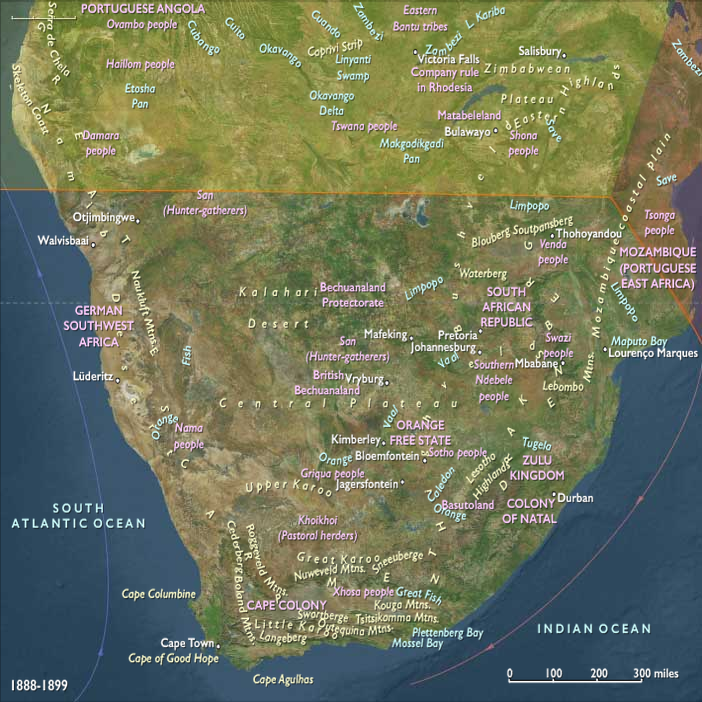
In 1888, Rhodes obtains a concession for mining rights from King Lobengula of the Ndebele peoples.
He presents this concession to persuade the government of the United Kingdom to grant a royal charter to the company over Matabeleland, and its subject states such as Mashonaland as well.
Rhodes used this document in 1890 to justify sending the Pioneer Column, a group of Europeans protected by well-armed British South Africa Police (BSAP) through Matabeleland and into Shona territory to establish Fort Salisbury (now Harare), and hereby establish company rule over the area.
In 1893 and 1894, with the help of their new Maxim guns, the BSAP go on to defeat the Ndebele in the First Matabele War.
Rhodes additionally seeks permission to negotiate similar concessions covering all territory between the Limpopo River and Lake Tanganyika, at this time known as "Zambesia".
In accordance with the terms of aforementioned concessions and treaties, mass settlement is encouraged, with the British maintaining control over labor as well as precious metals and other mineral resources.
In 1895, the BSAC adopt the name "Rhodesia" for the territory, in honor of Rhodes.
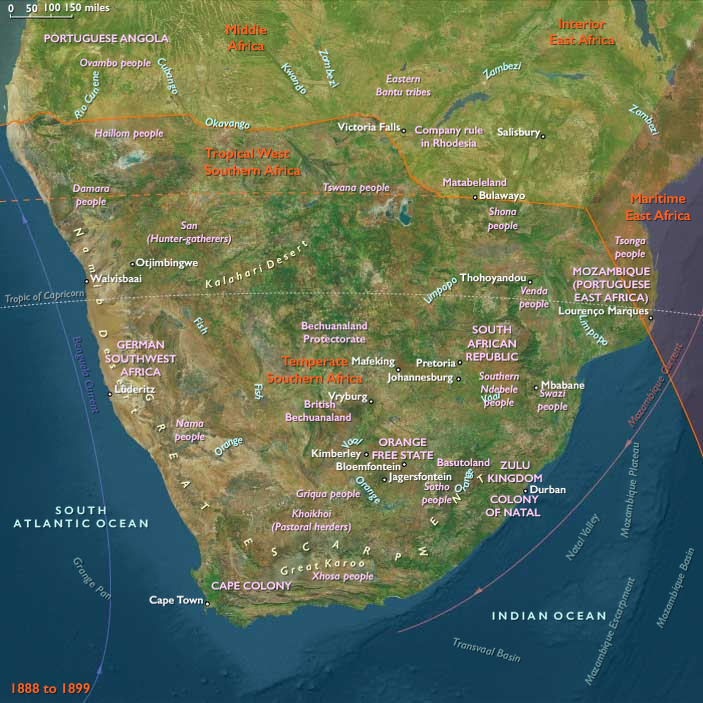
In 1898 "Southern Rhodesia" becomes the official name for the region south of the Zambezi,which will later become Zimbabwe.
The region to the north is administered separately and will later be termed Northern Rhodesia (now Zambia).
Shortly after Rhodes' disastrous Jameson Raid on the South African Republic, the Ndebele rebel against white rule, led by their charismatic religious leader, Mlimo.
The Second Matabele War lasts in Matabeleland until 1896, when Mlimo is assassinated.
Locations
Groups
Commodities
Subjects
Regions
Southern Africa
View →Subregions