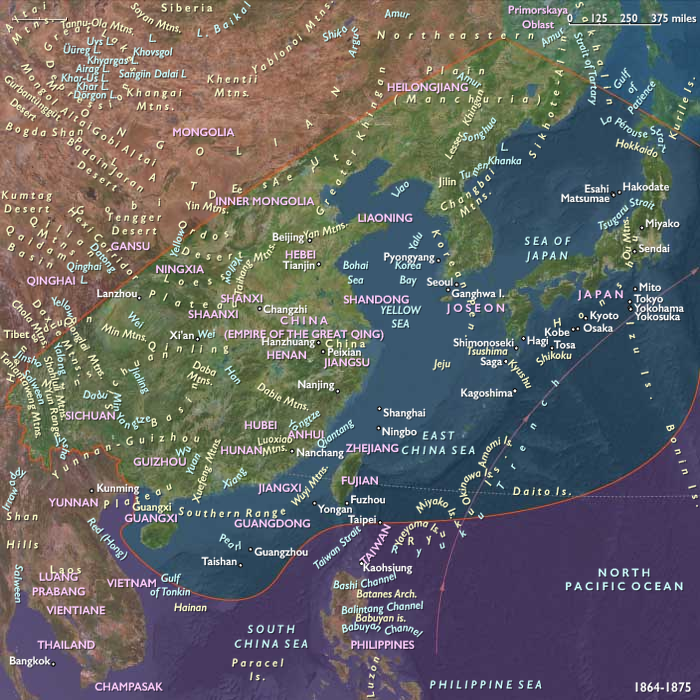
Nanking finally falls on July 19, 1864,…
July 1864 CE
Nanking finally falls on July 19, 1864, marking the end of the Taiping Rebellion, one of the greatest civil wars in world history.
After massive looting, the city is set on fire, burning until July 26, 1864.
The final imperial victory over the rebels is the climax of Zeng Guofan’s career.
Zeng is astonished when, after the capture of Nanking, almost one hundred thousand of the Taiping followers prefer death to capture.
Taiping Christianity, placing little emphasis on New Testament ideas of kindness, forgiveness, and redemption, emphasizes rather the wrathful Old Testament God who demands worship and obedience.
Prostitution, foot-binding, and slavery are prohibited, as well as opium smoking, adultery, gambling, and use of tobacco and wine.
Organization of the army is elaborate, with strict rules governing soldiers in camp and on the march.
For those who followed these rules, an ultimate reward had been promised.
In all, twenty million have lost their lives during the fourteen-year insurgency.
The success of the Imperial Chinese Army is partially due to the advanced weaponry adopted, namely, the firearms.
1864 is the year when the first Chinese indigenously built bolt-action single-shot rifle appears, and although the number of these is extremely few, they prove themselves over other firearms, and certainly over ancient weapons such as swords, sabers, spears and lances.
The third battle of Nanking is a testing ground for the first modern Chinese firearms.
Topics
Regions
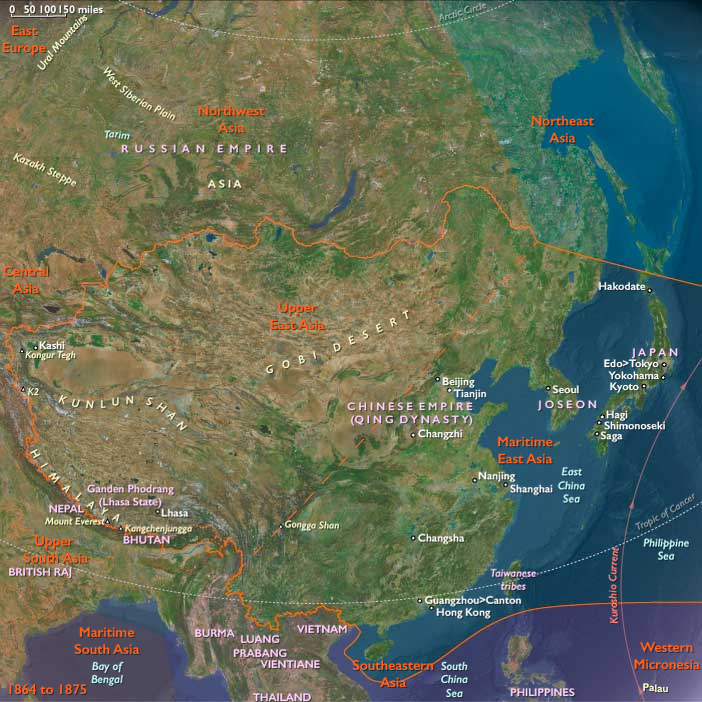
East Asia
View →Subregions