
Near East (40–51 CE): Political Maneuvering and …
Years: 40 - 51
Near East (40–51 CE): Political Maneuvering and Cultural Interactions
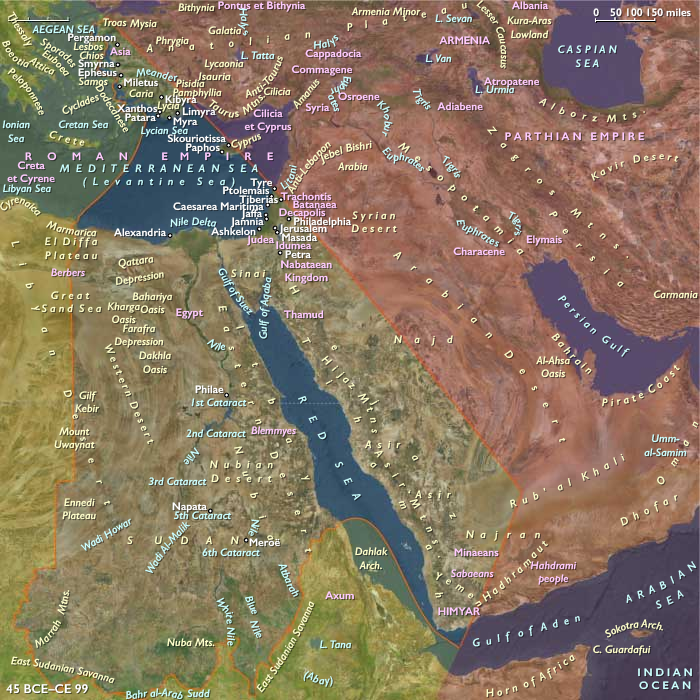
This era is characterized by significant political and cultural developments in the Near East, marked notably by continuing shifts in power dynamics and intercultural exchanges. The Roman client kings and tetrarchs persist in their delicate balancing acts, maintaining allegiance to Rome while managing internal affairs in their respective territories. This period sees notable figures such as Herod Agrippa I, grandson of Herod the Great, ascending to prominence. Agrippa is favored by Roman emperors, notably Claudius, and gradually consolidates his influence, culminating in his rule over much of Judea and its surrounding regions by 41 CE.
Agrippa’s reign is marked by a strategic balance of Hellenistic cultural patronage and sensitivity to Jewish traditions, thereby mitigating some internal tensions within his domains. His efforts include significant building projects, patronage of cities such as Caesarea Maritima, and active involvement in maintaining Jewish religious observances, which contribute to a relative, though short-lived, stability in the region.
However, Agrippa’s sudden death in 44 CE leads to the reinstatement of direct Roman governance over Judea, sparking renewed tensions and unrest. The Roman procurators who follow him lack his political savvy and understanding of local customs, exacerbating tensions between the Jewish populace and the Roman authorities.
Legacy of the Era
The era from 40 to 51 CE highlights the fragile interplay between Roman imperial power and local autonomy, underscoring the complexities of governing diverse cultural and religious populations. Agrippa’s brief rule illustrates the potential for temporary stability through adept political leadership, while his sudden demise underscores the inherent volatility of Roman provincial governance, foreshadowing further unrest in subsequent decades.
People
Groups
Topics
Subjects
Regions

Subregions
Related Events
Filter results
Showing 10 events out of 61840 total
Han China dispatches General Ma Yuan to lead an army to strike down the Yue rebellion of the Trung sister in the region of present Vietnam.
The Han army fully suppresses the uprising in 43 and regains complete control.
The Trung sisters are captured and beheaded.
Savaria (present Szombathely), founded as the Pannonian capital in CE 45 by the Roman emperor Claudius at the intersection of two Roman roads (still extant), is made a Roman colony under the name of Colonia Claudia Savariensum (Claudius' Colony of Savarians).
The first city in the region of present Hungary, it lies close to the important "Amber Road" trade route.
Scarbantia (present Sopron) and other cities in what is today Hungary are made municipia (self-governing communities).
Emperor Claudius reduces Thrace to a Roman province in 46, making Philippopolis, renamed Trimontium (City of Three Hills), the capital.
Caligula’s Expansion into Mauretania and the Failed Invasion of Britain (40 CE)
In 40 CE, Emperor Caligula sought to expand the Roman Empire, securing its hold over Mauretania and making an ambitious—though ultimately unsuccessful—attempt to invade Britain. His erratic behavior and eccentric actions during this campaign would become legendary, culminating in the bizarre "war against Neptune."
The Annexation of Mauretania
- Mauretania (modern Morocco and Algeria) had been a Roman client kingdom under King Ptolemy, a descendant of Cleopatra and Mark Antony.
- In 40 CE, Caligula ordered his assassination, annexing the kingdom into the Roman Empire.
- The former kingdom was divided into two new Roman provinces:
- Mauretania Tingitana (western region)
- Mauretania Caesariensis (eastern region)
This secured Rome’s control over North Africa’s western frontier and strengthened its military and trade networks along the Mediterranean coast.
The Failed Invasion of Britain and the "War Against Neptune"
- Caligula aimed to achieve military glory by invading Britain, a land beyond the reach of prior Roman conquests.
- However, before launching the actual campaign, his legions halted at the shores of Gaul, awaiting orders.
Caligula’s Bizarre Orders
- Instead of crossing the Channel to fight the Britons, Caligula declared war on Neptune, the Roman god of the sea.
- He ordered his troops to attack the waves, symbolizing his domination over the ocean.
- Soldiers were commanded to collect seashells, which were allegedly referred to as "spoils of war."
This display of eccentricity and apparent madness left his commanders and soldiers bewildered, further undermining his credibility.
Later Roman Conquest of Britain
- Despite Caligula’s failure, his successors Claudius and later emperors would successfully conquer Britain:
- In 43 CE, Emperor Claudius launched a full-scale invasion, leading to the Roman annexation of Britain.
- By the mid-2nd century CE, Rome had extended its control as far north as Scotland, fortifying the frontier with Hadrian’s Wall (122 CE).
Legacy of Caligula’s Military Campaigns
- His annexation of Mauretania permanently secured Roman control over the region, ensuring its integration into the empire.
- His failed invasion of Britain became one of the most infamous episodes of his rule, contributing to his reputation for madness and delusion.
- His successors—particularly Claudius—would later complete the conquest of Britain, fulfilling Rome’s longstanding ambition to subjugate the island.
While Caligula’s military campaigns were largely ineffective, they marked important moments in Rome’s expansion, setting the stage for future emperors to achieve what he could not.
Mediterranean Southwest Europe (40–51 CE): Caligula’s Fall and Claudius’s Stabilizing Reign
The era 40–51 CE sees the end of Caligula’s controversial rule, followed by the stabilizing and productive reign of his successor, Claudius. This period is characterized by political turmoil, followed by significant administrative reforms, territorial expansion, and efforts to restore public confidence in imperial leadership.
Caligula’s Increasing Tyranny and Assassination
By 40 CE, Caligula’s reign becomes increasingly erratic and despotic. His rule is marked by extravagance, cruelty, and erratic governance, deeply alienating the Roman elite and populace. Ultimately, Caligula’s extreme behavior leads to his assassination in January 41 CE by members of the Praetorian Guard and senatorial conspirators, ending his short but notorious reign.
Ascension of Claudius
Immediately following Caligula’s assassination, his uncle Claudius, initially overlooked due to perceived weakness and physical infirmities, is elevated to emperor by the Praetorian Guard. Claudius’s unexpected rise to power initially generates skepticism among the elite, but he swiftly demonstrates capability and effectiveness in governance.
Administrative Reforms and Stability
Claudius implements significant administrative and judicial reforms, strengthening central governance and improving provincial management. He emphasizes meritocracy, expands the bureaucracy with capable freedmen, and enhances legal frameworks, contributing substantially to the stability and efficiency of the Roman administration.
Territorial Expansion: The Conquest of Britain
Claudius notably initiates the Roman conquest of Britain in 43 CE, a bold military campaign intended to secure his legitimacy and prestige. This conquest significantly expands Roman influence and territory, further strengthening Rome’s geopolitical stature.
Infrastructure and Economic Growth
Claudius vigorously promotes infrastructure development, commissioning major public works such as roads, aqueducts, canals, and ports—including notable expansions in the port of Ostia. These projects significantly boost economic activity, trade, and connectivity within the empire.
Social and Cultural Developments
Under Claudius, cultural and scholarly pursuits experience a resurgence. A scholarly emperor himself, Claudius sponsors cultural and historical works, reviving intellectual and artistic activities. His reign fosters a renewed sense of stability and cultural optimism after the uncertainty and turmoil of Caligula’s rule.
Legacy of the Era
The era 40–51 CE is pivotal in restoring stability and effective governance after the turbulence of Caligula’s reign. Claudius’s reforms, administrative effectiveness, and territorial expansions significantly shape the trajectory of the Roman Empire, reaffirming its strength, resilience, and imperial cohesion.
North Africa (40–51 CE)
Roman Consolidation, Mauretanian Integration, Cyrenaic Continuity, Berber Stability, and Saharan Connectivity
Roman Provincial Consolidation and Economic Growth
Between 40 and 51 CE, Roman governance in Africa Proconsularis deepens, reinforcing administrative structures and economic integration. Infrastructure projects, agricultural innovations, and urban expansions continue to enhance provincial prosperity. Cities such as Utica and Leptis Magna flourish as essential hubs within the Roman Mediterranean trading network, with Leptis Magna solidifying its status as a major regional center due to continued infrastructural enhancements under Roman administration.
Numidia: Stability and Provincial Prosperity
Numidia remains economically vibrant under consistent Roman provincial administration. Ongoing agricultural improvements and developed trade networks strengthen local economies. Numidian society preserves its cultural heritage within the Roman administrative framework, contributing significantly to North Africa’s cohesive economic and social fabric.
Mauretania: Complete Roman Integration and Economic Stability
Mauretania experiences complete integration into the Roman provincial system, following extensive administrative restructuring initiated after the reign of King Juba II and Queen Cleopatra Selene II. Caesarea (modern Cherchell) maintains its economic prosperity and cultural importance, benefiting significantly from Roman infrastructural investments and strategic Mediterranean trade. The province continues robust trade activities, particularly in grain, olive oil, and luxury goods, solidifying its essential role within Roman North Africa.
Cyrenaica: Continued Economic Prosperity and Intellectual Influence
Cyrenaica continues its steady economic and intellectual vitality. The Greek Pentapolis—Cyrene, Barce (Al Marj), Euhesperides (Benghazi), Teuchira (Tukrah), and Apollonia (Susah)—remains economically active, notably in the trade of grain, wine, wool, livestock, and the highly valued medicinal herb Silphium. Cyrene persists as a major intellectual and cultural center, attracting scholars, philosophers, and medical experts, reinforcing its regional and Mediterranean-wide significance.
Berber Communities: Ongoing Economic Integration and Cultural Continuity
Berber communities sustain their active economic roles, especially through coastal trade networks centered around cities like Oea (Tripoli). Inland Berber populations continue to benefit indirectly from coastal commerce, maintaining traditional governance and cultural practices. This enduring relationship reinforces economic stability, cultural resilience, and regional cohesion.
Garamantes: Continued Strategic Role in Saharan Commerce
The Garamantes retain their central role in managing and facilitating trans-Saharan trade routes. Their advanced agricultural systems and efficient caravan management sustain vital economic and cultural exchanges between sub-Saharan Africa and Mediterranean economies, supporting continued regional prosperity.
Mauri (Moors) and Saharan Pastoral Nomads
The Mauri (Moors) sustain their prominence through ongoing diplomatic initiatives and active commercial engagement, ensuring western North Africa’s continued stability and prosperity.
Saharan pastoral nomads persist as crucial facilitators of trade, cultural exchange, and information dissemination, linking diverse ecological and economic regions and enhancing North Africa’s interconnectedness.
Cultural Syncretism and Continued Interaction
Ongoing cultural interactions among Berber, Roman, Greek, Garamantian, Musulami, Gaetulian, Mauri, and Saharan pastoral communities continue enriching regional cultural traditions. Religious syncretism remains vigorous, seamlessly blending indigenous Berber beliefs with Roman, Greek, Phoenician, and Saharan religious customs, significantly enriching North Africa’s diverse cultural landscape.
Foundations for Ongoing Stability and Prosperity
By 51 CE, North Africa continues to exemplify regional stability and economic prosperity, supported by effective Roman provincial governance, full Mauretanian integration, enduring Cyrenaic economic and intellectual vitality, resilient Berber communities, and dynamic Saharan trade networks. These interconnected factors affirm North Africa’s lasting strategic importance within the Mediterranean geopolitical context.
Atlantic Southwest Europe (40–51 CE): Provincial Flourishing, Economic Expansion, and Cultural Integration
Between 40 and 51 CE, Atlantic Southwest Europe—covering northern and central Portugal, Galicia, Asturias, Cantabria, and northern Spain south of the Franco-Spanish border (43.05548° N, 1.22924° W)—experienced sustained political stability, economic expansion, and cultural integration under Roman imperial rule. During the reigns of Caligula and Claudius, the region further integrated into Mediterranean economic networks, deepened its reliance on slavery, and witnessed significant cultural synthesis between indigenous traditions and Roman influences. Local tribal identities remained robust, adapting creatively within a firmly established provincial framework.
Political and Military Developments
Stability under Established Roman Provincial Administration
-
Under emperors Caligula and Claudius, Atlantic Southwest Europe enjoyed continued stability and prosperity due to well-established provincial governance structures. Effective administration supported by permanent military garrisons, fortified towns, and robust infrastructure maintained peace, facilitating economic growth and social cohesion.
-
Local tribal elites remained deeply integrated into the provincial administrative system, actively supporting Roman governance and ensuring internal stability.
Further Integration and Stability of Northern Tribes
-
Northern tribes, particularly the Gallaeci, Astures, and Cantabri, maintained peaceful relations with Rome, fully integrated into provincial governance and benefiting economically and socially from cooperation.
-
The Vascones continued their successful diplomatic neutrality, effectively preserving territorial autonomy, cultural distinctiveness, and internal stability within the provincial framework.
Economic and Technological Developments
Peak Economic Prosperity and Mediterranean Trade Integration
-
The regional economy experienced significant expansion and prosperity through deepened integration into Mediterranean trade networks. Atlantic Southwest Europe supplied metals (silver, copper, tin), agricultural goods, timber, salt, livestock products, textiles, and especially slaves to Mediterranean markets. Imports of luxury items, fine ceramics, wine, olive oil, and advanced iron products further stimulated regional prosperity.
-
Provincial elites and urban centers economically benefited substantially, reinforcing regional social stratification, economic specialization, and dependency on Mediterranean commerce.
Continued Centrality of Slavery
-
Slavery remained fundamental to regional economies, extensively employed in mining operations, agriculture, artisanal crafts, domestic services, and urban construction projects. The robust slave trade further embedded slavery within regional economic structures, profoundly influencing social hierarchies.
Ongoing Technological Advancements and Infrastructure Expansion
-
Continued advancements in metallurgy, especially ironworking, significantly enhanced agricultural productivity, military capability, and artisanal production. Skilled local artisans produced sophisticated weapons, armor, agricultural implements, and decorative objects, blending local traditions with Roman technological influences.
-
Roman infrastructure, including expansive road networks, aqueducts, fortified towns, urban centers, and bridges, facilitated further economic growth, administrative efficiency, and regional stability.
Cultural and Religious Developments
Cultural Resilience and Artistic Integration
-
Material culture exhibited continued integration of indigenous Iberian traditions, Celtic influences, and strong Roman artistic styles. Elaborate metalwork, jewelry, pottery, ceremonial artifacts, and household objects demonstrated ongoing cultural vitality and regional pride.
-
Despite firm Roman provincial authority, local tribal cultures—particularly among Lusitanians, Gallaeci, Astures, Cantabri, and Vascones—remained robust, creatively adapting within the integrated Roman context.
Ritual Continuity and Religious Adaptations
-
Ritual practices persisted, integrating indigenous Iberian, Celtic, and Roman traditions. Prominent sacred sites, sanctuaries, and communal ceremonies continued actively, reinforcing communal cohesion, cultural continuity, and tribal identities.
-
Traditional ancestral rites, warrior ceremonies, and local festivals continued actively, preserving regional solidarity, identity, and cultural resilience under stable Roman administration.
Notable Tribal Groups and Settlements
-
Lusitanians: Continued benefiting economically and culturally under stable Roman provincial administration, with sustained local prosperity and internal stability.
-
Vettones and Vaccaei: Maintained local autonomy, economic prosperity, and territorial integrity through strategic diplomatic cooperation with Roman authorities.
-
Gallaeci, Astures, Cantabri: Fully integrated into provincial governance, maintaining local traditions, cultural identities, and economic prosperity.
-
Vascones: Effectively preserved diplomatic neutrality, territorial autonomy, cultural distinctiveness, and internal stability within provincial administration.
Long-Term Significance and Legacy
Between 40 and 51 CE, Atlantic Southwest Europe:
-
Reinforced sustained Roman provincial stability, ensuring enduring political, economic, and social prosperity throughout the region.
-
Achieved peak economic integration with Mediterranean trade networks, solidifying the role of slavery as a foundational economic institution.
-
Demonstrated resilient cultural identities and traditions, dynamically adapting indigenous cultures within the stable, integrated Roman provincial framework.
This period further solidified Atlantic Southwest Europe's position as a thriving, economically prosperous, culturally resilient region, significantly shaping its historical trajectory within the broader Roman Empire.
Atlantic West Europe (40–51 CE): Turbulent Reign of Caligula, Restoration under Claudius, and Provincial Growth
From 40 to 51 CE, Atlantic West Europe—including Aquitaine, the Atlantic coast, northern and central France, Alsace, and the Low Countries—experienced a period of political instability under the later reign of Caligula, followed by renewed stability and provincial expansion under Emperor Claudius. Urban and economic growth resumed after initial uncertainty, deepening Roman integration and regional prosperity.
Political and Military Developments
Turmoil under Caligula (40–41 CE)
-
Emperor Caligula (r. 37–41 CE), increasingly erratic and tyrannical, created uncertainty within the empire, briefly unsettling regional governance and raising concerns among the provincial elite.
-
The Rhine frontier faced heightened tensions, although substantial Roman military presence prevented any major incursions into Atlantic West Europe.
Stability Restored by Claudius (41–51 CE)
-
The assassination of Caligula in 41 CE led to the accession of Emperor Claudius (r. 41–54 CE), who rapidly restored imperial stability and administration.
-
Claudius reinforced provincial governance by granting greater autonomy and citizenship rights to prominent local elites, significantly improving regional stability.
Claudian Conquest of Britain (43 CE)
-
In 43 CE, Claudius launched a successful invasion of Britain, significantly affecting Atlantic West Europe by increasing regional trade, enhancing military presence, and boosting the economies of port cities such as Gesoriacum (Boulogne) and coastal towns along the English Channel.
Economic and Social Developments
Trade Expansion and Urban Growth
-
The successful conquest of Britain boosted trade and commerce along the Atlantic coast, dramatically benefiting ports in northern Gaul.
-
Burdigala (Bordeaux) strengthened its position as a significant trade hub, exporting wine and agricultural products to newly conquered Britain and distant provinces of the empire.
-
Urbanization accelerated under Claudius, with cities such as Augustodunum (Autun), Lutetia (Paris), Durocortorum (Reims), and Argentoratum (Strasbourg) benefiting from renewed imperial investment and expanded trade networks.
Infrastructure Development
-
Claudius invested heavily in provincial infrastructure, further enhancing the Roman road system, improving transportation efficiency, and facilitating rapid troop movements and commerce across Atlantic West Europe.
-
Major aqueducts, public baths, theaters, and administrative centers expanded, reflecting increased urban prosperity.
Cultural and Religious Developments
Romanization and Provincial Identity
-
Gallo-Roman identity continued to deepen as elites actively participated in imperial governance and adopted Roman cultural norms, Latin language, and urban lifestyles.
-
Prominent provincial families increasingly gained citizenship and entered Roman administrative positions, further integrating regional interests into imperial structures.
Religious Syncretism and Imperial Cult
-
Worship of Roman and indigenous deities remained widespread, highlighting religious syncretism in cities and rural areas.
-
Imperial cults expanded notably under Claudius, reinforcing loyalty to the emperor and Rome, particularly after the instability of Caligula’s reign.
Key Figures and Events
-
Caligula (d. 41 CE): His turbulent reign created temporary instability before his assassination in 41 CE.
-
Claudius (from 41 CE): Established firm control, restored stability, granted citizenship to provincial elites, and expanded the empire into Britain, significantly impacting Atlantic West Europe's trade and economy.
Long-Term Significance
By 51 CE, Atlantic West Europe had emerged stronger following a brief period of uncertainty:
-
Claudius’s policies and Britain’s conquest greatly stimulated regional trade and urban prosperity.
-
Gallo-Roman elites became increasingly central to provincial administration and Roman imperial integration.
-
The renewed stability under Claudius laid essential groundwork for further economic growth, cultural assimilation, and provincial importance within the Roman Empire.
The Suppression of the Druids in Roman Gaul (1st Century CE)
After the Roman conquest of Gaul (58–51 BCE), led by Julius Caesar, the Gallic tribal chiefdoms were annexed into the Roman Empire. Following the establishment of Roman rule, efforts were made to eliminate the druids, the religious, legal, and intellectual elite of Celtic society.
Roman Measures Against Druidism
According to Roman sources, various emperors enacted laws to eradicate druidism in Gaul, perceiving it as a threat to Roman authority and assimilation efforts.
1. Augustus (27 BCE – 14 CE)
- The first recorded legal restriction against druids came under Emperor Augustus, who:
- Banned Roman citizens from practicing druidism, attempting to separate the elite from indigenous traditions.
- Targeted druids as symbols of resistance, as they were influential in Gallic governance and resistance efforts.
2. Tiberius (14–37 CE)
- According to Pliny the Elder (writing in the 70s CE), Emperor Tiberius took stronger action, enacting laws that banned druids, soothsayers, and healers.
- Pliny applauded the move, believing that it helped eliminate human sacrifice in Gaul, a practice often associated (perhaps inaccurately) with druidic rituals.
3. Claudius (41–54 CE)
- Suetonius, writing in the 2nd century CE, credited Emperor Claudius with passing the most decisive law, which:
- Completely outlawed druidic religious practices in Gaul.
- Led to the active persecution of druids, likely involving executions and destruction of sacred sites.
Motivations for the Suppression of Druids
- The Romans viewed the druids as a political and ideological threat, as they:
- Were key figures in Gallic resistance movements.
- Served as religious leaders, legal authorities, and advisors to tribal chieftains.
- Maintained a distinct cultural identity, resisting Romanization.
- Their influence contradicted Roman efforts to integrate Gaul into the empire, necessitating their elimination from public life.
The Last Strongholds of Druidism
- While druidism declined in Gaul, it persisted in Britain and Ireland, where Roman control was weaker.
- The final Roman action against druids came in 61 CE, when the governor Suetonius Paulinus led a brutal campaign against the druidic stronghold on the island of Mona (Anglesey, Wales).
Legacy of the Roman Campaign Against the Druids
- The suppression of druidism contributed to the cultural transformation of Gaul, replacing Celtic traditions with Roman law, administration, and religion.
- While the Romans destroyed much of the druids' influence, elements of Celtic spirituality survived, merging with later Gallo-Roman religious practices.
- The druids' historical role, largely recorded by Roman authors, remains shrouded in bias, as no written records from the druids themselves survive.
The campaign against the druids was a critical part of Roman efforts to consolidate power in Gaul, ensuring that resistance was crushed and local populations fully integrated into the empire.
Years: 40 - 51
People
Groups
Topics
Subjects
Regions
Subregions