
Near East (621–478 BCE): Transformation, Conquest, and …
Years: 621BCE - 478BCE
Near East (621–478 BCE): Transformation, Conquest, and Cultural Renewal
Josiah’s Religious Reforms and Judah’s Fall
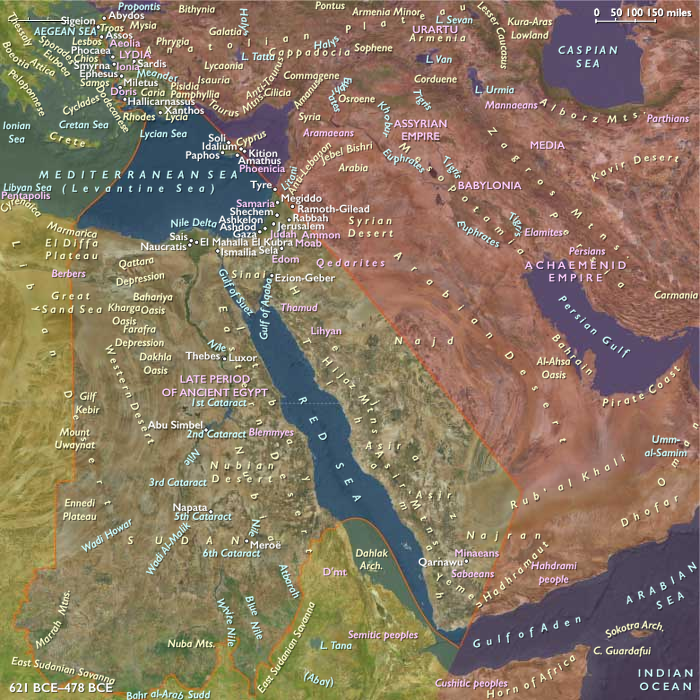
During the early part of this age, Josiah, king of Judah, implements sweeping religious reforms that establish the worship of Yahweh as the sole deity. This monotheistic movement centralizes religious practices in Jerusalem. Josiah aims to reunify Judah and Israel, leveraging the decline of the Assyrian Empire, but is killed at Megiddo in 609 BCE while confronting Egyptian Pharaoh Necho II. This marks the end of Judah’s independence, and subsequently, the kingdom falls under Egyptian and later Babylonian domination.
Babylonian Ascendancy and the Judahite Exile
Nebuchadnezzar II of Babylon decisively defeats Egypt at Carchemish in 605 BCE, subsequently asserting Babylonian dominance over the Near East. Jerusalem falls to Babylon in 586 BCE after a prolonged siege. The First Temple is destroyed, and a significant portion of the Judahite population, including King Zedekiah, is deported to Babylon—an event known as the Babylonian Captivity. Scattered in exile, Judahites maintain their identity through adherence to their religious laws and rituals such as circumcision, Sabbath observance, festivals, dietary rules, and cleanliness laws. These customs become foundational in preserving Jewish cultural identity.
Egyptian Revival and Saite Dynasty
Pharaoh Necho II, followed by his successor Amasis II, revitalizes Egypt, fostering cultural and economic growth. Amasis II adorns temples in Lower Egypt with splendid monolithic shrines and other monumental constructions, remnants of which still exist. The Cypriot kingdoms recognize Egyptian overlordship under Amasis, adopting Egyptian artistic and sartorial conventions. However, Egypt's strength is transient; Persian forces under Cambyses II conquer Egypt in 525 BCE, ending the Twenty-sixth Dynasty and integrating Egypt as a province within the Persian (Achaemenid) Empire. Persian emperors are thus recorded as Egypt's Twenty-seventh Dynasty.
Kush and the Shift to Meroë
Egypt under Pharaoh Psamtik II invades and sacks Napata in 590 BCE, causing the Kushite court to relocate southward to the iron-rich and secure region of Meroë. Here, Kush develops independently for centuries, insulated from Egypt’s subsequent periods of Persian, Greek, and Roman domination.
Phoenician Resistance and Babylonian Control
Phoenician cities experience increased turbulence during Babylonian dominance (605–539 BCE). The city of Tyre notably endures a thirteen-year siege by Nebuchadnezzar, finally capitulating in 574 BCE, resulting in enslavement and the deposition of its king.
Lydia and the Ionian Cities
Croesus of Lydia, ruling from Sardis, initially controls western Anatolia until defeated by Persian king Cyrus the Great in 546 BCE. The Ionian Greeks initially welcome Persian rule to escape Lydian dominance but soon rebel against the Persians’ imposition of tyrants. This triggers the Ionian Revolt (499–493 BCE), the opening conflict of the Greco-Persian Wars, a series of conflicts lasting until 448 BCE.
Philosophical Advances in Ionia
This period sees significant philosophical developments in Ionia. Thales of Miletus, active around 585 BCE, is known for predicting a solar eclipse and promoting water as the primary element. His student, Anaximander, introduces the concept of apeiron (the boundless), proposes a cylindrical earth, and creates the first known map of the world. His successor, Anaximenes, suggests air as the fundamental substance, explaining natural phenomena through its condensation and rarefaction.
Judahite Return and Temple Reconstruction
In 539 BCE, Persian conquest of Babylon under Cyrus the Great permits Judahites to return to Jerusalem. Led by Zerubbabel, they reconstruct the Temple by 515 BCE, despite opposition from local Samaritans.
Linguistic Developments and Cultural Influences
During this era, languages such as Lydian and Lycian begin to be recorded using the West Greek alphabet. Additionally, Egypt's influence significantly impacts Cypriot artistic practices, evident in surviving limestone sculptures.
Moab’s Disappearance and Edomite Migration
Moab disappears from historical records during Persian domination, with Arabian tribes like the Nabataeans infiltrating its territory. Edomites, pressed by Arab incursions, migrate into southern Judah, becoming known in later Roman periods as Idumaeans.
Samaritans and Religious Identity
The Samaritan population, regarded by Judahites as a mixed group originating from Assyrian colonists and native Israelites, adheres strictly to the Pentateuch, worshiping Yahweh and honoring Moses as their sole prophet. Their contentious relationship with returning Judahites becomes a defining cultural dynamic in post-exilic Judah.
Cultural and Philosophical Flourishing
The period concludes with the philosophical contributions of Heraclitus of Ephesus, who emphasizes the constant flux of reality and the unity of opposites, advancing ideas about change, identity, and the logos, influencing subsequent Greek philosophy and Western thought profoundly.
This age thus encapsulates an era of profound political transformations, religious realignments, and intellectual flourishing, setting the stage for enduring cultural legacies throughout the Near East.
People
- Amasis II
- Anaximander
- Anaximenes of Miletus
- Cambyses II
- Croesus
- Cyrus II ”the Great”
- Heraclitus
- Josiah of Judah
- Nebuchadnezzar II
- Necho II
- Psamtik II
- Thales of Miletus
- Xerxes I
- Zedekiah of Judah
- Zerubbabel
Groups
- Edomites, Kingdom of the
- Lydia, Kingdom of
- Arab people
- Kush, Kingdom of
- Judah, Kingdom of
- Cyprus, Classical
- Ephesus (Ionian Greek) city-state of
- Samaritans
- Egypt (Ancient), Late Period of
- Neo-Babylonian, or Chaldean, Empire
- Nabataeans
- Judahites
- Achaemenid Empire
Topics
- Assyrian Wars of c. 745-609 BCE
- Babylonian Captivity
- Persian Conquests of 559-509 BCE
- Persian-Lydian War of 547-546 BCE
- Ionian Revolt
- Greco-Persian Wars, Early
- Persian Invasion of Greece, First
Subjects
Regions
Subregions
Related Events
Showing 10 events out of 66140 total
Years: 621BCE - 478BCE
People
- Amasis II
- Anaximander
- Anaximenes of Miletus
- Cambyses II
- Croesus
- Cyrus II ”the Great”
- Heraclitus
- Josiah of Judah
- Nebuchadnezzar II
- Necho II
- Psamtik II
- Thales of Miletus
- Xerxes I
- Zedekiah of Judah
- Zerubbabel
Groups
- Edomites, Kingdom of the
- Lydia, Kingdom of
- Arab people
- Kush, Kingdom of
- Judah, Kingdom of
- Cyprus, Classical
- Ephesus (Ionian Greek) city-state of
- Samaritans
- Egypt (Ancient), Late Period of
- Neo-Babylonian, or Chaldean, Empire
- Nabataeans
- Judahites
- Achaemenid Empire
Topics
- Assyrian Wars of c. 745-609 BCE
- Babylonian Captivity
- Persian Conquests of 559-509 BCE
- Persian-Lydian War of 547-546 BCE
- Ionian Revolt
- Greco-Persian Wars, Early
- Persian Invasion of Greece, First
Subjects
Regions
Subregions