
Psamtik II
Pharaoh of Egypt
640 BCE to 589 BCE
Psamtik II (also spelled Psammetichus or Psammeticus) is a king of the Saite based Twenty-sixth dynasty of Egypt (595 BCE – 589 BCE).
His prenomen, Neferibre, means "Beautiful is the Heart of Re."
He was the son of Necho II.
World
The Middle of The Earth
View →Related Events
Showing 6 events out of 6 total
Near East (621–478 BCE): Transformation, Conquest, and Cultural Renewal
Josiah’s Religious Reforms and Judah’s Fall
During the early part of this age, Josiah, king of Judah, implements sweeping religious reforms that establish the worship of Yahweh as the sole deity. This monotheistic movement centralizes religious practices in Jerusalem. Josiah aims to reunify Judah and Israel, leveraging the decline of the Assyrian Empire, but is killed at Megiddo in 609 BCE while confronting Egyptian Pharaoh Necho II. This marks the end of Judah’s independence, and subsequently, the kingdom falls under Egyptian and later Babylonian domination.
Babylonian Ascendancy and the Judahite Exile
Nebuchadnezzar II of Babylon decisively defeats Egypt at Carchemish in 605 BCE, subsequently asserting Babylonian dominance over the Near East. Jerusalem falls to Babylon in 586 BCE after a prolonged siege. The First Temple is destroyed, and a significant portion of the Judahite population, including King Zedekiah, is deported to Babylon—an event known as the Babylonian Captivity. Scattered in exile, Judahites maintain their identity through adherence to their religious laws and rituals such as circumcision, Sabbath observance, festivals, dietary rules, and cleanliness laws. These customs become foundational in preserving Jewish cultural identity.
Egyptian Revival and Saite Dynasty
Pharaoh Necho II, followed by his successor Amasis II, revitalizes Egypt, fostering cultural and economic growth. Amasis II adorns temples in Lower Egypt with splendid monolithic shrines and other monumental constructions, remnants of which still exist. The Cypriot kingdoms recognize Egyptian overlordship under Amasis, adopting Egyptian artistic and sartorial conventions. However, Egypt's strength is transient; Persian forces under Cambyses II conquer Egypt in 525 BCE, ending the Twenty-sixth Dynasty and integrating Egypt as a province within the Persian (Achaemenid) Empire. Persian emperors are thus recorded as Egypt's Twenty-seventh Dynasty.
Kush and the Shift to Meroë
Egypt under Pharaoh Psamtik II invades and sacks Napata in 590 BCE, causing the Kushite court to relocate southward to the iron-rich and secure region of Meroë. Here, Kush develops independently for centuries, insulated from Egypt’s subsequent periods of Persian, Greek, and Roman domination.
Phoenician Resistance and Babylonian Control
Phoenician cities experience increased turbulence during Babylonian dominance (605–539 BCE). The city of Tyre notably endures a thirteen-year siege by Nebuchadnezzar, finally capitulating in 574 BCE, resulting in enslavement and the deposition of its king.
Lydia and the Ionian Cities
Croesus of Lydia, ruling from Sardis, initially controls western Anatolia until defeated by Persian king Cyrus the Great in 546 BCE. The Ionian Greeks initially welcome Persian rule to escape Lydian dominance but soon rebel against the Persians’ imposition of tyrants. This triggers the Ionian Revolt (499–493 BCE), the opening conflict of the Greco-Persian Wars, a series of conflicts lasting until 448 BCE.
Philosophical Advances in Ionia
This period sees significant philosophical developments in Ionia. Thales of Miletus, active around 585 BCE, is known for predicting a solar eclipse and promoting water as the primary element. His student, Anaximander, introduces the concept of apeiron (the boundless), proposes a cylindrical earth, and creates the first known map of the world. His successor, Anaximenes, suggests air as the fundamental substance, explaining natural phenomena through its condensation and rarefaction.
Judahite Return and Temple Reconstruction
In 539 BCE, Persian conquest of Babylon under Cyrus the Great permits Judahites to return to Jerusalem. Led by Zerubbabel, they reconstruct the Temple by 515 BCE, despite opposition from local Samaritans.
Linguistic Developments and Cultural Influences
During this era, languages such as Lydian and Lycian begin to be recorded using the West Greek alphabet. Additionally, Egypt's influence significantly impacts Cypriot artistic practices, evident in surviving limestone sculptures.
Moab’s Disappearance and Edomite Migration
Moab disappears from historical records during Persian domination, with Arabian tribes like the Nabataeans infiltrating its territory. Edomites, pressed by Arab incursions, migrate into southern Judah, becoming known in later Roman periods as Idumaeans.
Samaritans and Religious Identity
The Samaritan population, regarded by Judahites as a mixed group originating from Assyrian colonists and native Israelites, adheres strictly to the Pentateuch, worshiping Yahweh and honoring Moses as their sole prophet. Their contentious relationship with returning Judahites becomes a defining cultural dynamic in post-exilic Judah.
Cultural and Philosophical Flourishing
The period concludes with the philosophical contributions of Heraclitus of Ephesus, who emphasizes the constant flux of reality and the unity of opposites, advancing ideas about change, identity, and the logos, influencing subsequent Greek philosophy and Western thought profoundly.
This age thus encapsulates an era of profound political transformations, religious realignments, and intellectual flourishing, setting the stage for enduring cultural legacies throughout the Near East.
Near East (597–586 BCE): Siege, Subjugation, and Cultural Realignment
Miletus, Smyrna, and Ionian Decline
The Ionian city of Smyrna, having flourished in the previous century, suffers a devastating setback when Lydian King Alyattes captures and sacks the city around 600 BCE. Smyrna's inhabitants are forced into the countryside, dismantling their political unity and relegating the city to a mere collection of villages. This event highlights the peak of Lydian dominance under Alyattes, who also subjugates cities like Clazomenae, marking the decline of Ionian political autonomy despite continued cultural and commercial significance.
Egyptian Endeavors and Necho II’s Legacy
Pharaoh Necho II, having abandoned attempts at Asian conquest after the defeats against Babylon, redirects Egyptian efforts toward internal stabilization and maritime expansion. According to Herodotus, Necho commissions a pioneering circumnavigation of Africa by Phoenician sailors, a voyage reportedly lasting three years. Though debated by modern historians, this expedition underscores Egypt’s intensified interest in maritime exploration and trade. Necho’s reign concludes in 595 BCE, succeeded by his son Psamtik II, who notably removes Necho's inscriptions from monuments for unclear reasons.
Psamtik II and Egyptian Military Revival
Psamtik II undertakes a significant military campaign against Nubia around 592 BCE, decisively crushing the Kingdom of Kush. His forces sack Napata, destroy royal statues, and loot temples, compelling the Nubians to move their capital further south to the safer and iron-rich region of Meroë. Psamtik II’s aggressive strategy effectively eliminates Nubian aspirations to reconquer Egypt, solidifying Egypt’s southern frontier. The Pharaoh's reign also witnesses extensive temple construction, notably at Hibis in El-Kharga Oasis, marking his short but impactful rule.
Babylonian Siege and Fall of Jerusalem
Nebuchadrezzar II, King of Babylon, asserts dominion over Judah, responding decisively to Zedekiah’s rebellion incited partly by Egyptian intervention under Psamtik II in 589 BCE. Jerusalem endures an intense siege beginning in 588 BCE. The prophet Jeremiah advocates surrender, interpreting Babylonian dominance as divinely ordained, yet Jerusalem resists. In 586 BCE, Nebuchadrezzar breaches the city, destroys the Temple, and razes Jerusalem’s walls. King Zedekiah is captured, forced to witness his sons' execution, blinded, and exiled to Babylon along with Judah’s elite.
Lachish Letters and Regional Collapse
The Lachish Letters, a poignant archaeological discovery, vividly describe the last days before Lachish falls to Babylonian forces around 588–586 BCE. Written on pottery shards, these communications reveal the desperation of Judah’s defenders and underscore the widespread chaos preceding Jerusalem’s fall. The Edomites, historical adversaries of Judah, align themselves with Babylon, exacerbating Judah's collapse.
Cultural and Scientific Developments
The period also marks significant advancements in Greek philosophy and early science. Notably, Thales of Miletus, recognized for his studies in geometry and astronomy, is traditionally credited with predicting a solar eclipse in 585 BCE. His explorations into static electricity, observing amber's unique properties, exemplify early scientific curiosity that foreshadows later Hellenic intellectual achievements.
Legacy of the Era
This era signifies a profound reshaping of Near Eastern political and cultural landscapes. The destruction of Jerusalem by Babylonian forces dramatically alters the historical trajectory of the Hebrew people, marking the beginning of the Jewish exile. Egypt, under the Saite dynasty, experiences a brief military resurgence, while Greek cultural influence continues to grow despite setbacks, laying the foundation for future intellectual and scientific breakthroughs.
Egypt’s Pharaoh Necho II had abandoned Asia after 601 BCE, strengthening the Egyptian navy for strategic and trading purposes and maintaining close links with the Greeks.
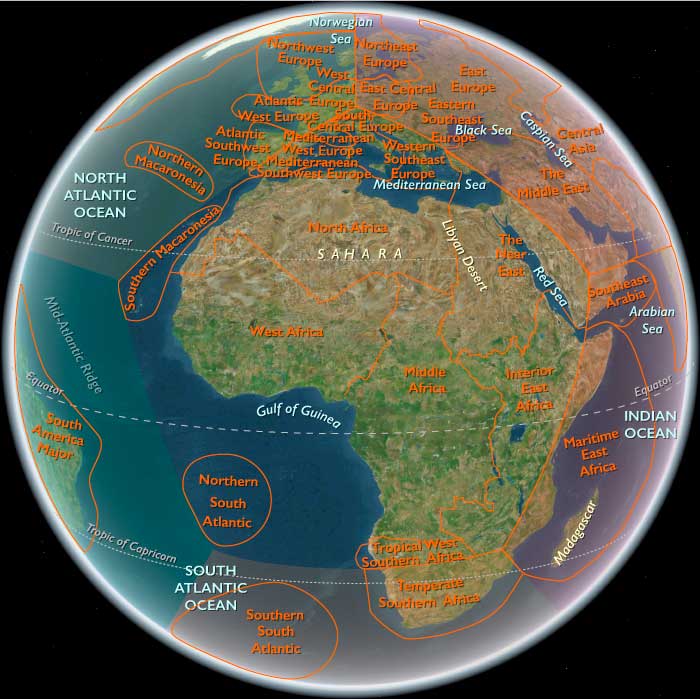
According to Herodotus (4.42), Necho engages a crew of Phoenician mariners to undertake the first known circumnavigation of Africa.
The expedition departs Egypt by way of the Red Sea and travels south past Ethiopia, reportedly expecting to turn west shortly after that point, as conventional theory has the continent as roughly rectangular in shape.
Finding that it is not, the sailors journey for three years, during which the sailors, each autumn, establish long-term encampments to sow, grow, and harvest grain that they carry with them.
They finally enter the Pillars of Hercules and sail through the Mediterranean to reappear in Egypt.
Some current historians tend to believe Herodotus' account, primarily because he stated with disbelief that the Phoenicians "as they sailed on a westerly course round the southern end of Libya (Africa), they had the sun on their right—to northward of them" (The Histories 4.42)—in Herodotus' time it was not known that Africa extended south past the equator; however, Egyptologists also point out that it would have been extremely unusual for an Egyptian Pharaoh to carry out such an expedition.
Necho II dies in 595 BCE and is succeeded by his son, Psamtik II, as the next pharaoh of Egypt.
Psamtik II, however, will later remove Necho's name from almost all of his father's monuments for unknown reasons.
Psamtik II is succeeded in 589 BCE by Apries, his son by Queen Takhut, a Princess of Athribis.
Th royal couple were also the parents of Menekhubaste, a Priestess of Atum at Heliopolis, and Ankhnesneferibre, a God's Wife of Amun who is to be served in this powerful office in Upper Egypt through to the remainder of the Saite period.
Apries is the name by which Herodotus (ii. 161) and Diodorus (i. 68) designate Wahibrea, pharaoh of Egypt (589 BC-570 BCE), the fourth king (counting from Psammetichus I) of the Twenty-sixth dynasty of Egypt.
Apries continues his father’s poor military record.
Unsuccessful attempts to intervene in the kingdom of Judah are followed by a mutiny of soldiers at Aswan.
Psamtik II leads a foray into Nubia, marching as far south as the Third or even the Fourth Cataract of the Nile in 592 BCE according to a contemporary stela from Thebes (Karnak) which dates to Year 3 of this king's name and refers to a heavy defeat that was inflicted upon the kingdom of Kush.
A well-known graffito inscribed in Greek on the left leg of the colossal seated statue of Ramesses II, on the south side of the entrance to the temple of Abu Simbel, states, "When King Psammetichus (i.e., Psamtik II) came to Elephantine, this was written by those who sailed with Psammetichus the son of Theocles, and they came beyond Kerkis as far as the river permits.
Those who spoke foreign tongues (Greek and Carians who also scratched their names on the monument) were led by Potasimto, the Egyptians by Amasis.” Kerkis is located near the Fifth Cataract of the Nile "which stood well within the Cushite Kingdom."
This is the first confrontation between Egypt and Nubia since the reign of Tantamani.
The Abu Simbel temples, two massive rock temples in Abu Simbel in Nubia, southern Egypt, are among the six rock temples erected in Nubia during the long reign of Ramesses II.
Their purpose was to impress Egypt's southern neighbors, and also to reinforce the status of Egyptian religion in the region.
Already in the sixth century BCE, the sand covers the statues of the main temple up to their knees.
Psamtik II is both a dynamic warrior pharaoh as well as a prolific builder in his brief six-year reign.
A significant Saite temple is likely built by Psamtik II and his son Apries at the village of El-Mahalla El-Kubra, which lies equidistant from Sebennytos and Behbeit El-Hagar in the Lower Nile Delta.
Officials from the Napoleonic expedition to Egypt will observe "an extraordinary number of pharaonic building elements of granite and turquoise reused in modern buildings" at this site; this discovery will subsequentlybe confirmed by Nestor L'Hôte in 1828 who counts more than one hundred and twenty granite columns built into this village's mosque alone.
A one point eight meter-long fragment of red granite with the name of Psamtik II and a door lintel of Apries will also be seen at El-Mahalla El-Kubra.
Psamtik II is also responsible for founding the Temple-house at Hibis in El-Kharga Oasis for the triad of Amun, Mut, and Khonsu with significant installations for the cult of Osiris.
This nineteen and a half by twenty-six meter temple was originally situated on the bank of an ancient lake which has now disappeared and its temple decorations were only completed under the Persian kings Darius I and possibly Darius II.
The Hibis temple consisted of a hypostyle hall with two-by-two papyrus capital columns, a hall of offerings, three sanctuaries in the rear section of the temple and a chapel at the side of the sanctuaries for the cult of Psamtik II.
The Temple of Psamtik II at Hibis will be completely preserved until 1832 when its roof and portions of the temple will be removed for the construction of an aluminum factory.
Only excavation work by the Metropolitan Museum of Art in 1910-1911 and restorations performed by the Egyptian Antiquities Service will arrest its decline.
Today, the Hibis temple remains—together with the Oracle or Ammoneion of Siwa--as "the best preserved and best-documented temple of the early Egyptian Late Period and is therefore a primary monument to the history of [Egyptian temple] building."