
Near East (489–478 BCE): Heraclitus and the …
Years: 489BCE - 478BCE
Near East (489–478 BCE): Heraclitus and the Quest for Understanding
Heraclitus and Philosophical Innovation
This era witnesses the intellectual prominence of Heraclitus of Ephesus, a philosopher whose innovative and enigmatic teachings profoundly influence Greek philosophical tradition. Flourishing in the early fifth century BCE, Heraclitus introduces a deeper self-consciousness regarding method and language into philosophical inquiry. Emphasizing introspection and self-awareness, he urges meticulous attention to the polarities and concealed structures inherent in language, suggesting that understanding the world requires first understanding oneself and the faculties through which knowledge is gained.
Heraclitus is especially notable for his theory concerning the nature of identity and change. He famously illustrates this through his assertion that an individual can and cannot step into the same river twice: though the river’s waters are continuously changing, its essential identity persists. This insightful paradox encapsulates his central teaching that reality is in constant flux, and stability is but an apparent condition amidst perpetual change.
Central Concepts: Fire and the Logos
According to Heraclitus, fire symbolizes the primary and central element of the cosmos, representing constant transformation. Fire’s ceaselessly active nature embodies his vision of a world without definitive beginning or end, continuously evolving through cycles of destruction and rebirth.
Equally significant is Heraclitus’s concept of the logos, an underlying rational principle governing the cosmos. The logos, universal and ever-present, maintains order amidst perpetual change and connects all phenomena in harmonious tension. This concept profoundly influences later philosophical and theological thought, shaping ideas about reason, language, and cosmic unity for centuries to come.
Heraclitus and the Human Soul
Breaking from earlier Greek philosophy, Heraclitus presents the first developed theory of the human soul, highlighting its creative and transformative capabilities. His exploration of human consciousness and perception emphasizes the importance of recognizing hidden relationships and balances within oneself and the broader cosmos.
Intellectual Legacy and Challenges
More than one hundred of Heraclitus’s aphorisms survive, notable for their compressed, cryptic, and paradoxical style. The dense nature of his thought has challenged interpreters throughout history, inviting numerous and diverse readings. Nevertheless, Heraclitus’s insistence on flux, dialectical tension, and the centrality of reason provides foundational concepts that guide philosophical inquiry well beyond his own time.
Broader Context: Greek and Near Eastern Dynamics
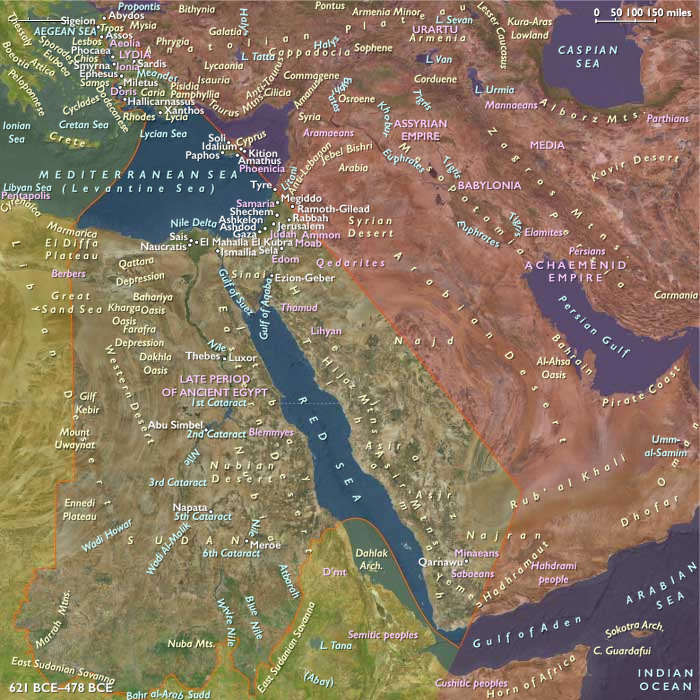
While Heraclitus advances philosophy in Ephesus, the broader Near East and Aegean regions undergo significant political realignments in the aftermath of the Persian defeat at Marathon (490 BCE). The Persian Empire, under Xerxes I, reorganizes itself, preparing to mount a renewed campaign against Greece. Simultaneously, Greek city-states, buoyed by their recent victory, enter a phase of unprecedented cultural and political self-confidence. These developments set the stage for monumental conflicts and transformations, as the Near Eastern and Greek worlds become increasingly intertwined.
Era’s Enduring Influence
This era, thus marked by Heraclitus’s profound philosophical reflections and the dynamic geopolitical shifts following Marathon, becomes a watershed period. Heraclitus's teachings not only lay essential groundwork for later philosophical traditions but also reflect and influence the era’s intellectual atmosphere—a complex interplay of continuity and change, unity and diversity—that continues to resonate in philosophical and historical scholarship.
People
Groups
Subjects
Regions
Subregions
Related Events
Showing 10 events out of 65624 total
Years: 489BCE - 478BCE
People
Groups
Subjects
Regions
Subregions