
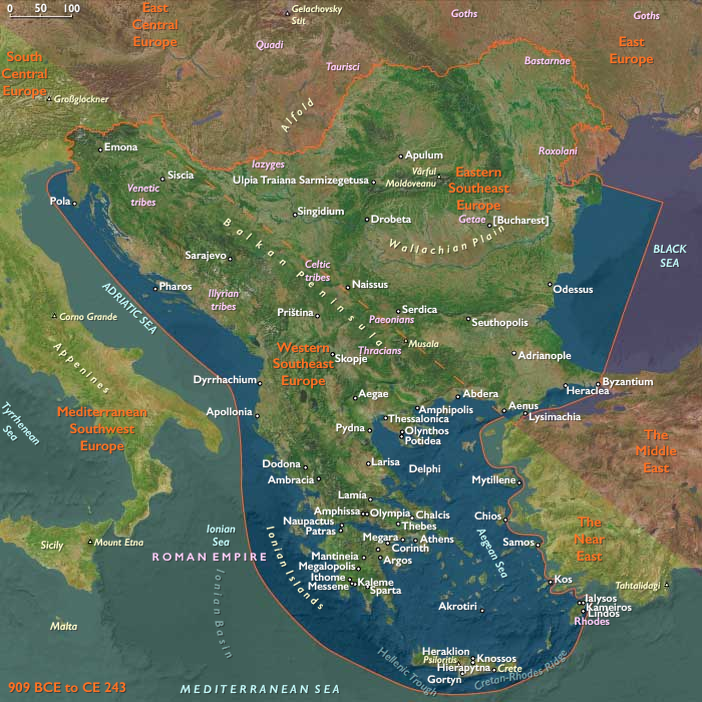
…those tribes living along the Strymon River…
489 BCE to 478 BCE
…those tribes living along the Strymon River (in present western Bulgaria) fall under Thracian control.
Locations
Groups
Topics
Commodities
Subjects
Regions
Southeast Europe
View →Subregions
Western Southeast Europe
View →Related Events
Showing 10 events out of 15 total
East Asia (820 – 963 CE): Tang Twilight, Tibetan Fragmentation, and the Maritime–Steppe Divide
Geographic and Environmental Context
East Asia between 820 and 963 CE stretched from the Pacific coastlands of Japan, Korea, and southern China to the mountain–desert worlds of Tibet, Xinjiang, and Mongolia.
It divided naturally into two great zones:
-
Maritime East Asia, encompassing China’s southern provinces, Korea, Japan, and Taiwan, where wet-rice agriculture and seaborne commerce shaped life.
-
Upper East Asia, including Tibet, Mongolia, and the western highlands of China (Xinjiang, Qinghai, Gansu, Ningxia)—the upland and steppe frontier linking East and Central Asia.
The age witnessed the end of the Tang Dynasty, the dissolution of the Tibetan Empire, and the ascent of new polities—Goryeo in Korea, Heian Japan, and the frontier states of Nanzhao and the Khitan.
Climate and Environmental Shifts
A relatively stable late-Holocene climate supported demographic and agrarian growth:
-
In southern China, warm, humid conditions expanded rice cultivation across the Yangtze and Sichuan basins.
-
The Tibetan Plateau and northern steppes remained cold and arid, favoring pastoral mobility.
-
Periodic droughts in the Tarim Basin and steppe belt triggered migration and warfare.
-
Along the coasts, monsoon predictability sustained maritime trade and coastal urbanization.
Despite political upheavals, the region’s ecological base remained robust.
Societies and Political Developments
Maritime East Asia: From Tang to the Heian Zenith
-
China (Tang 618–907): Southern prefectures (Fujian, Guangdong) prospered through rice and maritime trade. Tang’s authority collapsed amid rebellion and provincial warlordism; by 907, China fragmented into the Five Dynasties and Ten Kingdoms.
-
In the south, Yangtze and Sichuan economies ensured continued wealth under autonomous regimes.
-
Frontier states like Nanzhao (Yunnan, 738–902) resisted Tang power, linking to Southeast Asia.
-
Northeastern garrisons in Liaoning and Jilin fell to Khitan and Mohe incursions.
-
-
Korea: The Unified Silla kingdom waned after centuries of stability; internal unrest led to Goryeo’s foundation in 918, absorbing Silla by 935.
-
Japan: Under Heian rule (794–1185), the Fujiwara clan dominated court politics. The creation of kana writing fostered vernacular literature (Kokinshū, Tale of Genji foundations). Provinces grew increasingly autonomous, foreshadowing later warrior rule.
-
Taiwan: Austronesian-speaking communities cultivated taro and millet, fished coasts, and traded sporadically with Luzon and Fujian, remaining outside major state systems.
Upper East Asia: Fragmentation and Frontier Power
-
Tibet: Once a trans-Himalayan empire, Tibet fragmented after Langdarma’s assassination (842). Regional warlords and monasteries divided authority; Buddhist renewal began in western and eastern enclaves.
-
Mongolia and the Northern Steppes: Following the fall of the Uyghur Khaganate (840), Turkic and Mongolic tribes reorganized into shifting confederations; horse-trade diplomacy tied them to China and Central Asia.
-
Xinjiang and Gansu: Chinese retreat left oases like Khotan, Turfan, and Dunhuang under local Buddhist rulers and Uyghur refugees, who maintained Silk Road commerce.
-
The Hexi Corridor became a contested frontier between Chinese successor states, Tibetans, and steppe tribes.
-
Khitan and Mohe: In Manchuria, the Khitan built the foundation for the Liao dynasty (907–1125), while Mohe clans in Heilongjiang forged links to emerging Jurchen lineages.
Economy and Trade
-
Agrarian bases: Yangtze, Sichuan, and southern Chinese plains achieved major rice surpluses; riverine transport via canals supported dense markets.
-
Oasis economies: Wheat, barley, grapes, and cotton sustained Tarim Basin polities; irrigation canals and qanats extended arable belts.
-
Pastoralism: Yaks, horses, and camels dominated plateau and steppe economies; trade of hides, wool, and livestock offset scarce grain.
-
Maritime commerce: Southern Chinese ports, Guangzhou and Quanzhou, became key nodes linking India, Arabia, and East Africa.
-
Overland exchange: Silk, jade, and porcelain moved westward; silver, glass, and horses returned from Central Asia.
Despite Tang’s fall, economic integration deepened through overlapping sea and land networks.
Subsistence and Technology
-
Irrigation and rice terraces transformed southern landscapes.
-
Gunpowder and woodblock printing appeared in Tang–post-Tang China, reshaping military and intellectual life.
-
Silk and porcelain industries expanded, establishing enduring trade commodities.
-
Mounted warfare and composite bows defined steppe armies.
-
Buddhist monasteries doubled as banks, granaries, and literacy centers.
-
Navigation advanced with the magnetic compass’s proto-forms and larger oceangoing junks.
Technological vitality offset political fragmentation.
Movement and Interaction Corridors
-
Silk Road: The Tarim–Hexi–Chang’an axis remained vital, though fragmented among regional warlords and oasis kings.
-
Maritime Routes: Chinese, Arab, and Southeast Asian ships plied between the South China Sea and Indian Ocean, creating multicultural ports.
-
Tibetan Passes: Trade through Lhasa–Kathmandu–Patna connected Inner Asia to South Asia’s Buddhist centers.
-
Steppe Roads: Nomadic confederations maintained east–west corridors across Mongolia and north Manchuria.
These arteries linked the economies and religions of three continents.
Belief and Symbolism
-
China and Nanzhao: Buddhism, Daoism, and Confucianism intertwined; Chan (Zen) Buddhism matured.
-
Tibet: Buddhist revival replaced imperial cults; monasteries became both spiritual and political fortresses.
-
Steppes: Shamanic traditions honored sky and ancestor spirits; Manichaeism and Nestorian Christianity persisted among Uyghurs.
-
Korea and Japan: Buddhism flourished; Confucian codes regulated court ethics; Shinto remained vital in Japan’s ritual life.
-
Taiwan: Austronesian animism and ancestor worship persisted, integrated with sea rituals.
Cross-cultural synthesis was the hallmark of the age—faiths traveled the same routes as silk and spices.
Adaptation and Resilience
-
Agrarian south absorbed population and wealth after northern turmoil.
-
Steppe and plateau nomads survived climate variability through mobility and herding diversity.
-
Oasis fortification and caravan networks ensured prosperity amid shifting powers.
-
Maritime centers adapted to trade realignments, drawing new wealth from sea routes as land routes faltered.
-
Cultural patronage in Heian Japan and Goryeo Korea preserved continuity through aesthetic and spiritual investment.
Long-Term Significance
By 963 CE, East Asia had entered a transitional epoch of fragmentation and resilience:
-
China’s Tang empire had fallen, yet its agrarian heartlands and ports remained engines of prosperity.
-
Nanzhao and Khitan frontier powers foreshadowed new dynastic orders.
-
Tibet fragmented but laid the groundwork for monastic renaissance.
-
Korea unified anew under Goryeo; Japan reached cultural refinement in the Heian age; Taiwan’s Austronesians remained vital links in South China Sea voyaging.
From the steppe’s shifting alliances to the Heian court’s poetry, this was an age of continuity through transformation—the twilight of old empires and the dawn of regional autonomies that would define East Asia’s medieval heart.
Maritime East Asia (820 – 963 CE): Tang Twilight, Silla’s Last Century, Heian Flourishing, and Austronesian Taiwan
Geographic and Environmental Context
Maritime East Asia includes Japan, the Korean Peninsula, Taiwan, southern China (including Yunnan and Guangxi), northeastern China (including Liaoning, Jilin, and Manchuria/Heilongjiang), and the Sichuan Basin.
-
Southern China: rice-farming Yangtze basin, coastal provinces (Fujian, Guangdong, Zhejiang), and the upland frontiers of Yunnan and Guangxi, where hill peoples interacted with Tang garrisons and Southeast Asian polities.
-
Northeastern China: Yellow River heartland, Shandong peninsula, Liaoning plain, and Jilin–Manchuria, where Tang outposts and Khitan–Mohe tribes contested control.
-
Japan: Heian-period Kyoto as the political center.
-
Korea: Unified Silla controlled the peninsula, though weakening internally.
-
Taiwan: Austronesian villages linked coasts and rivers.
Societies and Political Developments
-
China (Tang, 618–907):
-
Southern prefectures (Fujian, Guangdong) prospered; rice expansion in Yangtze + Sichuan Basin created surpluses.
-
Yunnan and Guangxi uplands: Tang encountered frontier states like Nanzhao (738–902) in Yunnan, which resisted Tang authority and linked to Southeast Asia.
-
Northeast (Liaoning–Jilin–Manchuria): Khitan and Mohe tribes challenged Tang garrisons; frontier instability grew.
-
Collapse of Tang in 907 led to the Five Dynasties and Ten Kingdoms (north vs. south).
-
-
Korea: Unified Silla weakened, and by 918 Wang Geon founded Goryeo, replacing Silla in 935.
-
Japan: The Fujiwara clan dominated court politics; kana writing systems enabled new literature.
-
Taiwan: Austronesian-speaking peoples practiced swidden horticulture and coastal fishing, tied into Luzon and Fujian trade.
Long-Term Significance
By 963 CE, Maritime East Asia stood divided:
-
Tang China collapsed, but Yangtze/Sichuan surpluses and southern ports ensured prosperity.
-
Nanzhao in Yunnan exemplified rising frontier powers outside Tang control.
-
Khitan and Mohe pressure in Jilin–Manchuria foreshadowed the Liao dynasty.
-
Goryeo Korea emerged, Heian Japan flourished culturally, and Taiwan’s Austronesians remained part of South China Sea voyaging networks.
Ethnic differences between Goguryeo and the Malgal people native to Manchuria weaken Balhae by the early tenth century, however, just as Silla's power had begun to dissipate a century earlier when regional castle lords splintered central power and rebellions shook Silla's foundations.
While Balhae comes under severe pressure from Khitan warriors from Inner Asia (the region west and north of China proper), Silla's decline encourages a resurgent Baejhe under a leader named Kyonhwon to found Later Baekje at Chonju in 892, and another restorationist, named Kungye, to found Later Goguryeo at Kaesong in central Korea.
Wang Kon, the son of Kungye, who succeeds to the throne in 918, shortens the name to Goryeo and becomes the founder of a new dynasty (918-1392) by this name, whence comes the modern term "Korea."
The Later Three Kingdoms of Korea (892–936) consists of Silla, Hubaekje ("Later Baekje") and Taebong, or Hugoguryeo ("Later Goguryeo"; it is replaced by Goryeo).
The latter two claim descent from the earlier Three Kingdoms of Korea, which had been united by Silla, even though Hugoguryeo has little to do with Goguryeo.
This period arises out of national unrest during the reign of Queen Jinseong of Silla, and usually refers to the era between the founding of Hubaekje by Gyeon Hwon to the time Goryeo unifies the peninsula.
The Unified Silla kingdom is shaken in the ninth and tenth centuries by problems arising from its reliance on the "bone rank system", a rigid class system under which only those from an aristocratic background can be appointed in high office.
The system is being abused as means for the ruling royal family to dominate politically and this causes much unrest in the latter days of Silla.
The local gentry called hojok, i.e.
midlevel nobility or village chiefs, strengthen heir power during this chaotic period by assembling armies of their own and independently centralizing their forces.
Dissension deepens within the nobility after the death of King Hyegong as contention over royal succession intensifies and power struggles are constant among the hojok.
Not only is the political atmosphere in shambles, the financial state of Silla is dire.
Taxation is difficult without the nobles' cooperation.
As a result, the tax burden falls heavily on the peasants and farmers, who consequently had revolted in 889, the third year of Queen Jinseong's reign.
Numerous revolts and uprisings will occur during the ensuing century, causing the breakdown of the Unified Silla state.
As Silla starts to crumble, Gyeon Hwon, a former general of Silla, leads rebel troops to seize the provincial capital of Mujinju, today's Gwangju, in 892.
Gyeon Hwon conquers the southwest regions and in 900 declares himself king of Hubaekje ("later Baekje"), a country meant to revive Baekje's glory.
He establishes his capital at Wansanju, today's Jeonju, and continues to expand the kingdom.
The Kingdom of Hu Goguryeo (later called Taebong) is established by Gung Ye in the Korean peninsula.
Gung Ye is known as a son of King Heonan or King Gyeongmun.
A soothsayer had prophesied that the newborn baby would bring disaster to Silla, so the King had ordered his servants to kill him.
However, his nurse had hid Gung Ye and raised him secretly.
He had joined Yang Gil's rebellion force in 892.
Silla, after nearly a millennium as a centralized kingdom, was quickly declining, and Gung Ye had instigated his own rebellion and absorbed Wang Geon's force in Songak.
In 898, he had set up the capital in Songak.
He eventually defeats Yang Gil and other local lords in central Korea to proclaim himself king of Later Goguryeo in 901.
Gyeon Hwon, king and founder of Hubaekjek, had changed the state's name to Majin in 904, and eventually to Taebong in 911; he had also transferred the capital from Songak to Cheorwon in 905.
Taebong at its peak consists of territory in the present-day provinces North Hwanghae and South Hwanghae, Gyeonggi, Gangwon-do (South Korea)/Kangwon-do (North Korea), Pyongyang, North Chungcheong and southern part of South Jeolla.
In his later reign, Gung Ye had proclaimed himself a Buddha and become a tyrant who sentenced death to anyone opposing him, including his own wife Lady Gang.
As a result, in 918 four of his own generals—Hong Yu, Bae Hyeon-gyeong, Shin Sung-gyeom and Bok Ji-gyeom—overthrow Taebong and install Wang Geon as king, Soon thereafter, the Goryeo dynasty is proclaimed, from which the name Korea derives.
Wang Geon's naval raids in the Naju region, which have worked to disrupt trade and diplomatic ties with Southern Chinese kingdoms, have troubled Hubaekje for much of its existence by .
Hubaekje possesses considerable military strength, and Lee (1984, p. 99) writes of Gyeon Hwon that "Had Gung Ye and Wang Geon not stood in his way, he surely would have had little difficulty in toppling Silla."
Hubaekje shows its greatest strength in 927.
In this year, its armies attack and pillage the Silla capital at Gyeongju, slaying King Gyeongae and establishing King Gyeongsun as the ruler.
Before the attack, Silla had sent for aid from Goryeo, and Wang Geon arrives with a large army shortly after Gyeongju was taken.
The two armies meet near Palgong Mountain in present-day Daegu.
Wanggeon's forces in the battle reportedly number ten thousand men.
Hubaekje triumphs, and Wanggeon himself only escapes through the daring self-sacrifice of his general Shin Sung-gyeom and Kim Nak.
Wang Kon's army fights ceaselessly with Later Baekje for the next decade, with Silla in retreat.
After a crushing victory over Baekje forces at present-day Andong in 930, Goryeo receives a formal surrender from Silla and proceeds to conquer Later Baekje by 935—amazingly, with troops led by the former Baekje king, Kyonhwon, whose son had treacherously cast him aside.
After this accomplishment, Wang Kon becomes a magnanimous unifier.
Regarding himself as the proper successor to Goguryeo, he embraces survivors of the Goguryeo lineage who are fleeing the dying Balhae state, which had been conquered by Khitan warriors in 926.
He now takes a Silla princess as his wife and treats the Silla aristocracy with unexampled generosity.
Wang Kon establishes a regime embodying the last remnants of the Three Kingdoms and accomplishes a true unification of the peninsula.