
Near East (580–591 CE): Consolidation and Rising…
580 CE to 591 CE
Near East (580–591 CE): Consolidation and Rising Tensions
Between 580 and 591 CE, the Near East experiences a period of consolidation following earlier political disruptions, setting the stage for significant religious, political, and economic developments.
Persian Consolidation in Yemen
In the aftermath of Persian expansion, initiated by King Khosrow I, Persian rule becomes firmly established in Yemen. The Persian administration stabilizes the region through military fortifications and strengthened control over trade routes. Yemen becomes a crucial strategic asset, enhancing Persian influence over maritime trade networks connecting the Near East and East Asia.
Continued Decline in Southern Arabia
The ramifications of the earlier collapse of the Ma'rib Dam continue to be felt, leading to widespread agricultural and economic decline in southern Arabia. The loss of irrigation infrastructure permanently disrupts local economies and contributes to increased internal migrations and sociopolitical instability.
Heightened Religious and Cultural Tensions
This period witnesses heightened religious tensions and cultural dynamics, particularly involving the growth and interactions of Judaism, Christianity, and emerging monotheistic beliefs in the Arabian Peninsula. Religious communities become increasingly interconnected, resulting in both cooperative exchanges and occasional conflicts, foreshadowing larger shifts that will culminate in the following century.
Regional Realignments
The Near East sees significant realignments as communities adapt to new geopolitical realities. The consolidation of Persian power and declining local dynasties force regional groups to navigate alliances and rivalries carefully. This transitional phase sets a complex socio-political backdrop against which emerging leaders and movements, notably Islam, will later develop.
Legacy of the Era
The era from 580 to 591 CE acts as a bridge between the turbulence of the preceding decades and the transformative events of the seventh century. Persian control stabilizes strategic maritime and commercial interests, while environmental decline and religious tensions continue to reshape societal landscapes, laying critical groundwork for the significant religious, cultural, and political transformations soon to follow.
People
Groups
Regions
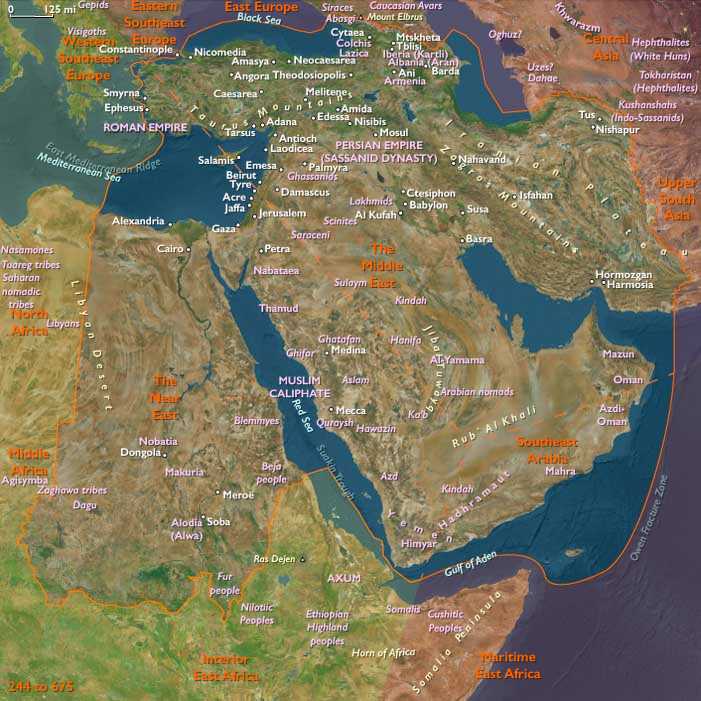
The Near and Middle East
View →Subregions
