
Near East (16–27 CE): Governance and Stability…
16 CE to 27 CE
Near East (16–27 CE): Governance and Stability under Philip the Tetrarch
Philip the Tetrarch, ruler of Ituraea and Trachonitis, distinguishes himself from his half-brothers through his conscientious governance and attentive approach to administration. Unlike his extravagant relatives, Philip avoids lengthy sojourns to Rome, choosing instead to extensively travel within his territory. He devotes considerable time to directly addressing the needs of his subjects and managing local affairs.
Philip’s style of leadership emphasizes stability, local engagement, and a reduced reliance on imperial favor. Although historical records suggest he may have participated in accusations against his half-brother concerning mismanagement of Judaea, Philip gains little personal advantage from this involvement, ultimately focusing his energies inward on responsible governance.
Legacy of the Era
The era from 16 to 27 CE in the Near East highlights a period of relative internal stability and attentive local administration under Philip the Tetrarch. His emphasis on regional engagement and moderate governance provides a notable contrast to the turbulence and extravagance seen elsewhere, offering a model of pragmatic leadership during a period marked by broader imperial dynamics and political complexities.
People
Topics
Subjects
Regions
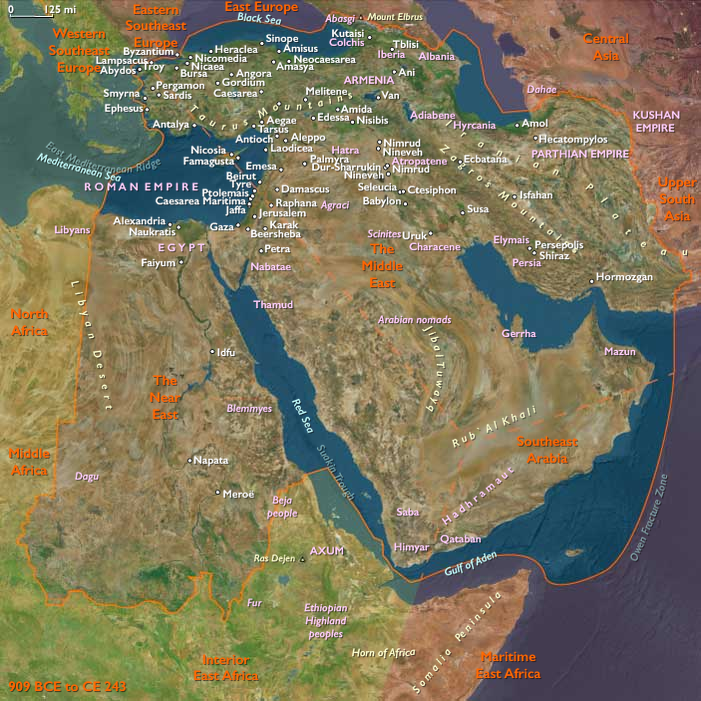
The Near and Middle East
View →Subregions

Near East
View →Related Events
No active filters.
Showing 10 events out of 61999 total
The history of the Malay-speaking world begins with the advent of Indian influence, which dates back to at least the third century BCE.
Indian traders come to the archipelago both for its abundant forest and maritime products and to trade with merchants from China, who had also discovered the Malay world at an early date.
Both Hinduism and Buddhism are well established in the southeastern Asian mainland by the beginning of the first century CE, and from here spreads across the vast arc of islands extending from Sumatra in the west to Sulawesi (Celebes) in the east.
The Chimei or Red Eyebrows is, along with Lülin, one of the two major agrarian rebellion movements against Wang Mang's short-lived Xin Dynasty.
The Chimei rebellion, initially active in the modern Shandong and northern Jiangsu regions, eventually leads to Wang Mang's downfall by draining his resources, allowing Liu Xuan (Emperor Gengshi), leader of the Lülin, to overthrow Wang and temporarily reestablish an incarnation of the Han Dynasty.
Eventually, Chimei forces overthrow Emperor Gengshi and place their own Han descendant puppet, teenage Emperor Liu Penzi, on the throne, who rules briefly until the Chimei leaders' incompetence in ruling the territories under their control (which matches their brilliance on the battlefield) causes the people to rebel against them, forcing them to retreat and attempt to return home.
When their path is blocked by the army of the newly established Eastern Han regime of Liu Xiu (Emperor Guangwu), they surrender to him.
Opposition from wealthy landowners and provincial officials still loyal to the Han dynasty forces the autocratic Xin (Hsin) emperor Wang Mang to rescind his radical reforms.
A descendant of the Han rulers, Liu Xiu (Liu Hsiu), effects a restoration of the old dynasty in CE 25.
Wang Mang’s brief rule thus separates the Han Dynasty into two periods: that of the Former, or Earlier, Han, before CE 9, and that of the Later Han, after CE 25.
The Romans, having finally subdued the Illyrian tribes southwest of the Danube River in 9 CE, organize the region encompassing parts of present Austria, Hungary, Serbia (Vojvodina), and Slovenia, as the province of Pannonia sometime after CE 20 and before 50.
Ovid’s last datable poems refer to the year 16; presumably, he dies soon after at the age of sixty or so, an unhappy victim of an authoritarian emperor.
The Middle East: 16–27 CE
Parthian Instability and Roman Intervention
The uneasy stability achieved by Rome's cautious diplomacy in the preceding era rapidly deteriorates, leading to further upheaval in Parthia. Vonones I, installed with Roman support, struggles to maintain his legitimacy amidst escalating resentment among the Parthian nobility due to his overtly Romanized manner and affiliations. By 16 CE, internal opposition compels Vonones to flee, first to Armenia and subsequently to Roman protection in Syria, where he lives under Roman custody.
Seizing upon this power vacuum, the Parthian aristocracy invites Artabanus II, ruler of Media Atropatene, to assume the Parthian throne. Artabanus II swiftly consolidates his position around 18 CE, adopting a distinctly anti-Roman stance. His assertiveness marks a new phase of Parthian resurgence, significantly shifting regional dynamics and prompting renewed Roman diplomatic and military attention.
Roman interests, deeply invested in the status of Armenia as a critical buffer state, become increasingly concerned by Artabanus's assertiveness, which threatens to destabilize the carefully maintained balance of power. Artabanus openly challenges Roman hegemony, maneuvering to install a pro-Parthian king in Armenia. Rome responds swiftly, deploying diplomatic envoys backed by the implicit threat of military intervention.
In 20 CE, the Roman general and future emperor Germanicus Caesar travels eastward to assert Roman interests, but his sudden death in Antioch in 19 CE delays decisive action, fueling suspicion and tension on both sides. Meanwhile, Artabanus's domestic policy of centralization provokes discontent among the powerful Parthian noble houses, fostering continued instability within the Parthian state.
The era concludes with Artabanus II temporarily consolidating power but presiding over an increasingly fragmented realm. Rome, for its part, continues to carefully monitor Parthian internal politics, ready to exploit weaknesses and preserve its strategic influence in Armenia and the broader Middle East. The ongoing rivalry between Rome and Parthia thus persists, characterized by diplomatic maneuvering, shifting alliances, and intermittent threats of war.
Traces remain of the presence of the Kushans in the area of Bactria.
Archaeological structures are known in Takht-I-Sangin, and Surkh Kotal (a monumental temple).
The earliest documented ruler, and the first one to proclaim himself as a Kushan ruler, s Heraios.
He calls himself a "tyrant" on his coins, and also exhibits skull deformation.
He may have been an ally of the Greeks, and he shared the same style of coinage.
Heraios may have been the father of the first Kushan emperor Kujula Kadphises.
Philip, tetrarch of Ituraea and Trachonitis, may have joined in charging his half brother with misgoverning Judaea, but with little benefit to himself.
Less extravagant a ruler than his brothers, he avoids prolonged trips to Rome, instead traveling extensively in his territory and devoting his time to his subjects.
Six of the eight volumes of the encyclopedia on medicine known as De Medicina describe various diseases and discuss therapy using diet, drugs, and manipulation.
Authored by Aulus Cornelius Celsus, a Roman of patrician lineage who flourishes from 10 to 37, the remaining two books deal with surgical topics, including operations for bladder stone, goiter, and hernia, as well as describing tonsillectomy and the removal of eye cataracts.
Celsus also recommends the use of splints and starch-stiffened bandages to treat fractures.
Nothing is known about the life of Celsus.
Even his praenomen is uncertain; he has been called both Aurelius and Aulus, with the latter being more plausible.
Some incidental expressions in his De Medicina suggest that he lived under the reigns of Augustus and Tiberius; which is confirmed by his reference to the eminent physician Themison of Laodicea as being recently in his old age.
It is not known with any certainty where he lived.
He has been identified as the possible dedicator of a gravestone in Rome, but it has also been supposed that he lived in Narbonese Gaul, because he refers to a species of vine (marcum) which, according to Pliny, is native to that region.
It is doubtful whether he practiced medicine himself, and although Celsus seems to describe and recommend his own medical observations sanctioned by experience, Quintilian says that his volumes included all sorts of literary matters, and even agriculture and military tactics.
Mediterranean Southwest Europe (16–27 CE): Transition and Consolidation under Tiberius
The era 16–27 CE marks a significant transitional period following Augustus’s death and the ascendancy of his successor, Tiberius. This era is characterized by efforts to maintain the stability and prosperity established during Augustus’s rule, alongside challenges in governance and public perception.
Death of Augustus and Accession of Tiberius
Augustus dies in 14 CE after over four decades as Rome’s first emperor, leaving a secure yet complex legacy. His stepson and adopted heir, Tiberius, ascends as emperor, assuming power amidst high expectations and considerable uncertainty. Tiberius's accession represents the first true test of Rome’s imperial succession system.
Tiberius’s Governance and Administrative Continuity
Initially, Tiberius continues Augustus’s policies, maintaining administrative stability and economic prosperity throughout the provinces, including Mediterranean Southwest Europe. His rule is marked by cautious consolidation rather than expansion, prioritizing internal stability and reinforcing existing imperial structures.
However, Tiberius’s reserved and somewhat withdrawn leadership style contrasts sharply with Augustus’s highly visible and public approach. Over time, this aloofness generates tension and suspicion among Rome's political elite and broader public.
Military Stability and Frontier Management
Tiberius demonstrates competent military leadership, focusing on stabilizing the empire’s frontiers rather than pursuing aggressive expansion. His strategies ensure the continued security of Roman territories, particularly in maintaining peace and preventing incursions along vulnerable borders.
Social and Moral Policies
Continuing Augustus’s social and moral initiatives, Tiberius promotes policies aimed at reinforcing traditional Roman values. Nonetheless, his implementation often lacks the vigor and visibility of Augustus's earlier reforms, reflecting his more conservative and pragmatic governance style.
Rise of Sejanus and Political Intrigue
The period sees the rise of the powerful Praetorian prefect Lucius Aelius Sejanus, who increasingly influences imperial administration and politics. Sejanus's consolidation of power within Rome, notably through control of the Praetorian Guard, introduces significant political intrigue and lays groundwork for future instability.
Cultural Continuity and Challenges
Despite political uncertainties, cultural and artistic activities continue, albeit with less imperial patronage than under Augustus. Literary and artistic traditions persist, influenced heavily by Augustan precedents, though public sentiment increasingly reflects concerns about political stability and transparency.
Legacy of the Era
The era 16–27 CE is a crucial transitional phase in Roman history, marked by Tiberius’s careful but contentious consolidation of imperial authority. His cautious governance style, juxtaposed against emerging political intrigues, shapes the future trajectory of Rome, highlighting the complexities inherent in managing an expansive and politically sophisticated empire.