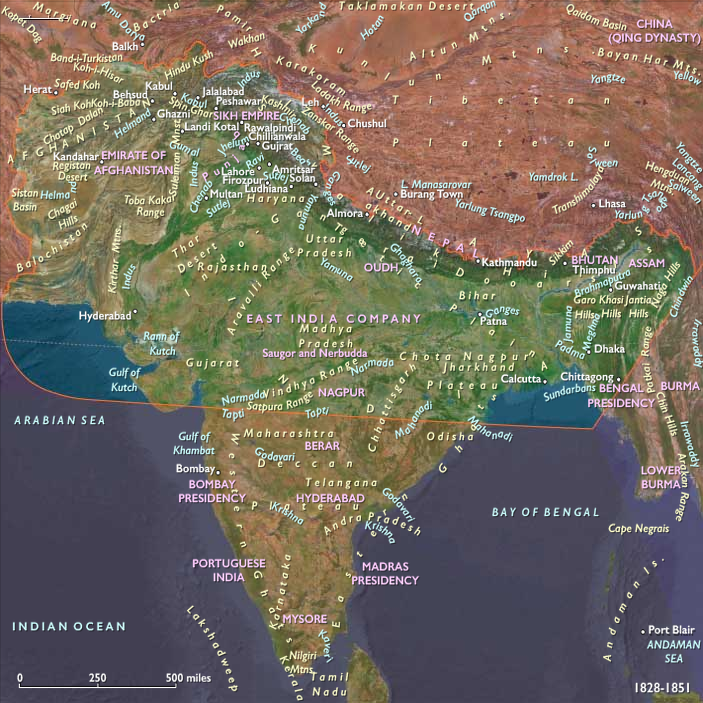
The power balance in Nepal begins to…
1828 CE to 1839 CE
The prime minister loses his main support at a time when the young ruler is coming under greater influence from the Pande faction at court.
In 1833 Brian Hodgson becomes British resident and begins a more aggressive campaign to increase British influence and trading opportunities; because Bhimsen Thapa opposes him, Hodgson openly favors Bhimsen Thapa' s opponents.
In 1837 the king announces his intention to rule independently, deprives both Bhimsen Thapa and Mathbar Singh of their military powers, and promotes some members of the Pande faction.
Shortly afterward, the youngest son of the elder queen dies, and Bhimsen Thapa is arrested on a trumped up charge of poisoning the prince.
All the property of the Thapas is confiscated.
An eight-month trial leasd to an acquittal, but the Thapas are in disarray.
When Rana Jang Pande, head of his family, becomes prime minister, he reimprisons Bhimsen Thapa.
The man who had ruled the country with an iron hand commits suicide in prison in August 1839.
This series of events marks the end of the longest stable period in the early history of the Shah Dynasty of Nepal, dominated by the prime minister in the name of the king.
Locations
Groups
Subjects
Regions
South Asia
View →Subregions