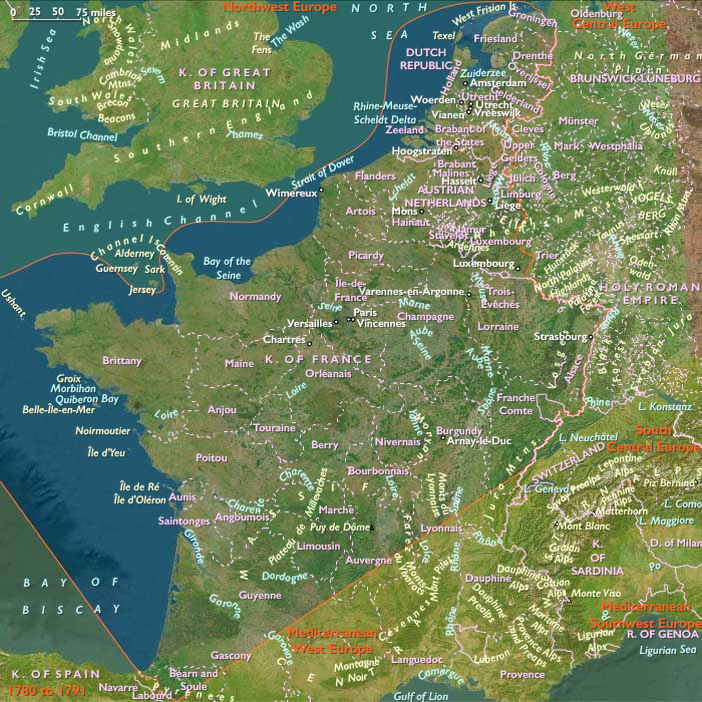
Swiss and German regiments are among the…
July 1789 CE
By early July, approximately half of the twenty-five thousand regular troops in Paris and Versailles are drawn from these foreign regiments.
The French regiments included in the concentration appear to have been selected either because of the proximity of their garrisons to Paris or because their colonels are supporters of the reactionary "court party" opposed to reform.
During the public demonstrations that start on July 12, the multitude displays busts of Necker and of Louis Philippe II, Duke of Orléans, then march from the Palais Royal through the theater district before continuing westward along the boulevards.
The crowd clashes with the Royal German Cavalry Regiment ("Royal-Allemand") between the Place Vendôme and the Tuileries Palace.
From atop the Champs-Élysées, the Prince de Lambesc unleashes a cavalry charge that disperses the remaining protesters at Place Louis XV—now Place de la Concorde.
The Royal commander, Baron de Besenval, fearing the results of a blood bath among the poorly armed crowds or defections among his own men, then withdraws the cavalry towards Sèvres.
Meanwhile, unrest is growing among the people of Paris, who express their hostility against state authorities by attacking customs posts blamed for causing increased food and wine prices.
The people of Paris start to plunder any place where food, guns and supplies can be hoarded.
In the evening, rumors spread that supplies are being hoarded at Saint-Lazare, a huge property of the clergy, which functions as convent, hospital, school and even as a jail.
An angry mob breaks in and plunders the property, seizing fifty-two wagons of wheat, which are taken to the public market.
That same day multitudes of people plunder many other places including weapon arsenals.
The Royal troops do nothing to stop the spreading of social chaos in Paris.
Locations
Topics
Commodities
Regions
West Europe
View →Subregions