
Severus, Niger having been neutralized, turns on…
195 CE
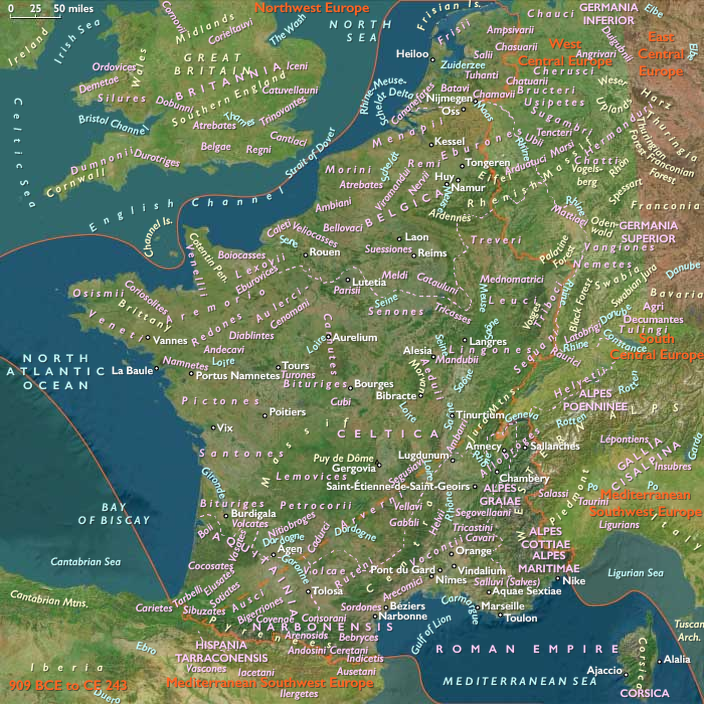
Severus, Niger having been neutralized, turns on his ally in Britannia—though it is likely that Clodius Albinus sees he will be the next target and is already preparing for war.
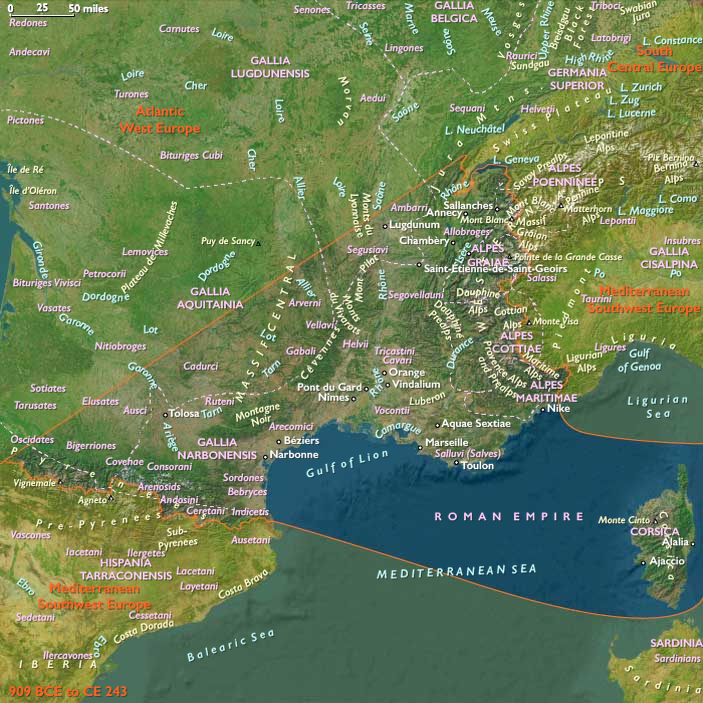
Albinus crosses to Gaul in 195 CE, where the provinces are also sympathetic to him, and sets up at Lugdunum.
Groups
Topics
Commodities
Subjects
Regions
West Europe
View →Subregions
Mediterranean West Europe
View →Related Events
No active filters.
Showing 10 events out of 60868 total
Lady Fu had become an imperial consort as Emperor Xian was being forced by Dong Zhuo to move the capital west to Chang'an in 190.
Her father was Fu Wan, a seventh generation descendant of the early Eastern Han official Fu Dan and the hereditary Marquess of Buqi.
His wife (although it is not clear whether she was Fu Shou's mother) was the Princess Yang'an, a daughter of Emperor Huan.
In 195, while Emperor Xian is largely under the control of Li Jue and Guo Si, he creates her empress.
As Emperor Xian continues to reign under the constant control of one warlord or another, he and Empress Fu apparently have a loving relationship, but both have seen their power become increasingly minimal.
Dong Zhuo's former subordinates, led by Li Jue and Guo Si, have taken Emperor Xian and the imperial court under their control.
However, Li Jue and Guo Si do not have serious ambitions, and their incompetence in governance furthers the breakdown of the Han empire into warlord regimes.
Li Jue and Guo Si soon have a major falling-out, and Li takes Emperor Xian hostage while Guo takes the officials hostage as they battle.
Later in the year, after peace talks between Li Jue and Guo Si, they agree to allow Emperor Xian to return to Luoyang, but as soon as Emperor Xian departs Chang'an, they regret their decision and chase him with their troops.
Dong Cheng, Emperor Xian’s father-in-law, repels the attack from Li and Guo with the assistance of Han Xian, former leader of the White Wave Bandits, who are remnants of the Yellow Turban Rebellion that rose up in Baibo Gorge in 188.
It said they numbered in the hundreds of thousands and even the Imperial Court could not quell them.
During Emperor Xian's flight back to the old capital, Empress Fu is personally carrying silk, which is seized by soldiers ostensibly protecting her—such that even her own personal bodyguards are killed, and their blood splashes on her.
Li Jue and Guo Si are never able to recapture Emperor Xian, but his court has been rendered poor and unable to fend for itself; once it returns to Luoyang, it lacks even the basic essentials of life.
Many imperial officials starve to death or are killed by robbers.
At this time, Yuan Shao's strategist Ju Shou suggests that he welcome Emperor Xian to his province so that he can effectively be in control of the central government, but the other strategists Guo Tu and Chunyu Qiong oppose this move—under the faulty logic that if he did, he would have to yield to Emperor Xian on key decisions.
Yuan Shao heeds the advice of Guo Tu and Chunyu Qiong and never again considers welcoming Emperor Xian.
Wu Jing and Sun Ben have been unable to break down the defense of Liyang for more than a year, and Sun Ce requests to lead a force to assist the effort.
Though Yuan Shu knows Sun Ce intends to leave, he believes the latter will not be able to defeat Liu Yao.
Thus he deploys the young general with merely a thousand-odd troops and a tiny cavalry force.
Along with a few hundred more willing followers, Sun Ce proceeds to Liyang, where he boosts his strength to more than five thousand.
He then launches an offensive across the Yangtze River and successfully occupies the strategic position of Niuzhu (present-day Caishiji, southwest of Ma'anshan, Anhui) in 195.
Two of Liu Yao's allies then come south from Pengcheng and Xiapi respectively to aid him.
Sun Ce chooses to first attack one of them, Ze Rong, who makes camp south of Moling.
After suffering initial defeat in the hands of the aggressor, Ze Rong falls back to a defensive position and refuses to engage in battle.
Sun Ce then marches further north and attacks Xue Li in Moling.
Although Xue Li soon gives up the city and escapes, Liu Yao's subject Fan Neng and other regroup their forces and launch a renewed attack on Niuzhu.
Turning back, Sun Ce defeats Fan Neng and secures Niuzhu.
He then begins a second offensive against Ze Rong.
However, he is struck by a stray arrow in the thigh.
Returning to Niuzhu, he sends out false words that he had been killed in battle.
Ze Rong, elated at the news, then sends a force to attack.
Sun Ce leads his enemies into an ambush and annihilates them.
When Ze Rong hears that Sun Ce is still alive, he further reinforces his defense works.
Sun Ce temporarily gives up attacking Ze Rong and focuses his forces on Qu'e.
After all the surrounding areas are taken over by Sun Ce, Liu Yao gives up the city and escapes south to Yuzhang (present-day Nanchang, Jiangxi), where he will later die.
As Sun Ce implements strict discipline among his troops, he wins the instant support of the local people and gathers many talented men, such as Chen Wu, Zhou Tai, Jiang Qin, Zhang Zhao, Zhang Hong, Qin Song, and Lü Fan.
He then pushes his force deeper into Yangzhou and conquers Kuaiji (present-day Shaoxing, Zhejiang), whose governor Wang Lang surrenders.
Sun Ce makes Kuaiji his base city and strikes out at the wandering bandit army led by Yan Baihu.
Yan Baihu sends his younger brother Yan Yu to offer Sun Ce a position alongside Yan Baihu, but Sun Ce shows no mercy and personally slays the emissary.
As Yan Yu is known among Yan Baihu's men as a fierce warrior, his death strikes fear into their hearts and they are soon defeated.
Sun Ce now appoints his relatives and a trusted subject to govern Danyang and Yuzhang, from which he divides a new prefecture named Luling.
His campaign, from the occupation of Niuzhu to the conquest of the entire region southeast of the Long River, has taken less than a year.
He then defeats and receives the services of Zu Lang, the Chief of Danyang, and Taishi Ci, the leader of the remnants of Liu Yao's forces; he then urges the surrender of Hua Xin, another one of the remnants of Liu Yao's forces.
Thus, with the exception of the scattered but still numerous army of Yan Baihu, the lands south of the Yangtze are mostly pacified.
The barbarians of the Shanyue tribe, however, are not easily dealt with.
To counter the frequent rebellions of the Shanyue (who will continue to rebel for many years), Sun Ce appoints a certain He Qi to a military rank with orders to subdue the Shanyue.
He Qi will go on to become a highly successful general; his appointment by Sun Ce is the first important step to Wu's eventual subjugation of the Shanyue.
Severus devotes the following year to suppressing Mesopotamia and other Parthian vassals who had backed Niger.
Northern Mesopotamia, including Osroene, had come again under Roman control in the expedition of Lucius Verus in 161–166, but had not been formally organized into provinces; instead, they had been left under local vassal rulers, although Roman garrisons have been maintained, notably at Nisibis.
This control is threatened in 195, during the civil war between Severus and Niger, when rebellions break out in the area, and Nisibis is besieged.
Severus quickly restores order and organizes Osroene as a full province.
Both the Roman and Eastern churches, before the elevation of Victor to the Roman episcopacy—he had succeeded Eleuterus in about 189—had tolerated a difference in dating the celebration of the Christian Passover/Easter between Rome and the bishops of Asia Minor.
The churches in Asia Minor celebrate it on the fourteenth of the Jewish month of Nisan, the day before Jewish Passover, regardless of what day of the week it falls on, as the Crucifixion had occurred on the Friday before Passover.
The Latins call them Quartodecimans.
Rome and the West celebrate Easter on the Sunday following the fourteenth of Nisan.
Victor is remembered for the great concern he displayed for order in the church by severing ties with bishops such as Polycrates of Ephesus who opposed his views on Easter.
Pope Victor attempted to cut off from the common unity Polycrates and others for taking this stance, but later reversed his decision after Irenaeus and others intercede.
Polycrates is best known for his letter addressed to Victor: it will be used as proof against the argument that the Churches in Asia Minor accepted the authority of the bishops at Rome.
It is unclear what happened to Polycrates after his letter.
Victor also breaks with Theodotus of Byzantium for his beliefs about Christ: Theodotus claims that Jesus was born of the Virgin Mary and the Holy Spirit as a mortal man, and though later "adopted" by God upon baptism (that is to say, he became the Christ), was not himself God until after his resurrection.
This doctrine, sometimes called "Dynamic Monarchianism" or "Adoptionism,” is declared heretical by Victor, and Theodotus is excommunicated.
Until Victor's time, Rome celebrated the Mass in Greek.
Pope Victor changes the language to Latin, which is used in his native North Africa.
According to Jerome, he was the first Christian author to write about theology in Latin.
Latin masses, however, will not become universal until the latter half of the fourth century.
Severus, trying to gain favor with the family of Marcus Aurelius, rehabilitates Commodus's memory and has the Senate deify him in 195.
The warlord Sun Ce leads a series of military campaigns from 194 to 199 to conquer territories in the Jiangdong and Wu regions during the final years of the Eastern Han Dynasty.
The campaign concludes with victory for Sun Ce, and the conquered lands will serve as a foundation for the state of Eastern Wu during the Three Kingdoms era.
The first use of paper without writing has been excavated in China dating to the reign of Emperor Wu of Han from the second century BCE, used for purposes of wrapping or padding protection for delicate bronze mirrors.
It was also used for safety, such as the padding of poisonous 'medicine' as mentioned in the official history of the period.
Although paper used for writing becomes widespread by the third century, paper continues to be used for wrapping (and other) purposes.
The Introduction of Shafted Carts and Chariots in Europe (c. 200 CE)
By 200 CE, shafted carts and chariots, long used in China, made their first recorded appearance in Europe, marking a significant advancement in transportation technology. This development enhanced mobility, trade, and military logistics, further integrating the Eurasian world through technological exchange.
What Are Shafted Carts and Chariots?
- Unlike earlier pole-drawn carts, which had yoke systems for oxen, shafted carts and chariots used a single central shaft attached to a harness, allowing:
- Better maneuverability and stability.
- The use of horses for more efficient transport.
- Increased speed for both military and commercial use.
How Did They Reach Europe?
The transfer of this technology may have occurred through:
-
The Silk Road
- China had been using shafted chariots since at least the 6th century BCE.
- Trade and military exchanges between the Han Dynasty and Rome (via Parthia and the Kushan Empire) could have facilitated technological diffusion.
-
Roman-Parthian Interactions
- The Romans frequently clashed with the Parthians, who acted as intermediaries between China and Rome.
- Parthian use of Chinese-style cavalry techniques and chariots could have influenced Roman and European designs.
-
Migration and Warfare
- The Germanic and Sarmatian tribes along Rome’s borders were exposed to Eurasian innovations, potentially introducing shafted carts through steppe nomadic cultures.
Impact on Europe
-
Improved Transport Efficiency
- Shafted carts allowed for better weight distribution, making it easier to transport goods and suppliesover long distances.
-
Military Applications
- While chariots had declined in Roman warfare, the improved shafted harness system contributed to better cavalry mobility and logistics.
-
Economic Expansion
- The ability to move goods more efficiently helped facilitate trade between the Roman provinces and beyond.
Conclusion: A Sign of Eurasian Technological Exchange
The adoption of shafted carts and chariots in Europe by 200 CE reflects the broader exchanges of technology, culture, and ideas along Eurasian trade routes. This innovation contributed to improved transportation, military tactics, and economic integration, demonstrating how the Roman and Chinese worlds were indirectly linked through technological diffusion.