
North Africa (1840–1851 CE) French Colonial …
Years: 1840 - 1851
North Africa (1840–1851 CE)
French Colonial Consolidation and Abdelkader’s Defeat
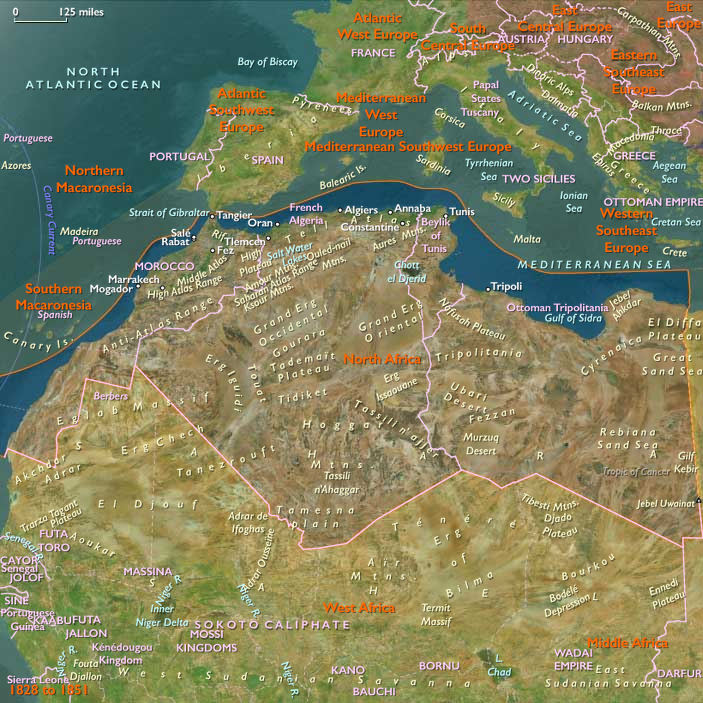
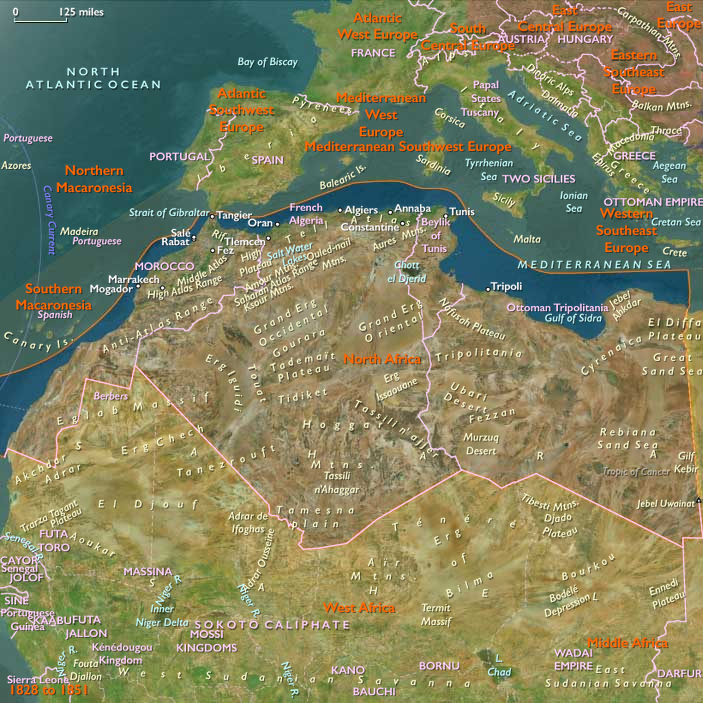
The period from 1840 to 1851 witnesses a critical phase in the consolidation of French control in Algeria, marked by the decisive suppression of Abdelkader’s resistance, intensified colonial settlement, and evolving geopolitical dynamics in the broader region.
French Military Consolidation and Abdelkader’s Resistance (1840–1847)
After the deliberate breach of the Treaty of Tafna by French forces in 1839, hostilities resume vigorously. Abdelkader El Djezairi, the charismatic leader of Algerian resistance, intensifies his guerrilla warfare, targeting French settlements on the Mitidja Plain and briefly threatening Algiers itself. Initially successful through mobile warfare tactics, Abdelkader ultimately faces overwhelming French military resources, enhanced by the appointment of General Thomas Robert Bugeaud as Governor-General in 1840. Bugeaud employs ruthless scorched-earth tactics and aggressive counterinsurgency strategies, systematically weakening Abdelkader’s forces and support networks.
Reinforcements continue to pour into Algeria until Bugeaud commands 108,000 troops, approximately one-third of the entire French army. French forces repeatedly target Abdelkader's strongholds, adopting tactics including the burning and asphyxiation of noncombatants hiding in caves. By 1843, French troops capture Abdelkader’s fortified stronghold, Smaala, marking a significant turning point. Internal dissension among the tribes and military setbacks lead to Abdelkader’s surrender to General Louis Juchault de Lamoricière on December 23, 1847. Despite promises of safe conduct to the Middle East, Abdelkader is exiled and imprisoned in France.
Expansion of French Colonization and Administration
With Abdelkader defeated, French colonization accelerates. European settlers—colons or pieds noirs—from France, Italy, and Spain, increasingly occupy land confiscated from indigenous Algerian communities. Authorities systematically expropriate pastoralists and farmers, intensifying rural colonization. A class divide emerges between grands colons (wealthy landholders) and petits blancs (smallholders and laborers), further structuring colonial society.
Administrative reforms in 1845 establish three distinct commune types: communes de plein exercice with significant European populations enjoying self-government; mixed communes, governed jointly by European and indigenous representatives; and communes indigènes, under strict military control. Algeria’s incorporation as an integral part of France in 1848 sees its organization into three civil territories—Algiers, Oran, and Constantine—each with limited self-governance predominantly for settlers. Indigenous representation remains heavily restricted.
The bureaux arabes—specialist units staffed by Arabists—play dual roles in administering and surveilling the indigenous population, often mediating between settlers and the military regime.
Ottoman Authority and Regional Dynamics
In Tripoli, restored Ottoman administration temporarily stabilizes the region. The Ottoman governor attempts reforms, but tribal autonomy and regional unrest persist. Administrative control largely remains confined to coastal towns, with minimal influence over inland tribes. The administrative division includes four subprovinces (sanjaks), each subdivided into districts, but effective Ottoman authority is limited.
Rise of the Sanusi Movement in Cyrenaica
Muhammad ibn Ali as Sanusi, founder of the Sanusi religious order, establishes a network of lodges in Cyrenaica after his return from Mecca. His austere Islamic teachings attract widespread Bedouin adherence. The Sanusi movement emphasizes practical spirituality, strict adherence to Islamic law, and disciplined self-sufficiency, laying the foundations for future political influence across the region.
European Pressures on Morocco and Tunisia
Morocco increasingly attracts European interest, notably from France, to protect Algeria’s western border and control Mediterranean trade. Diplomatic tensions between European powers escalate, highlighting Morocco's strategic vulnerability.
In Tunisia, European economic influence, particularly from France and Britain, foreshadows later colonial intervention. Despite nominal Ottoman suzerainty, Tunisia experiences growing European financial and political control, setting the stage for future dominance.
By 1851, North Africa’s trajectory is shaped decisively by French colonization, indigenous resistance and accommodation, regional movements such as the Sanusi order, and intensifying European geopolitical ambitions.
People
Groups
- Arab people
- Berber people (also called Amazigh people or Imazighen, "free men", singular Amazigh)
- Bedouin
- Islam
- Ottoman Empire
- Alawi dynasty
- Morocco, 'Alawi (Filali) Sultanate of
- Tunis, Beylik of
- United States of America (US, USA) (Washington DC)
- Britain (United Kingdom of Great Britain and Ireland)
- France, constitutional monarchy of
- Algeria, French Colony of
- Senussi, or Sanussi
Topics
- Abd el-Kader, First War of (Algerian French Wars of 1832-1847)
- Abd al-Qadir, or Abd el-Kader, Second War of (Algerian French Wars of 1832-1847)
- Pacification of Algeria
Subjects
Regions
Subregions
Related Events
Showing 10 events out of 18028 total
Years: 1840 - 1851
People
Groups
- Arab people
- Berber people (also called Amazigh people or Imazighen, "free men", singular Amazigh)
- Bedouin
- Islam
- Ottoman Empire
- Alawi dynasty
- Morocco, 'Alawi (Filali) Sultanate of
- Tunis, Beylik of
- United States of America (US, USA) (Washington DC)
- Britain (United Kingdom of Great Britain and Ireland)
- France, constitutional monarchy of
- Algeria, French Colony of
- Senussi, or Sanussi
Topics
- Abd el-Kader, First War of (Algerian French Wars of 1832-1847)
- Abd al-Qadir, or Abd el-Kader, Second War of (Algerian French Wars of 1832-1847)
- Pacification of Algeria
Subjects
Regions
Subregions