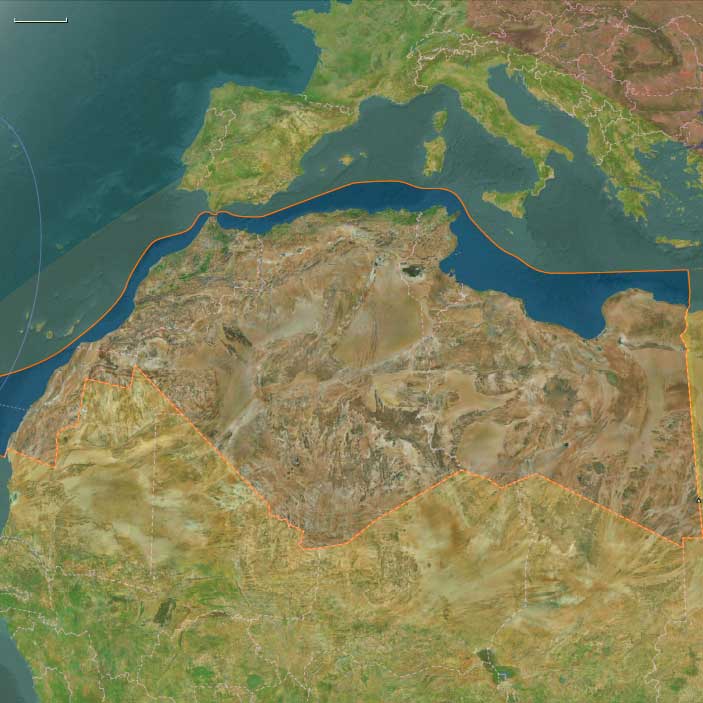
North Africa
Subregions
North Africa
View →Related Events
Showing 10 events out of 1205 total
The Middle of the Earth, one of the twelve divisions of the globe, encompasses Africa down to its subcontinent, the lands and seas of the Mediterranean Basin and the Red Sea, the Canary Islands, and the Cape Verde Islands.
The northwestern boundary extends from south-central Germany along the Swiss border, encompassing all Swiss cities except Basel. It then separates southern France from northern France, continues through Spain, and divides Portugal at Setúbal, marking a north-south division within both countries. The boundary then extends into the Atlantic Ocean, where it distinguishes Madeira (a Portuguese territory) from the Canary Islands (ruled by Spain).
The northeastern boundary separates Alpine Austria from the rest of the country, then moves through the Balkans, roughly following the borders between:
- Hungary and Slovenia,
- Serbia and Croatia,
- Bosnia and Herzegovina, Montenegro, and Kosovo,
- Bulgaria and North Macedonia,
- Turkey-in-Europe and Greece.
From there, the line continues through western Turkey and Cyprus, dividing Syria and most of Lebanon from Israel and most of Jordan, and marking the separation between western and eastern Arabia.
The southeastern boundary follows the historic division between North and South Yemen, then extends through eastern Africa, delineating Mozambique from Zambia.
HistoryAtlas contains 18,610 entries for the Middle of The Earth from the Paleolithic period to 1899.Narrow results by searching for a word or phrase or select from one or more of a dozen filters.
The beginning of the last Ice Age is conventionally dated at about one hundred and twenty thousand BCE with the onset of the Abbassia Pluvial, an extended wet and rainy period in the climate history of North Africa.
The Abbassia Pluvial, which lasted approximately thirty thousand years, and ended around ninety thousand ybp, spanned the end of the Lower Paleolithic and the start of the Middle Paleolithic eras—an interval that is also sometimes identified as the Acheulean (two hundred and fifty to ninety kybp).
As with the subsequent Mousterian Pluvial (circa fifty to thirty kybp), the Abbassia was brought about by global climate changes associated with the ice ages and interglacials of the Pleistocene Epoch.
Like the Mousterian Pluvial, the Abbassia Pluvial brought wet and fertile conditions to what is now the Sahara Desert, which bloomed with lush vegetation fed by lakes, swamps, and river systems, many of which later disappeared in the drier climate that followed the pluvial.
During this period, African wildlife now associated with the grasslands and woodlands south of the Sahara penetrated the entire North African.
Human Stone Age cultures—notably the Mousterian and Aterian Industries—flourished in Africa during the Abbassia Pluvial.
The shift to harsher climate conditions that came with the end of the pluvial promoted the emigration of modern Homo sapiens out of Africa and over the rest of the globe.
This was the third wave of the Sahara pump cycle.
The Moderns are taller, more slender, and less muscular than the Neanderthals, with whom they share—perhaps uneasily—the Earth.
Though their brains are smaller in overall size, they are heavier in the forebrain, a difference that may allow for more abstract thought and the development of complex speech.
Yet, the inner world of the Neanderthals remains a mystery—no one knows the depths of their thoughts or how they truly expressed them.
The invention of writing was not a single event, but rather a gradual evolution, preceded by the use of symbols, possibly originating for ritual or cultic purposes.
Researchers from the University of Victoria in Canada suggest that Neolithic cave painters employed symbolism as a form of early communication.
"...Von Petzinger and Nowell were surprised by the clear patterning of the symbols across space and time—some of which remained in use for over twenty thousand years.
Their research identifies twenty-six distinct signs, which may represent the earliest evidence of a graphic code used by humans shortly after their arrival in Europe from Africa—or possibly even earlier, suggesting they brought this practice with them.
If confirmed, these findings would support the growing body of evidence that the so-called "creative explosion"—once thought to have occurred later—actually began tens of thousands of years earlier than previously believed.
The small population of moderns had spread from the Near East to South Asia by fifty thousand years ago, and on to Australia by forty thousand years ago, Homo sapiens for the first time colonizing territory never reached by Homo erectus.
It has been estimated that from a population of two thousand to five thousand individuals in Africa, only a small group, possibly as few as one hundred and fifty to one thousand people, crossed the Red Sea.
Of all the lineages present in Africa only the female descendants of one lineage, mtDNA haplogroup L3, are found outside Africa.
Had there been several migrations one would expect descendants of more than one lineage to be found outside Africa.
L3's female descendants, the M and N haplogroup lineages, are found in very low frequencies in Africa (although haplogroup M1 is very ancient and diversified in North and Northeast Africa) and appear to be recent arrivals.
A possible explanation is that these mutations occurred in East Africa shortly before the exodus and, by the founder effect, became the dominant haplogroups after the exodus from Africa.
Alternatively, the mutations may have arisen shortly after the exodus from Africa.
Some genetic evidence points to migrations out of Africa along two routes.
However, other studies suggest that only a few people left Africa in a single migration that went on to populate the rest of the world, based in the fact that only descents of L3 are found outside Africa.
From that settlement, some others point to the possibility of several waves of expansion.
Many regions of Northern Africa are well watered, bearing lakes, swamps, and river systems during an extended wet and rainy period in the climate history of North Africa from around fifty thousand to around thirty thousand years before the present called the Mousterian Pluvial.
What is now the Sahara desert supports typical African wildlife of grassland and woodland environments: herbivores from gazelle to giraffe to ostrich, predators from lion to jackal, even hippopotamus and crocodile, as well as extinct forms like the Pleistocene camel.
The Mousterian Pluvial resembles the earlier Abbassia Pluvial in these respects; the later Neolithic Subpluvial is a weaker reiteration of the same pattern.
North Africa (49,293 – 28,578 BCE) Upper Pleistocene I — Ice-Edge Steppes, Coastal Refugia, and Early Maghrebi Traditions
Geographic and Environmental Context
North Africa includes Morocco, Algeria, Tunisia (Ifriqiya), Libya (Tripolitania–Fezzan–Cyrenaica), and Western Sahara.Anchors: the Atlas ranges (High/Middle/Anti-Atlas; Tell Atlas; Aurès), the Tell and Sahel coasts (Atlantic Morocco, Rif/Alboran, Kabylia, Ifriqiya, Syrte/Gulf of Sidra, Cyrenaica), the Saharan platforms and sand seas (Erg Chech, Grand Erg Occidental & Oriental, Tanezrouft), the oases and basins (Tafilalt, Draâ, Touat–Gourara–Tidikelt, M’zab, Wadi Igharghar, Fezzan (Wadi al-Ajyal, Ubari and Murzuq dunes)), and the trans-Saharan corridors toward Lake Chad, Niger Bend, and the Nile.
-
Atlas forelands opened onto periglacial steppe–tundra; the Tell/Sahel littoral had embayed lagoons and dune fields; much of the Sahara was hyper-arid plateau punctuated by rare springs.
-
The Alboran–Strait of Gibraltar shelf was broader; Gulf of Gabès shallower; Syrte (Gulf of Sidra) exposed terraces.
Climate & Environmental Shifts
-
Last Glacial Maximum (LGM): colder, drier; winter westerlies strengthened; dust accumulation high in the interior.
-
Moisture pockets persisted on windward Atlas slopes and in coastal refugia.
Subsistence & Settlement
-
Refugial foragers occupied caves and rockshelters along the Atlas piedmont and coast, hunting gazelle, equids, aurochs, and ibex, with seasonal littoral shellfish and fish.
-
Inland groups ranged widely between piedmont springs and basin playas.
Technology & Material Culture
-
Late Middle–Upper Paleolithic lithics: Levallois-derived flake/point industries transitioning toward bladelets in some zones.
-
Bone points, scrapers; ochre and shell/teeth beads signal symbolic life.
Movement & Interaction Corridors
-
Atlantic–Alboran ribbon (Rif–Tangier–Atlantic Morocco) and Tell coast acted as highways; Atlas passes linked coast to basins; isolated Saharan wadis channeled episodic movement.
Cultural & Symbolic Expressions
-
Parietal and portable markings in cave contexts; patterned hearth renewal in long-used shelters.
Environmental Adaptation & Resilience
-
Coast–piedmont switching and multi-resource diets buffered LGM stress; knowledge of perennial springs was critical.
Transition
As deglaciation commenced, woodland patches and wetlands expanded along the coast and Atlas foothills, inviting broader foraging repertoires.
Cultural features associated with modern humans, such as careful burial of the dead, the production of art in the form of elaborate cave decoration, and the decoration of objects of everyday use, date from this period.
Between 100,000 and 38,000 BCE, African cultures have adapted to desert, savanna, and forest environments, with distinctive toolkits for each.
Hunting, fishing, and gathering remain the basic way of life, but Africans employ a wider range of strategies in exploiting different environments.
North Africa (28,577 – 7,822 BCE) Upper Pleistocene II — Deglaciation, Iberomaurusian Beginnings, and Proto-Capsian Shores
Geographic and Environmental Context
North Africa includes Morocco, Algeria, Tunisia (Ifriqiya), Libya (Tripolitania–Fezzan–Cyrenaica), and Western Sahara.Anchors: the Atlas ranges (High/Middle/Anti-Atlas; Tell Atlas; Aurès), the Tell and Sahel coasts (Atlantic Morocco, Rif/Alboran, Kabylia, Ifriqiya, Syrte/Gulf of Sidra, Cyrenaica), the Saharan platforms and sand seas (Erg Chech, Grand Erg Occidental & Oriental, Tanezrouft), the oases and basins (Tafilalt, Draâ, Touat–Gourara–Tidikelt, M’zab, Wadi Igharghar, Fezzan (Wadi al-Ajyal, Ubari and Murzuq dunes)), and the trans-Saharan corridors toward Lake Chad, Niger Bend, and the Nile.
-
Rising seas drowned coastal terraces; lowland wetlands and lagoons formed in Atlantic Morocco, Kabylia, Ifriqiya, and Cyrenaica.
-
Interior playas intermittently recharged; foothill biomes mosaicked with shrubland.
Climate & Environmental Shifts
-
Bølling–Allerød (warm/moist) encouraged woodland and wetland expansion; the Younger Dryas reversed to cooler/drier; Early Holocene warmed and moistened again.
Subsistence & Settlement
-
Iberomaurusian cultural horizon (c. 25–13 ka BP) developed along the Maghrebi littoral and Rif–Atlas piedmont: dense shell midden economies, gazelle–equid hunting, broad plant gathering.
-
In Tunisia–Algeria, epipaleolithic foragers occupied dunes and back-barrier lagoons, setting the stage for Capsian traditions.
Technology & Material Culture
-
Backed bladelets and microliths proliferated; bone gorges/harpoons, net sinkers in lagoon settings.
-
Beadwork (shell, ostrich eggshell) and ochre widespread.
Movement & Interaction Corridors
-
Littoral cabotage on foot (shoreline trails), Atlas foothill trails, and Tell river courses linked camps; exchange of shells and fine raw materials visible across sites.
Cultural & Symbolic Expressions
-
Formalized middens as places of memory; funerary use of ochre; ornament standardization across wide zones.
Environmental Adaptation & Resilience
-
Estuary–lagoon + gazelle steppe duality hedged the Younger Dryas; mobility maintained access to seasonal pulses.
Transition
By 7,822 BCE, a coastally anchored Mesolithic was in place, poised to transform with Green Sahara conditions.
The Upper Paleolithic (also spelled Upper Palaeolithic) is the final subdivision of the Paleolithic (Old Stone Age), as defined in Europe, Africa, and Asia.
Broadly dating between 40,000 and 10,000 years ago, this period coincides with the emergence of behavioral modernity and predates the development of agriculture.
The terms "Late Stone Age" and "Upper Paleolithic" refer to the same time period. However, due to historical conventions, "Stone Age" is more commonly used in reference to Africa, while "Upper Paleolithic" is typically applied to Europe.